Candelabra Glass Modern Flower Vase

Regular price $26.95
Sizes
Hand Blown Glass
Dishwasher safe cleaning
30-day return policy

Build the Arrangement That Looks Harder Than It Was

Pick a vase to anchor the shelf, then add the rest until it reads as curated instead of collected.


The Candelabra vase was designed for a hotel, and I am not going to tell you which hotel. Some people are unreasonably good at guessing this sort of thing and I would rather not spoil the exercise for them. What I can say is that the room it was made for had the kind of expensive quiet that never announces itself, where the lobby smells deliberate and no price tag has ever been sighted. A branched glass vase has to hold its own in a space like that without competing with it, so the arms rise from a single foot and separate cleanly, each one taking one stem. Diameter holds at two and a half inches. Height runs from five and a half up to six, depending which of the pair you choose. Glass for this multi arm vase is worked by hand at Chive Ceramics Studio now, as it was then.

Product detail

Product Detail:

  • Material: Glass
  • Glaze finish: Translucent
  • Year Designed: 2020
Dimension
  • Small: 2.5 inches diameter, 5.6 inches tall
  • Medium: 2.5 inches diameter, 6 inches tall
Vase Care Instructions

All glass vases in this collection are dishwasher safe for easy cleaning, with one exception: mercury glass vases should be hand-washed only. The silvered mercury finish is a delicate coating rather than a solid color, and dishwasher heat and detergent can dull or strip it over time.

For standard glass vases, just load it in with the rest of the dishes — no special care needed. For mercury glass pieces, wash gently with warm water and mild soap, and dry with a soft cloth rather than letting it air dry with water spots.

Rinse and dry after each use, especially if flower food or cut-stem residue was in the water, so nothing lingers and clouds the glass.

Flowers that Love this Vase
  • Marigold
  • Baby's Breath
  • Peony
  • Cornflower
  • Celosia
  • Allium
  • Foxglove
  • Black-Eyed Susan
  • Primrose
  • Heather

Quick Guide to Building a Floral Arrangement

  1. Pick your vase first
  2. Start with your anchor flower.
  3. Build in odd numbers.
  4. Add height, then fill.
  5. Greenery does the quiet work.
  6. Cut stems at an angle, underwater if you can.
  7. Step back before you decide it's done.

Shipping & returns

Shipping

  • Free shipping: Orders $200+ within the US
  • Standard: 5–8 business days, Express 2–3 business days (at checkout)
  • International Ships: to 40 countries — rates at checkout
  • Packaging Ships: in outer box to protect gift box

View full shipping policy →

Returns

We accept returns within 30 days of delivery on unused items in original packaging. If your piece arrives damaged, contact us within 7 days with a photo and we will replace it at no charge.

View full return policy →

Wholesale Inquires

Have a cool shop? Know someone that does?

Find Chive on Faire →

Candelabra Glass Modern Flower Vase - Chive Ceramics Studio - Vases - Chive US

Designed For A Hotel. Still Not Saying Which.

The colours were the difficult part. An iconic silhouette recoloured badly looks like a knockoff of itself, and we spent longer arguing about three shades than we did resolving the form. Lilac was agreed quickly. Grey took a fortnight, because grey glass wants to look like dirty glass unless the tone is pitched precisely, and pitching it precisely means accepting that a percentage of every run will miss and go to the seconds shelf. Chartreuse nearly did not happen. Two of us thought it was wrong for the shape and were outvoted by people who turned out to be correct, which I mention because it is important to record these things accurately. What none of us predicted was that the three would be bought together far more often than separately. The intention had been a choice. The result was a set, and a set behaves differently on a mantelpiece than any single object does, because the eye starts comparing rather than simply looking. We should probably have foreseen that. The seconds shelf, incidentally, is where most of the studio buys its own glassware, and a grey that missed by a shade is still a perfectly good vase for somebody who is not being paid to notice. Nobody in this building foresees anything.

Chive Studio trimming tulip stems with scissors on a wooden surface, with white, purple, and pink tulips arranged nearby.
How to Cut Flowers Like a Pro:

A (Mostly) Simple Guide to Cutting Your Flowers

So, you’re making an arrangement? Let’s ensure it lives long enough to impress someone—even if it's just you.

  1. Scrub the Scissors: Wash your shears first. Your flowers do not want a side of Dorito dust.
  2. Cut at 45°: Snip stems at an angle. It gives them a straw instead of making them chug from the bottle.
  3. Trim Underwater (Fancy Mode): Cut them submerged to block air bubbles. It’s extra, but they didn’t ask to suffocate.
  4. Ditch Submerged Leaves: Strip anything below the waterline. Unless you are actively going for a swamp aesthetic.
  5. Snip Again if Stale: If they sat out on the counter, trim them again. They need a fresh start (don’t we all?).
  6. Swap the Water: Change it and trim the stems every few days so they don't die immediately.

Voilà! You are now a domestic deity. Go take your Instagram photo before you forget to water them.

Pro Tip: The light does half the work.

Glass catches and bends light in a way ceramic can't. Set the arrangement somewhere it'll get some late afternoon sun, even for an hour, and the water and stems start doing something a solid vase never will.

Perfect Pairs for Any Shelf
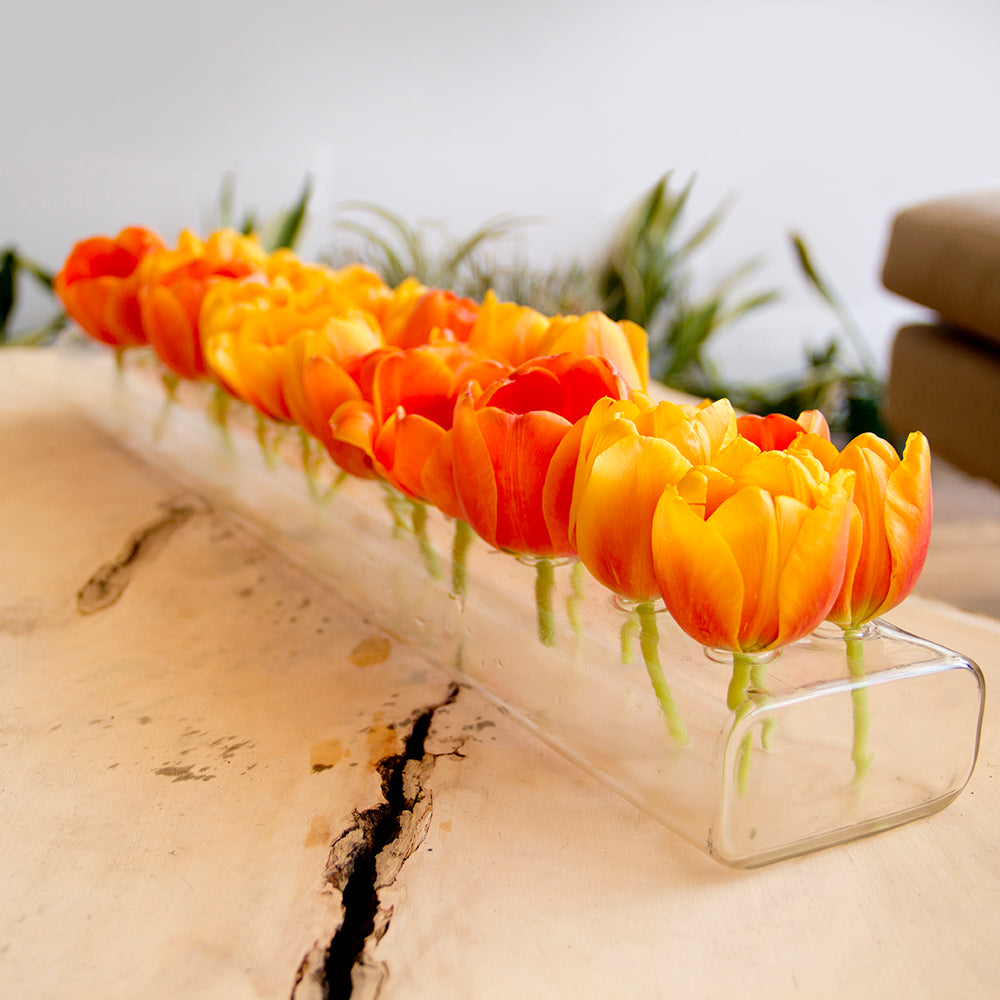
The Same Idea, Laid Flat
The glass vases at Chive come out of the same studio habit that produced everything else here: design the object once, correctly, then resist every opportunity to complicate it. Each one holds stems. None of them hides anything. Several arms rising from a single foot is one way to carry a handful of stems. Laying the same idea flat along a table is another, which is precisely what the Caterpillar Glass Vase does.

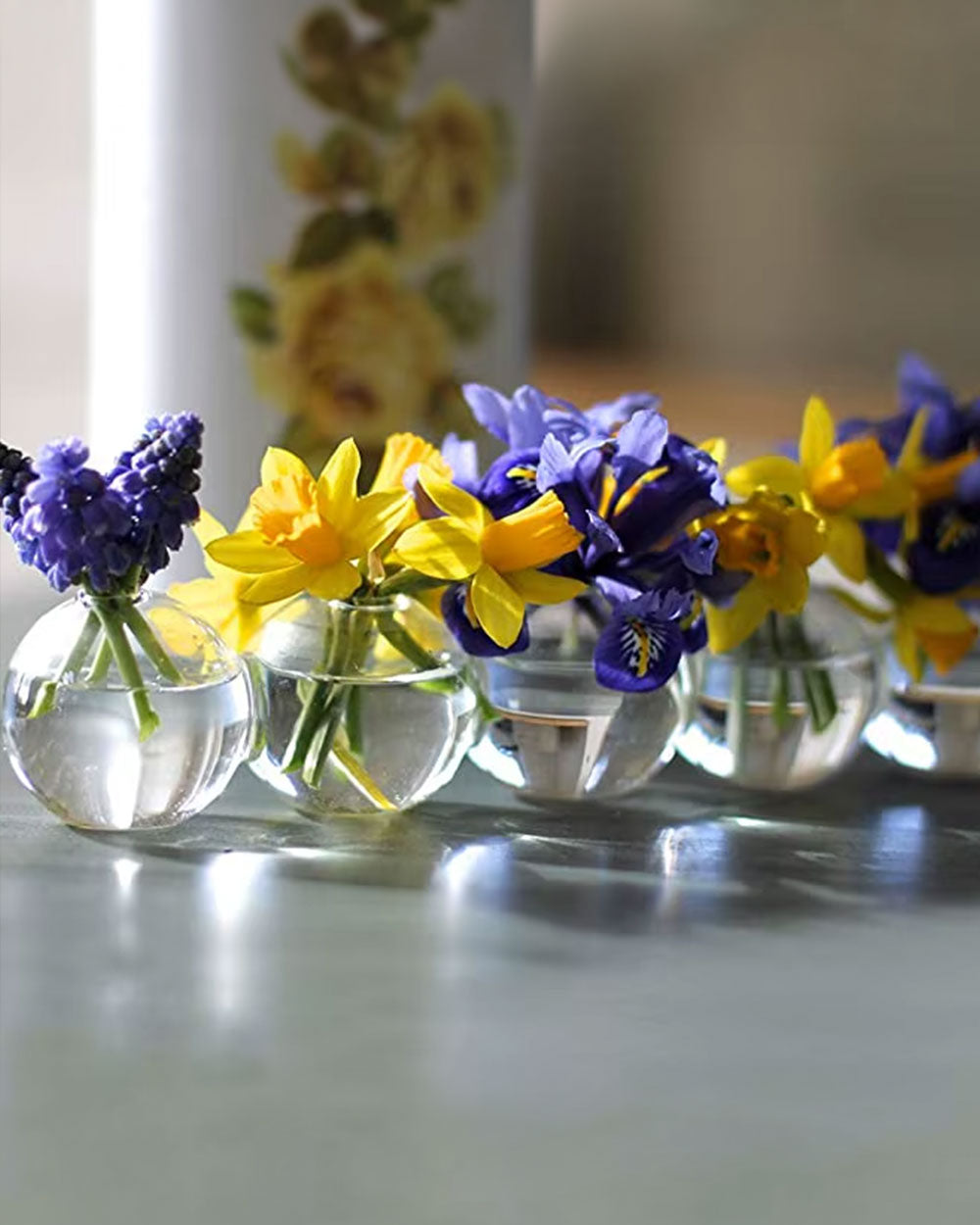
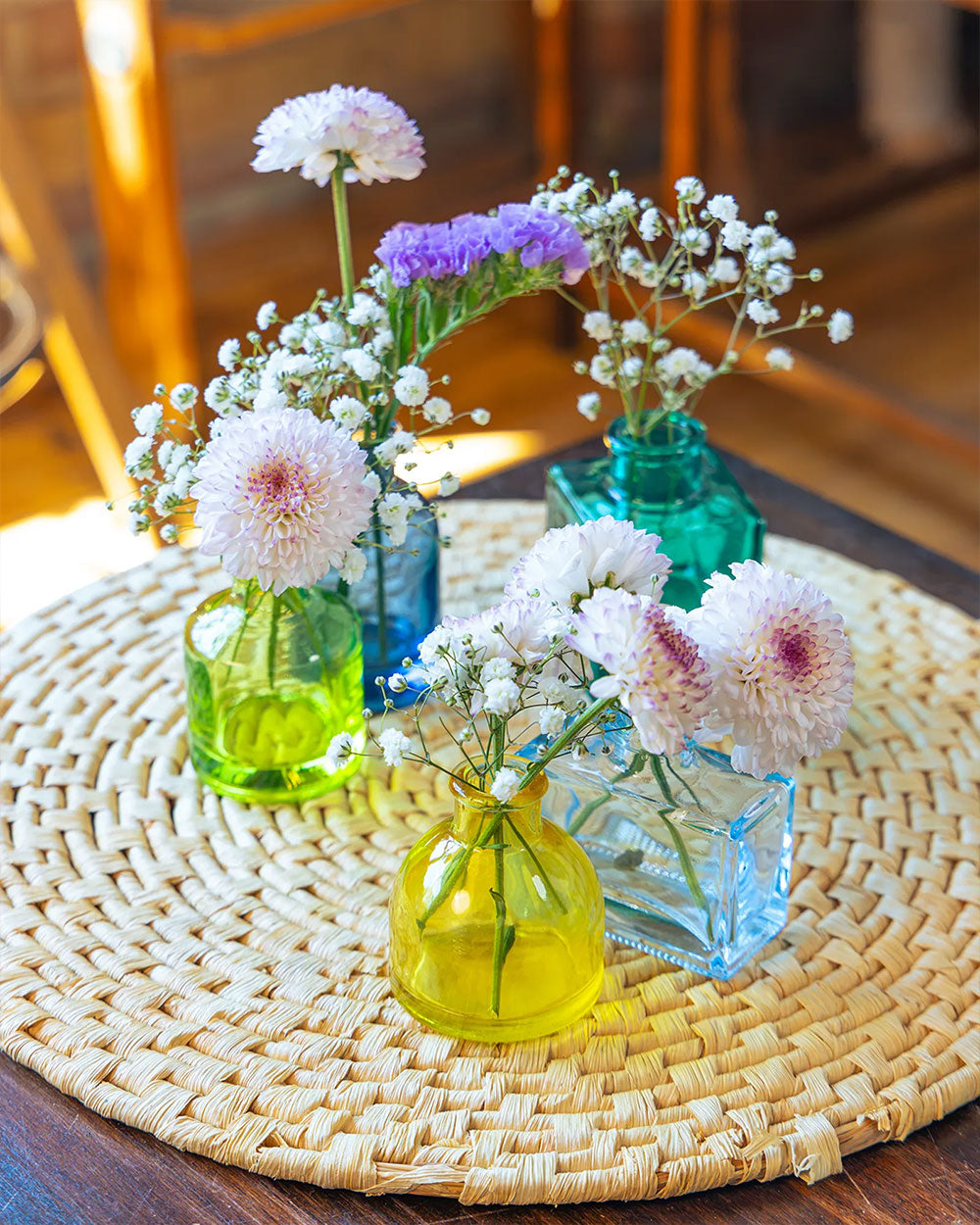
Chive Loft glass bud vase set in assorted shapes and colors on a table mat, each styled with flowers.

Spacing Already Decided For You

Every Chive vase is built around one decision about how flowers should stand, then finished by hand until that decision reads as obvious. Branched forms are the smallest group inside the glass vases collection and by some way the fussiest to produce, since every arm gets pulled and set individually while the body still holds heat. What you gain is an object that arranges flowers on your behalf. Drop one stem into each opening, stand back, and the spacing has already been decided by somebody else. That is the entire proposition.

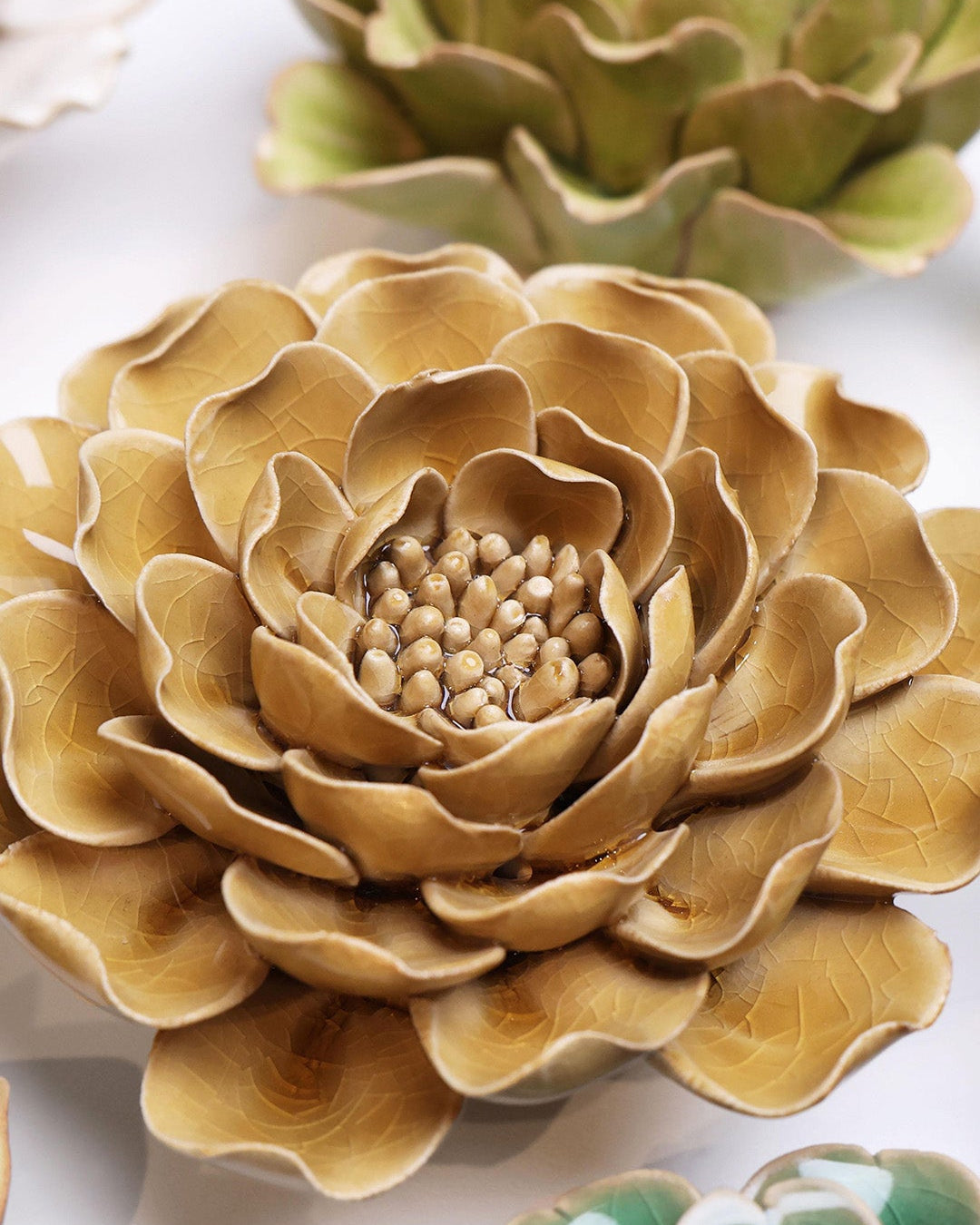
Caramel Charm Peony ceramic wall flower mounted on a wall — Chive Ceramics Studio

Layer Them, Do Not Align Them

Above a mantel, this piece wants something behind it instead of alongside, and the Caramel Charm Peony answers in the same register without repeating the shape. Fired violet against lilac glass reads as a decision. The wall carries the colour permanently, the arms carry it only while something is flowering. Layer them, do not align them.


Built To A Brief

Commissions have shaped the Chive catalogue since 2004 more than any internal brainstorm ever has. Somebody arrives with a room, a budget and a problem, and the constraint does the creative work that a blank page never manages. Hotels want objects that survive being handled by strangers. Restaurants want objects that survive being handled by staff in a hurry. Both requirements sharpen a design far faster than taste alone. A good portion of what now sits on the public catalogue began life answering a brief from one client, and only afterwards proved useful to everybody else. We keep the ones that travel and quietly let go of the ones that only ever suited one room in one building.


Inside the Chive Design Studio

Low maintenance, high impact. Let's make home styling look easy.

The Best 10 Styles of Vases

Jessie Duenas
The glorious world of flower vases! Because nothing says "I have my life together" quite like a carefully chosen vessel for your soon-to-be-wilting flora. Gather 'round, fell...
Read the full story

Wedding Centerpiece Vases: The Planning Guide Nobody Gives You

Jessie Duenas
Wedding centerpiece vases work best small and plural — three to seven per table, one to three stems each. A fifteen-table reception needs roughly seventy-five vases and 100 to 1...
Read the full story

Frequently asked questions

Why would you choose a vase like the Candelabra vase?

Because it removes the arranging entirely. Several separate stem holders on one foot mean the spacing and the heights have been resolved at the design stage, so a person with no floristry instinct at all drops in four stems and gets a composition. A cluster of individual bud vases demands constant adjustment and never quite settles. This one settles the moment you step back from it. Skill not required.

What single flowers look striking on their own in the Candelabra?

Tall ones with a single strong head. Peony works, provided the stem is trimmed so the weight sits close to the arm rather than swinging out from it. Allium and foxglove suit the vertical emphasis particularly well. Black-eyed susan and cornflower do the job on a smaller scale. Anything multi-headed fights the structure and looks crowded. Give each arm one flower.

How tall is the Candelabra vase and what space does it need?

It occupies a circle scarcely wider than a jam jar lid, so the footprint is negligible, but it wants headroom. The two versions finish at roughly five and a half and six respectively, and whatever you put in the arms adds a further foot on top. Under a low shelf it will not work. On an open mantel it will.

How is the Candelabra vase's glass finish made at the studio?

Colour is introduced to the molten batch and the arms are then drawn out and set by hand while the body still carries working heat. Each arm gets pulled individually, which is why no two pieces have quite the same angles and why the set never looks machine-stamped. Lilac, grey and chartreuse each behave differently under heat. Grey is the temperamental one.

What is the safest way to wash the Candelabra vase at home?

The arms are too narrow for any brush, so soaking replaces scrubbing. Fill the whole piece with hot water and a little washing-up liquid, leave it an hour, then flush each opening under a running tap. A pipe cleaner reaches anything stubborn near the join. Invert on a towel to drain fully. Patience beats force.

Which rooms suit the Candelabra vase's shape and scale best?

Formal spaces, or spaces pretending to be formal. A mantelpiece suits it because the height reads against a chimney breast, and a hall console suits it for the same reason. Dining tables are a mistake, since the arms block eye contact across the width. A busy kitchen overwhelms it completely. Give it somewhere still.

Does the Candelabra vase pair well with the Caterpillar vase on display?

They do, though only when kept apart. Both carry several stems at once, one climbing upward from a foot and one running horizontally along a surface, so putting them side by side makes the similarity obvious and the difference trivial. Separate them and each looks deliberate. Mantel for this one, table for that one. Distance flatters both.

What was the original idea behind the Candelabra vase's form?

A hotel asked for it, and I am still not naming the hotel. The brief called for something capable of holding a room designed by people paid handsomely to make rooms feel expensive, without competing against any of it. We took a silhouette everybody already recognised and changed only the colour. Restraint was the whole assignment.

Ceramic astronaut vase with flowers styled on shelf — Chive Studio Toronto
Behind the Studio

The story behind the Chive astronaut vases

The story of Laika, Félicette, a solar eclipse in New York, and a space bar that ordered a hundred vases a month until it closed.