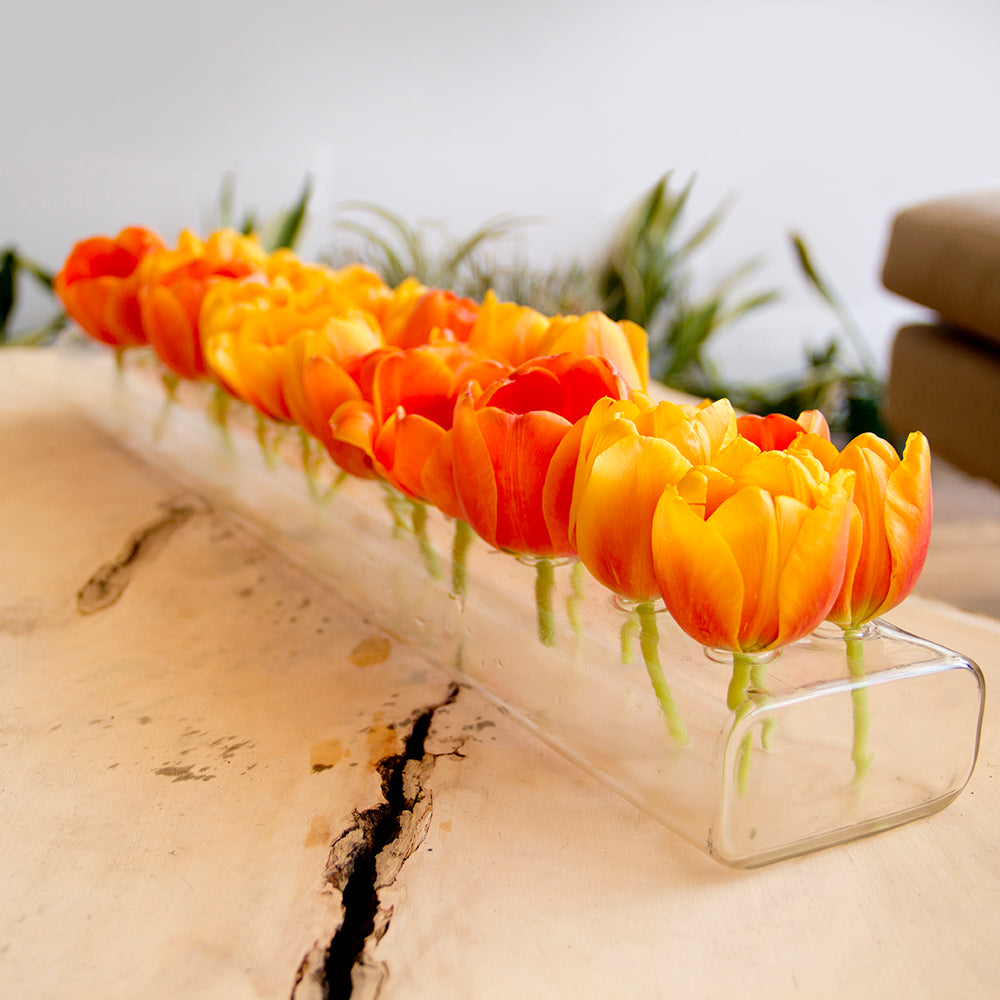
Cube Glass Modern Clear Flower Vase

Regular price $16.50
Sizes
Hand Blown Glass
Dishwasher safe cleaning
30-day return policy

Build the Arrangement That Looks Harder Than It Was

Pick a vase to anchor the shelf, then add the rest until it reads as curated instead of collected.


A square vase settles a problem round ones create: it sits flush against a wall, it lines up with its neighbours, and it stays put when somebody knocks the table. This square glass vase is not trying to be clever about any of that. Buy one and you own a tidy little container holding a tidy little flower. Buy twelve, or thirty-six, and you own something that looks like it needed a florist with firm views on symmetry, when what it actually needed was arithmetic. The diameter holds constant at 2.5 inches while the height climbs in steps of two — 2, 4, 6, then 8. Mixed heights read as composition. Matched heights read as intent. Either way this cube glass vase pays for itself twice, as a container and again as a component. The form has not changed since 2008, mostly because nobody has put forward a convincing reason to change it. Start with three. You will not stop there.

Product detail

Product Detail:

  • Material: Glass
  • Glaze finish: Translucent
  • Year Designed: 2008
Dimension
  • Small: 2.5 inches diameter, 2 inches tall
  • Medium: 2.5 inches diameter, 4 inches tall
  • Large: 2.5 inches diameter, 6 inches tall
  • XL: 2.5 inches diameter, 8 inches tall
Vase Care Instructions

All glass vases in this collection are dishwasher safe for easy cleaning, with one exception: mercury glass vases should be hand-washed only. The silvered mercury finish is a delicate coating rather than a solid color, and dishwasher heat and detergent can dull or strip it over time.

For standard glass vases, just load it in with the rest of the dishes — no special care needed. For mercury glass pieces, wash gently with warm water and mild soap, and dry with a soft cloth rather than letting it air dry with water spots.

Rinse and dry after each use, especially if flower food or cut-stem residue was in the water, so nothing lingers and clouds the glass.

Flowers that Love this Vase
  • Lavender
  • Chrysanthemum
  • Sweet Pea
  • Peony
  • Feverfew
  • Sweet William
  • Queen Anne's Lace
  • Waxflower
  • Spider Flower
  • Wallflower

Quick Guide to Building a Floral Arrangement

  1. Pick your vase first
  2. Start with your anchor flower.
  3. Build in odd numbers.
  4. Add height, then fill.
  5. Greenery does the quiet work.
  6. Cut stems at an angle, underwater if you can.
  7. Step back before you decide it's done.

Shipping & returns

Shipping

  • Free shipping: Orders $200+ within the US
  • Standard: 5–8 business days, Express 2–3 business days (at checkout)
  • International Ships: to 40 countries — rates at checkout
  • Packaging Ships: in outer box to protect gift box

View full shipping policy →

Returns

We accept returns within 30 days of delivery on unused items in original packaging. If your piece arrives damaged, contact us within 7 days with a photo and we will replace it at no charge.

View full return policy →

Wholesale Inquires

Have a cool shop? Know someone that does?

Find Chive on Faire →

Cube Glass Modern Clear Flower Vase - Chive Ceramics Studio - Vases - Chive Ceramics Studio

Thirty Of Them On Our Own Windowsill — The Cube

We keep about thirty of these on the windowsill by the phone, and over the years an unspoken convention has formed around them: whoever is stuck on a long call gets to rearrange the windowsill. Nobody agreed to this. It simply became true. By the end of a difficult supplier conversation the whole run will have been regrouped into a staircase, or sorted into pairs, or pushed into one dense block with the tall ones at the back like a bad school photograph. The next person undoes it without comment, and in all that time nobody has once mentioned the previous arrangement to whoever built it. What none of us anticipated when the shape was drawn is that a container with no features would turn out to be the most fiddled-with object in the building. There is nothing to adjust on it. No lid, no mechanism, no correct orientation. The only variable is where it stands in relation to the others, and that variable turns out to be endlessly interesting to a person who is trying not to say something regrettable to a supplier. I have rearranged that windowsill more times than I would like recorded. It helps. That is more than most desk objects manage.

Chive Studio trimming tulip stems with scissors on a wooden surface, with white, purple, and pink tulips arranged nearby.
How to Cut Flowers Like a Pro:

A (Mostly) Simple Guide to Cutting Your Flowers

So, you’re making an arrangement? Let’s ensure it lives long enough to impress someone—even if it's just you.

  1. Scrub the Scissors: Wash your shears first. Your flowers do not want a side of Dorito dust.
  2. Cut at 45°: Snip stems at an angle. It gives them a straw instead of making them chug from the bottle.
  3. Trim Underwater (Fancy Mode): Cut them submerged to block air bubbles. It’s extra, but they didn’t ask to suffocate.
  4. Ditch Submerged Leaves: Strip anything below the waterline. Unless you are actively going for a swamp aesthetic.
  5. Snip Again if Stale: If they sat out on the counter, trim them again. They need a fresh start (don’t we all?).
  6. Swap the Water: Change it and trim the stems every few days so they don't die immediately.

Voilà! You are now a domestic deity. Go take your Instagram photo before you forget to water them.

Pro Tip: The light does half the work.

Glass catches and bends light in a way ceramic can't. Set the arrangement somewhere it'll get some late afternoon sun, even for an hour, and the water and stems start doing something a solid vase never will.

Perfect Pairs for Any Shelf

Decal Glass Modern Flower Vase - Chive Ceramics Studio - Vases - Chive US

A Production Run That Won't Last

The glass vases at Chive come out of the same studio habit that produced everything else here: design the object once, correctly, then resist every opportunity to complicate it. Each one holds stems. None of them hides anything. The obvious next step from a plain cube is a printed one, which is exactly what the Decal Glass Modern Vase is. Identical footprint, different surface, and a production run that will end long before this one does. Buy those when you see them.

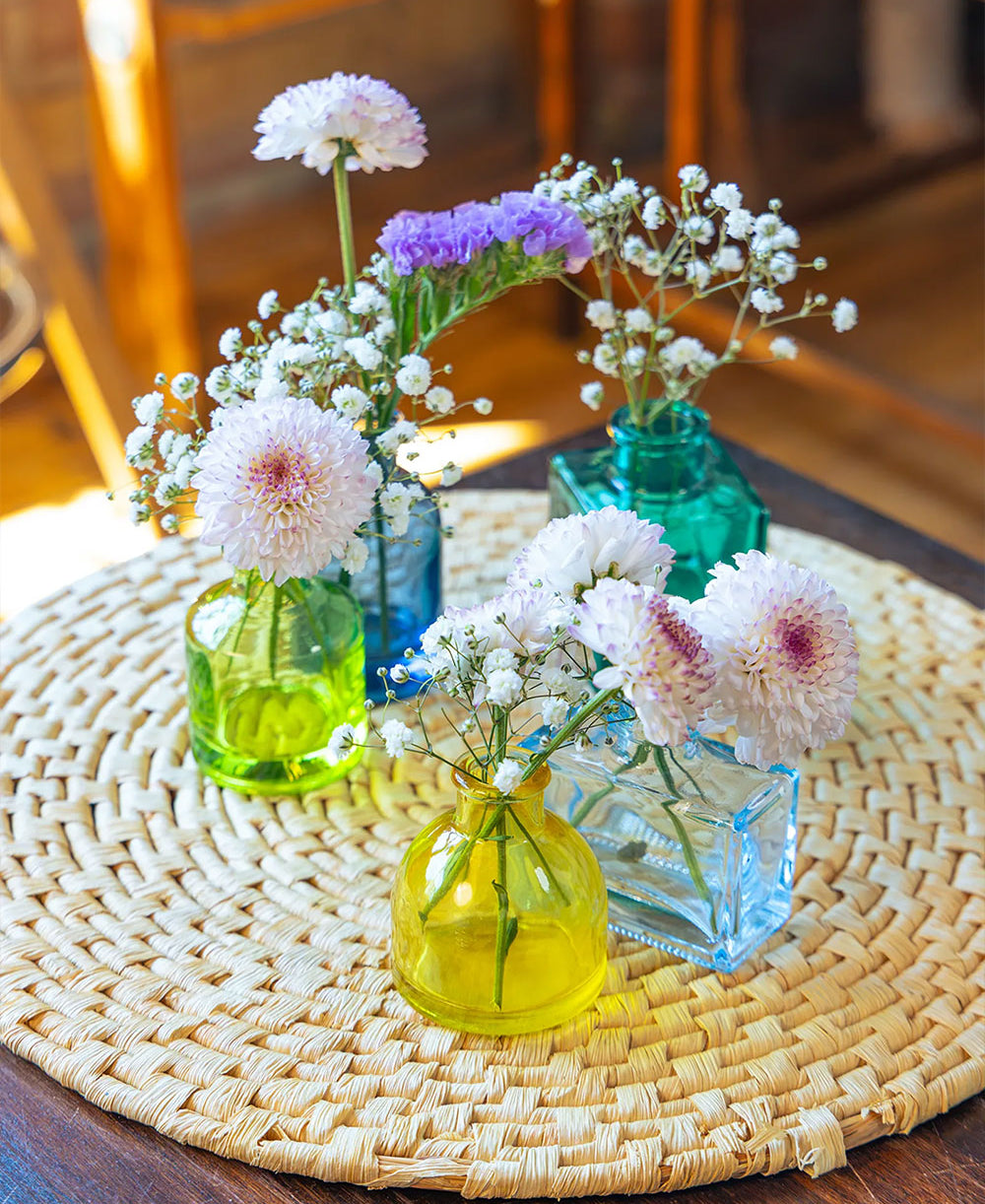
Chive Loft glass bud vase set in assorted shapes and colors on a table mat, each styled with flowers.

Eight Problems, Actually Finished

Every Chive vase is built around one decision about how flowers should stand, then finished by hand until that decision reads as obvious. With this piece the decision was to give a flower a straight line to stand against, then repeat it. Elsewhere in the glass range the same discipline produces very different objects: a wall fitting, a tapered throat, a suspended bulb, a raised reservoir. None of them shares a silhouette with any other, and that is deliberate. A range should not look like eight versions of one idea with the proportions nudged around. It should look like eight problems somebody actually finished.

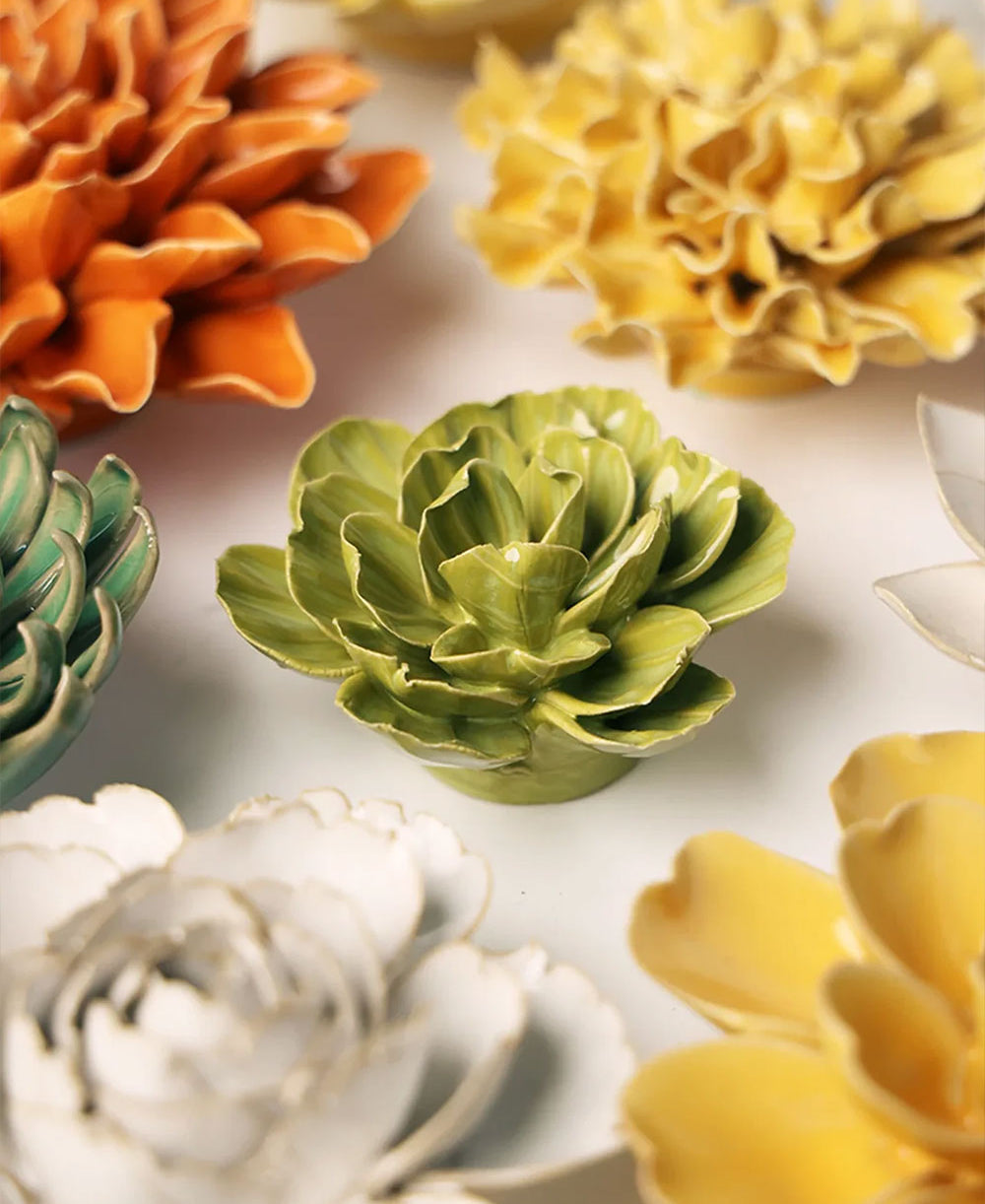
Close-up of the Chive February Birth Flower Primrose chartreuse ceramic flower among assorted Chive ceramic flowers.

Half The Arrangement Never Needs Water
Pair the smallest height with a February Birth Flower Primrose and you have a gift that survives February, which fresh flowers rarely manage. Ceramic bloom in one, a real cut stem in the next, alternating along a windowsill for as long as you like. Half of the arrangement never needs water.


Components, Not Statements

Since 2004 this studio has designed roughly as many components as it has statement pieces, and we have never been embarrassed about it. Not every object needs to hold a room on its own. Some are there to be repeated, counted and arranged by somebody else, and designing for that use requires restraint rather than flair: no detail that would irritate at the twelfth repetition, no feature that fights its neighbour. Every object here is drawn, made and finished by our own hands, whether it is meant to be bought singly or by the dozen. A component has to survive being ordinary at close range for years on end without irritating anybody. The plain ones are harder than the showpieces. We keep making them anyway.


Inside the Chive Design Studio

Low maintenance, high impact. Let's make home styling look easy.

The Best 10 Styles of Vases

Jessie Duenas
The glorious world of flower vases! Because nothing says "I have my life together" quite like a carefully chosen vessel for your soon-to-be-wilting flora. Gather 'round, fell...
Read the full story

Wedding Centerpiece Vases: The Planning Guide Nobody Gives You

Jessie Duenas
Wedding centerpiece vases work best small and plural — three to seven per table, one to three stems each. A fifteen-table reception needs roughly seventy-five vases and 100 to 1...
Read the full story

Frequently asked questions

What is a square vase and when would you actually use one?

It is a vase with four straight sides and a flat base, and the reason to own one is geometry rather than beauty. A round container has to be positioned. A square one only has to be put down, because it aligns with the edge of whatever it stands on and with every other square beside it. Use one where a shelf is already tidy. Use nine where it is not.

Which stems suit the Cube Glass vase's opening and proportions best?

Short and structural does best here, since the opening is narrow enough to hold a stem upright without any support. Sweet William, feverfew and waxflower all sit well at this scale. Peony works in the tallest height only, and one head fills it completely. Anything with a heavy head on a weak neck will sulk in an opening this narrow. Lavender is close to perfect.

Is the Cube Glass vase sized for a windowsill or a mantel?

Both, depending on which height you buy, and that is the argument for buying more than one. The two-inch and four-inch versions were drawn for a windowsill and clear almost every sash. The six-inch and eight-inch versions have the presence a mantel needs. All four share a 2.5-inch footprint, so a mixed group still lines up cleanly along one edge. Height is the only variable.

What glass quality can you expect from the Cube Glass vase?

Clear soda-lime glass, formed and finished in our own studio, with walls thick enough that the base does not chip the first time somebody sets it down too hard on a stone counter. There is no decorative coating, no printed layer and no seam you can feel with a fingernail. What you can see through is the material itself. Nothing has been added to it.

Does the Cube Glass vase need special care between flower arrangements?

Not really, which is most of the appeal of a plain container. Empty it, rinse it, put it back on the shelf, and leave it there until it is wanted again. Because there is no pattern and no finish, there is nothing that can be worn off by ordinary washing up. The only genuine risk is a sudden temperature change. Cold glass hates boiling water.

How do you group the Cube Glass vase with other Chive pieces?

Group by height, not by contents, and let the flowers vary instead. A run of five at alternating heights along a sill reads as one object rather than five, and mixing our ceramic blooms into every second one means half the arrangement never needs replacing. Odd totals settle faster than even ones do on a shelf. Nine is where most people stop.

Should you choose the Cube Glass vase or the Decal vase first?

Take this one first, because it stays in the catalogue and the Decal does not. The printed version is a limited run built on the same body, so anything you learn about grouping these applies directly when you add a patterned one later. Start plain and add the pattern when it appears. Nobody regrets that order.

Why is it called the Cube Glass vase and what's the story?

The name came from the shape and nobody in 2008 saw any reason to be cleverer about it. What is worth explaining is the footprint decision: every height shares one base measurement, so the range stacks visually no matter which combination somebody buys. That single constraint is the actual design. The name is just a label. The base is the idea.

Ceramic astronaut vase with flowers styled on shelf — Chive Studio Toronto
Behind the Studio

The story behind the Chive astronaut vases

The story of Laika, Félicette, a solar eclipse in New York, and a space bar that ordered a hundred vases a month until it closed.