
Ligne Glass Modern Flower Vase

Regular price $21.85
Colors: Amber Grid
Shapes
Hand Blown Glass
Dishwasher safe cleaning
30-day return policy

Build the Arrangement That Looks Harder Than It Was

Pick a vase to anchor the shelf, then add the rest until it reads as curated instead of collected.


The Ligne vase is a lined glass vase made in three forms, and the surface work on it is the kind normally kept for pieces four times the size. Egg stands taller than it is wide. Oval does the reverse, wider across than it is high. Sphere is neither, carrying the same measurement in both directions. All three take the same drawn banding, which is why it also reads as a striped glass vase depending on which one is in front of you. Those lines sit in the glass wall rather than over it, so nothing on the surface can wear off a piece this small. Working at a shade over two inches means the spacing has nowhere to hide, and a hand that drifts by a fraction shows immediately. That is why there are three shapes and not six: each one had to earn its place against the other two before we would run it. Three forms, one surface decision, applied at a scale that punishes it.

Product detail

Product Detail:

  • Material: Glass
  • Glaze finish: Translucent
  • Year Designed: 2019.0
Dimension
  • Egg: 2.25 inches diameter, 4 inches tall
  • Oval: 3.5 inches diameter, 2.25 inches tall
  • Sphere: 3 inches diameter, 3 inches tall
Vase Care Instructions

All glass vases in this collection are dishwasher safe for easy cleaning, with one exception: mercury glass vases should be hand-washed only. The silvered mercury finish is a delicate coating rather than a solid color, and dishwasher heat and detergent can dull or strip it over time.

For standard glass vases, just load it in with the rest of the dishes — no special care needed. For mercury glass pieces, wash gently with warm water and mild soap, and dry with a soft cloth rather than letting it air dry with water spots.

Rinse and dry after each use, especially if flower food or cut-stem residue was in the water, so nothing lingers and clouds the glass.

Flowers that Love this Vase
  • Ranunculus
  • Baby's Breath
  • Lavender
  • Cherry Blossom
  • Feverfew
  • Lily of the Valley
  • Larkspur
  • Waxflower
  • Bee Balm
  • Iceland Poppy

Quick Guide to Building a Floral Arrangement

  1. Pick your vase first
  2. Start with your anchor flower.
  3. Build in odd numbers.
  4. Add height, then fill.
  5. Greenery does the quiet work.
  6. Cut stems at an angle, underwater if you can.
  7. Step back before you decide it's done.

Shipping & returns

Shipping

  • Free shipping: Orders $200+ within the US
  • Standard: 5–8 business days, Express 2–3 business days (at checkout)
  • International Ships: to 40 countries — rates at checkout
  • Packaging Ships: in outer box to protect gift box

View full shipping policy →

Returns

We accept returns within 30 days of delivery on unused items in original packaging. If your piece arrives damaged, contact us within 7 days with a photo and we will replace it at no charge.

View full return policy →

Wholesale Inquires

Have a cool shop? Know someone that does?

Find Chive on Faire →

Ligne Glass Modern Flower Vase - Chive Ceramics Studio - Vases - Chive Ceramics Studio

Three forms, one surface - The Ligne

There is a specific kind of meeting that happens here when the Ligne samples come off the rack, and it is not a meeting anybody scheduled. Someone carries a tray past the packing bench, someone else says hold on, and forty minutes later eleven of them are lined up on a windowsill in order of how much we like them, which changes twice. Dana keeps a notebook for this. She writes the ranking down, dates it, and then produces the previous ranking from four months earlier to demonstrate that we have all changed our minds again, which she enjoys more than she admits.

I have tried to work out why a piece this size does that to people who stay perfectly calm around large expensive objects. My best explanation is that the smaller a thing gets, the less room there is for anything to be concealed, so what you are looking at is only the decision, sitting there. You cannot be vague at two inches. Either the bands are evenly spaced or they are not, and everybody in the room can see which, including whoever ran it.

Nobody has ever asked for the tray to be taken away early. That is not true of most things we make.

Chive Studio trimming tulip stems with scissors on a wooden surface, with white, purple, and pink tulips arranged nearby.
How to Cut Flowers Like a Pro:

A (Mostly) Simple Guide to Cutting Your Flowers

So, you’re making an arrangement? Let’s ensure it lives long enough to impress someone—even if it's just you.

  1. Scrub the Scissors: Wash your shears first. Your flowers do not want a side of Dorito dust.
  2. Cut at 45°: Snip stems at an angle. It gives them a straw instead of making them chug from the bottle.
  3. Trim Underwater (Fancy Mode): Cut them submerged to block air bubbles. It’s extra, but they didn’t ask to suffocate.
  4. Ditch Submerged Leaves: Strip anything below the waterline. Unless you are actively going for a swamp aesthetic.
  5. Snip Again if Stale: If they sat out on the counter, trim them again. They need a fresh start (don’t we all?).
  6. Swap the Water: Change it and trim the stems every few days so they don't die immediately.

Voilà! You are now a domestic deity. Go take your Instagram photo before you forget to water them.

Pro Tip: The light does half the work.

Glass catches and bends light in a way ceramic can't. Set the arrangement somewhere it'll get some late afternoon sun, even for an hour, and the water and stems start doing something a solid vase never will.

Perfect Pairs for Any Shelf
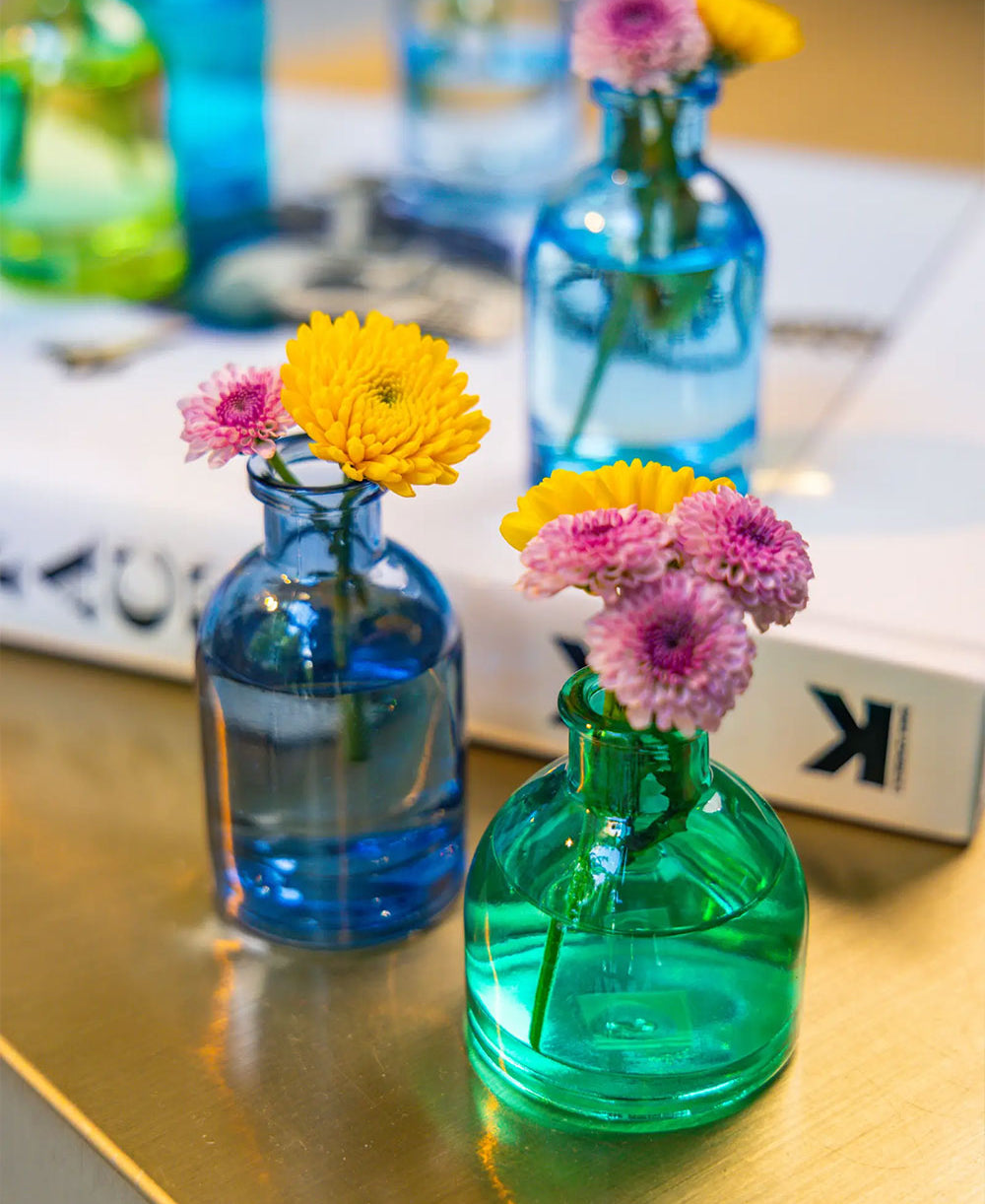
The Same Restraint, Spread Across Five Shapes
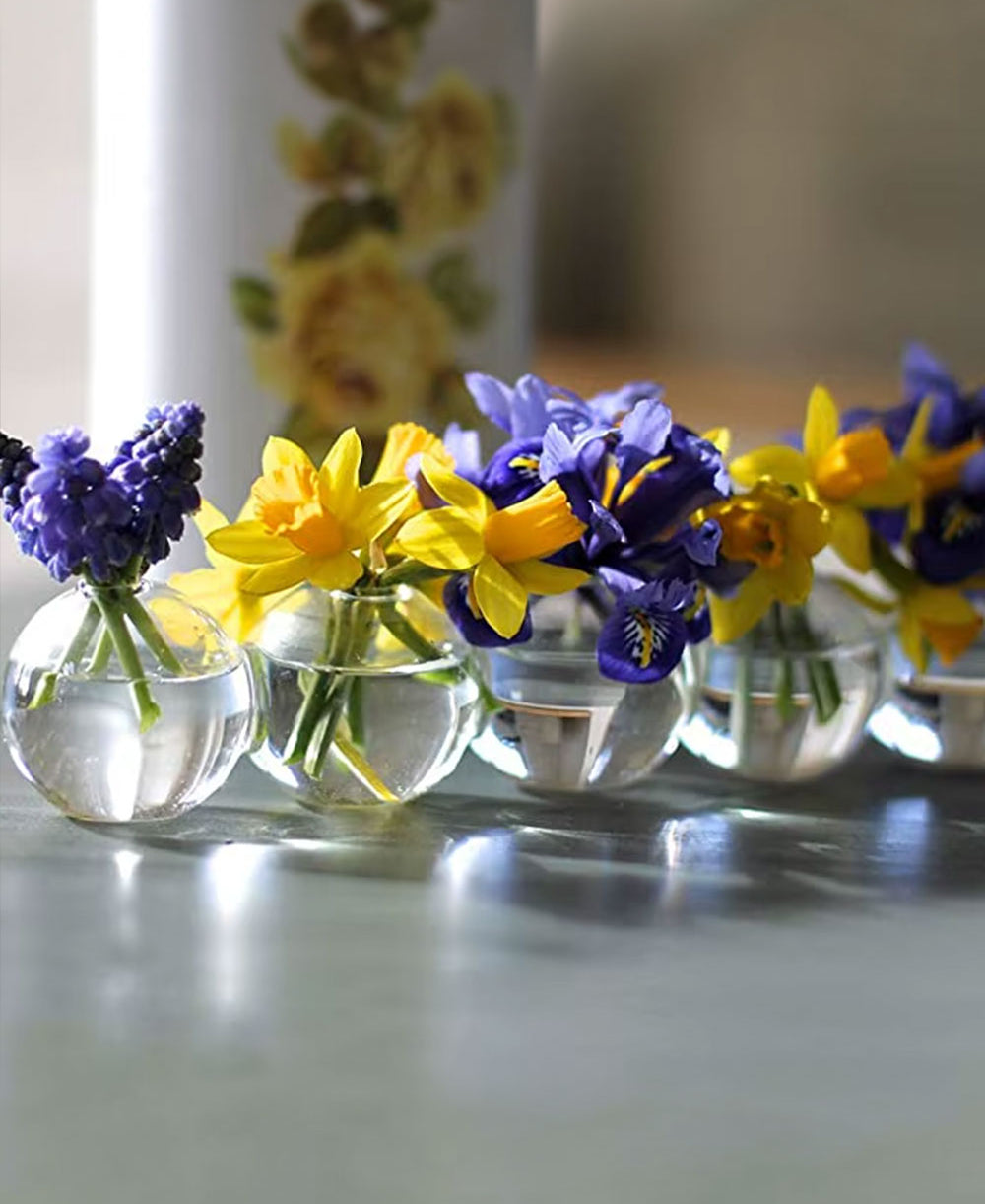
The glass vases at Chive come out of the same studio habit that produced everything else here: design the object once, correctly, then resist every opportunity to complicate it. Each one holds stems. None of them hides anything. The Ligne answers it at two inches, where an uneven line has nowhere to go and no size to hide behind. For the same restraint spread across five shapes instead of three, the Loft Vintage Bud Vases go next.

A Technique Built For Bigger Work, Shrunk Down

Every Chive vase is built around one decision about how flowers should stand, then finished by hand until that decision reads as obvious. With the Ligne the decision was scale: take a banding technique normally reserved for larger work and hold it to something you can close a hand around. Three forms, one surface, no allowance anywhere for a wandering line. It suits a sill, a stack of books, the corner of a desk. The rest of the glass vases collection is built the same way, one decision at a time.

The Thing That Changes Over An Evening
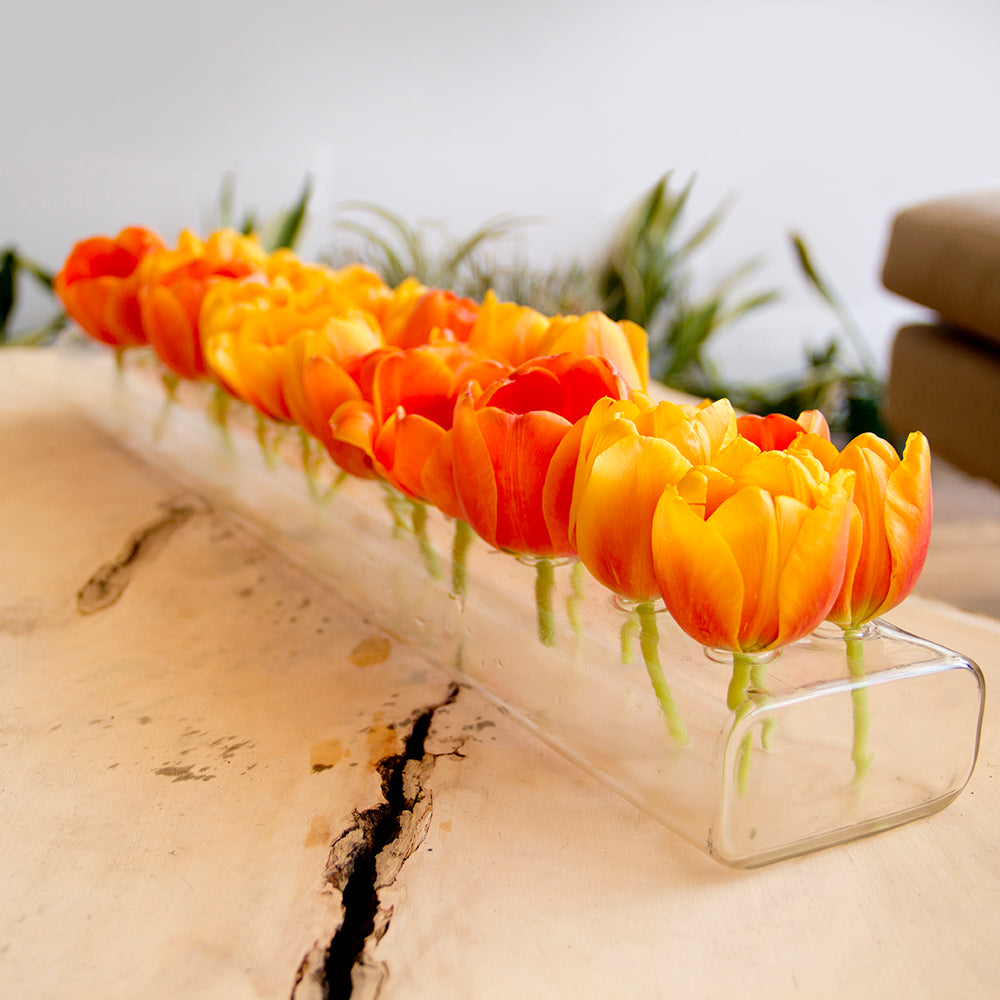
Stand the Foxglove Shido Candle at the end of the Ligne row and the group stops being three variations on a single idea. Glass wants something matte beside it, the way a shiny object needs a dull one to look shiny against. The candle is also the only thing in the arrangement that changes over the course of an evening.


Designed Once, Correctly

Chive has been drawing, sampling and selling its own designs since 2004. The banding on a piece like this is laid down at our own bench instead of being bought in as a finish. That distinction sounds small until something needs changing. A bought-in finish means asking somebody else for a favour and waiting six weeks to learn the answer. Doing it here means walking twenty feet and having an argument, which is quicker and usually produces a better line. The Ligne exists in three forms and not thirty because each form had to survive that walk. We would rather make a short list properly than a long list adequately, and two decades on, the short list is the entire business.


Inside the Chive Design Studio

Low maintenance, high impact. Let's make home styling look easy.

Wedding Centerpiece Vases: The Planning Guide Nobody Gives You

Todd Newgren
Wedding centerpiece vases work best small and plural — three to seven per table, one to three stems each. A fifteen-table reception needs roughly seventy-five vases and 100 to 1...
Read the full story

Frequently asked questions

What is a ligne vase and what sets the Ligne apart?

A ligne vase is a small glass vessel carrying fine parallel banding set into the wall of the glass rather than printed onto it. Three forms exist: Egg, Oval and Sphere. What separates it from most banded glass is the scale, because this technique normally goes onto vessels several times this big, where a wavering line is easier to forgive. Here it is not forgiven at all.

Can the Ligne vase hold dried stems as well as fresh?

Yes, and which form you pick matters more than whether the stems are dried. The Oval is wide and low, so dried material splays outward and settles into a shallow fan. The Egg is the reverse, narrow and taller, so it stands the same stems up in a tight bunch. Choose by the arrangement you want rather than by the condition of the flowers. Sphere manages either adequately.

How much water does the Ligne vase hold when filled?

Not much, and the widest form holds the least. The Oval measures 3.5 inches across but only 2.25 tall, so its usable depth is shallow, perhaps a few tablespoons. The Egg, at 2.25 across and 4 tall, takes roughly twice that while looking smaller. Width spreads the stems; depth is what actually holds the water. Fill either to just below the banding.

Why was glass chosen for the Ligne vase's construction?

Because at this size glass is the only material that will accept the banding and still stay thin. A ceramic piece 2.25 inches across needs a wall heavy enough to survive a kiln, and a heavy wall swallows fine surface work. Glass can be drawn thin and worked while hot, so the lines stay crisp where ceramic would blur them into ridges. That is the whole reason for the material.

Can you remove hard water marks from the Ligne vase easily?

Yes, though the form decides how easily. The Oval opens wide enough to take a finger and a cloth, so a mark lifts under warm water and steady pressure. The Egg narrows toward its mouth and admits no hand at all, so it wants something soft on a stick and rather more patience. Reach is the real variable here, not the glass. Sphere falls between them.

Where does the Ligne vase look best in a modern room?

On a surface wide enough to hold all three. Modern rooms generally want one gesture rather than several scattered ones, and the Ligne supplies three heights, 4 inches, 3 and 2.25, inside a single footprint of roughly eight. Console tables, a wide sill, the end of a kitchen counter. One plane, three elevations, nothing further required.

Should you choose the Ligne vase or the Loft vase first?

Take the Ligne first for one considered object and the Loft first for a scatter. The Ligne is three related forms meant to sit together as a trio, whereas the Loft is five shapes meant to multiply across a table in numbers. Ligne is the shelf and Loft is the event. Different jobs entirely.

When did the Chive studio team design the Ligne vase?

In 2019, which makes it one of the newer designs here and the only one that arrived fully formed. Egg, Oval and Sphere were drawn together as a set rather than as a first shape with variations bolted on afterward, which is why they share a banding pitch and a wall thickness precisely. Nothing has joined the line since. Three was the answer.

Ceramic astronaut vase with flowers styled on shelf — Chive Studio Toronto
Behind the Studio

The story behind the Chive astronaut vases

The story of Laika, Félicette, a solar eclipse in New York, and a space bar that ordered a hundred vases a month until it closed.