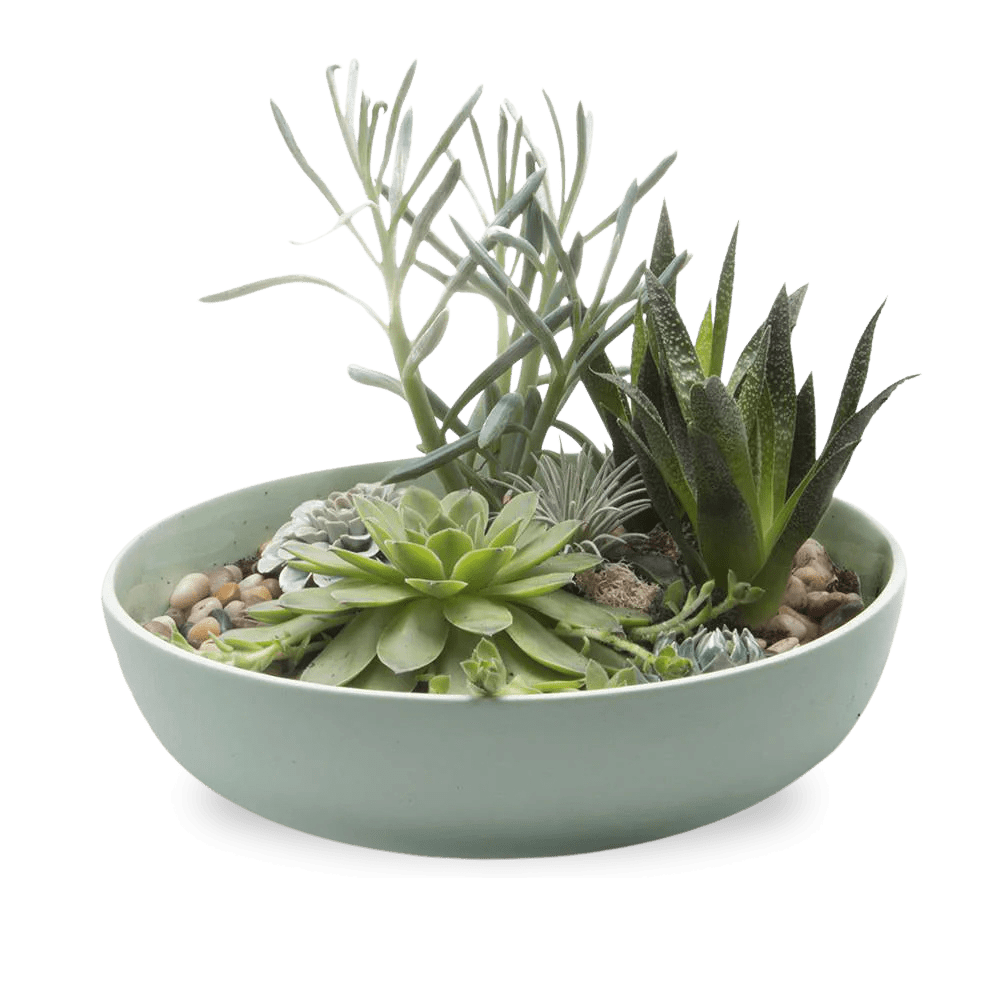
Moog Porcelain Succulent Garden Dish - Blue Grey

Regular price $47.25
Sizes
Drainage hole
Saucer Included
30-day return policy

Give Your Plants What They're Missing:

Start with the terrarium, then build out the shelf with the tools that keep what's inside actually thriving.


The Moog in Blue Grey is a low, wide ceramic succulent dish, the right shape for shallow-rooted plants that resent standing water and the wrong shape, technically, for lunch, which has not stopped any of us. The blue holds up under a window's worth of afternoon light.

It started as a dish for succulents and quietly became the studio's lunch plate, a transition nobody decided on and nobody has reversed. Blue Grey is the coolest of the three colors, the one that looks equally at home holding a cactus or, if we are honest, a bowl of something at noon. There is no drainage hole, so plant succulents or cacti and water sparingly. Ryan eats dinner off a full set of these at home. We learned this slowly, and we have chosen, on reflection, to take it as a compliment to the dish rather than a concern about Ryan.

Product detail
  • Color: Blue Grey
  • Material: Porcelain
  • Glaze finish: Matte
  • Finish variation: Natural variation between pieces
  • Drainage: No drainage hole
  • Saucer: No Saucer
  • Dishwasher safe: Yes
  • Indoor / Outdoor: For indoor use and covered outdoor temperate weather use
  • Designed by: Chive Studio
  • Year Designed: 2017
Dimension
  • Large: 10 inches in diameter, 2.75 inches tall
  • Medium: 8.25 inches in diameter and 2.75 inches tall

Plants that love this pot
  • Echeveria
  • Haworthia
  • Sedum
  • Small barrel or ball cacti
  • Crassula
  • Sempervivum

Quick Terrarium Building Guide:

  1. Add a Drainage Layer
  2. Add Soil
  3. Place Your Plants
  4. Top It Off
  5. Water Sparingly
Pot Care instructions
  1. Dishwasher-safe. Can also be hand-washed with warm soapy water and a soft cloth.
  2. Glazed terrariums and dishes are dipped and kiln-fired — they are sealed, durable, and not looking for trouble. No special cleaning products required.
  3. Not frost-safe. Designed for indoor use and covered outdoor temperate weather use. Freezing temperatures are not recommended.
Shipping & returns

Shipping

  • Free shipping: On qualifying US orders — threshold shown at checkout
  • Standard: 5–8 business days Express2–3 business days (at checkout)
  • International Ships: to 40 countries — rates at checkout
  • Packaging Ships: in outer box to protect gift box

View full shipping policy →

Returns

We accept returns within 30 days of delivery on unused items in original packaging. If your piece arrives damaged, contact us within 14 days with a photo and we will replace it at no charge.

View full return policy →

Wholesale Inquires

Have a cool shop? Know someone that does?

Find Chive on Faire →

The Story Behind This Piece

Blue-grey is the color a lot of succulent dishes reach for eventually, mostly because it's the one shade that reads as neutral without reading as boring, which turns out to be a harder combination to pull off than it sounds. Too blue and it starts competing with a blue-toned echeveria; too grey and the whole dish disappears into whatever surface it's sitting on. This glaze sits in the narrow window between both problems — cool enough to complement a succulent collection's silvery, waxy leaves, warm enough in undertone that it doesn't read as cold or clinical on a windowsill. The shape underneath does the same job the white version does: wide, shallow, built for a cluster of small plants that each want fast-draining soil and don't particularly care what color surrounds them, though the person arranging them clearly does. Two sizes cover a small grouping or a genuinely ambitious one. The color is the whole differentiator here, and it earns that role instead of just filling a spot on a swatch chart somewhere. Most people who own one end up building a whole collection around it rather than stopping at a single dish, which the studio considers a reasonable outcome for a color this easy to keep adding to.

Choosing the Right Terrarium Container

Shape matters more than most people expect:

  • Wide, shallow bowls and dishes work well for succulent clusters — several small plants sharing one visible root zone, with plenty of surface area for soil to actually dry out between waterings.
  • Tall, narrow jars hold humidity near the base while venting excess moisture from an open top — a good middle ground if you want an enclosed look without going fully sealed.
  • Flat-backed or wall-mounted shapes (like a half-moon bowl) solve a placement problem more than a planting one — useful when floor or table space is the real constraint, not the terrarium's needs.
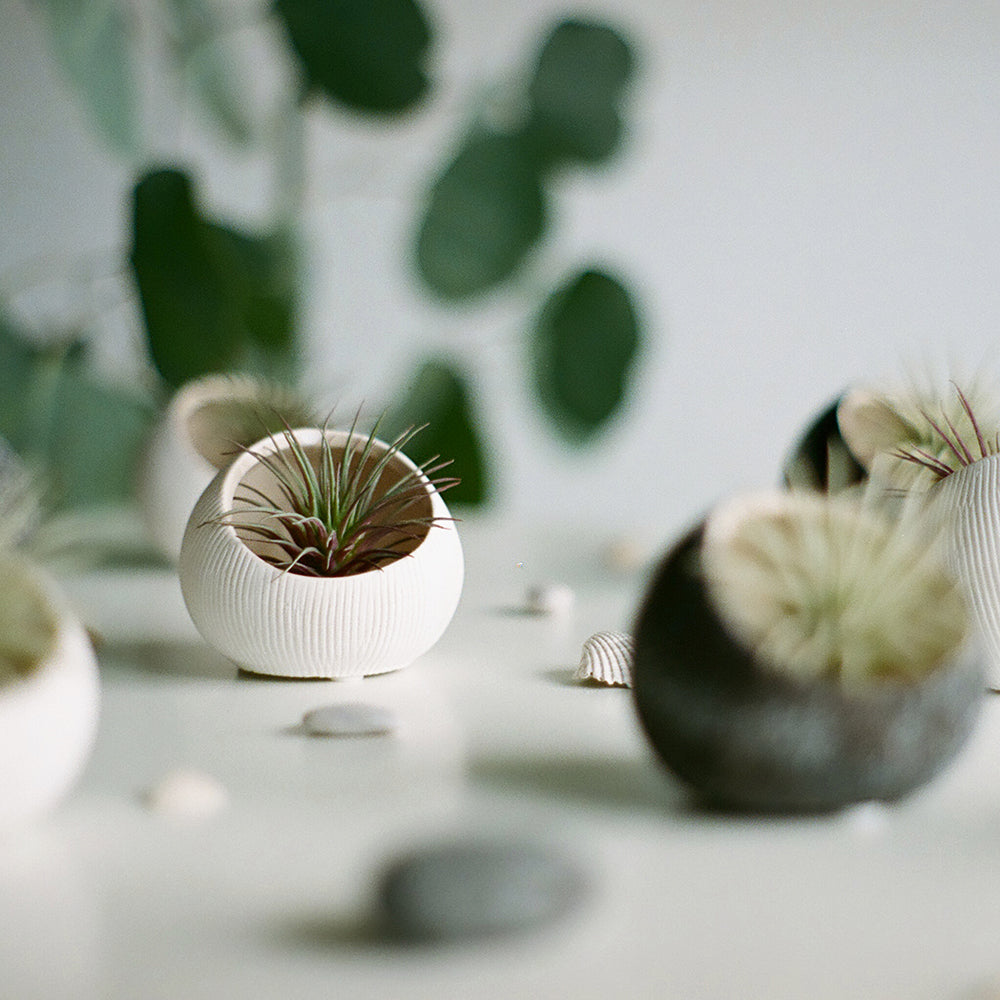
  • Open, punched ceramic shapes (built for air plants specifically) skip soil entirely, relying on airflow through negative space rather than drainage.
Moog Porcelain Succulent Garden Dish - Chive Ceramics Studio - Pots - Chive US

The Rest of the No-Drainage Range

Blue-grey stays deliberately neutral, which is the opposite instinct from the Moog Porcelain Succulent Garden Dish - Peacock Green, the boldest glaze offered in the same shape.

No Drainage, No Problem

A bold glaze like this one is one kind of decision; Chive's wider terrarium lineup turns up an entirely different kind of variety — enclosed jars, hanging shapes, vessels built around humidity rather than color.

Verte Rx Shiny Leaves for Plants - Chive Ceramics Studio - Chive Ceramics Studio

Go Easy on the Watering

Keeping several succulents thriving in one shallow dish takes a different feeding rhythm than a single pot does, and Verte Rx Shiny Leaves was built for exactly that kind of closely grouped planting.

About Chive Studio

Glaze mixing has been part of the studio's daily work since 2004, and blue-grey is one of the harder shades to get consistently right — it drifts warm or cold depending on the kiln's mood that day, more than almost any other glaze in rotation. The studio keeps mixing it anyway, because a neutral that isn't quite grey and isn't quite blue turns out to be more useful than either extreme on its own. Consistency here isn't about the same numbers every time so much as a trained eye catching drift before it ever leaves the kiln. That's most of what twenty-some years of glaze work actually looks like, day to day.


Plant Tips from Chive Studio

Quick tips, straight answers, and the occasional reminder that overwatering kills more houseplants than neglect does.

How to Repot a Plant: Watch for the Linen

Todd Newgren
How to repot a plant comes down to three signs, one rule, and one soil decision that most people get wrong. Chive Studio has been making drainage pots since 2004. The neighbor i...
Read more

Begonia Care: The Complete Guide

Ryan Hearst
Begonia plant care requires bright indirect light, consistent watering, and a pot that drains. Chive has been designing ceramic pots with real drainage for over two decades. Her...
Read more

Frequently asked questions

What is the Moog in Blue Grey best suited to?

The Moog is a porcelain dish for indoor plants. It works well for succulents, cacti, and other plants that like to dry out and suits modern, boho, and minimalist rooms. As a porcelain dish, the Moog fits a shelf, sill, or desk and pairs cleanly with the rest of the Chive pot range. This listing is the Blue Grey colorway.

Does the Moog dish have a drainage hole?

No, the Moog is an indoor dish without a drainage hole, so it is best used with plants that tolerate less frequent watering or as a cachepot. Either plant succulents directly and water lightly, or drop a nursery pot inside and lift it out to water. Without a drainage hole, the trick is to add water slowly and avoid leaving any pooled at the bottom.

What plants grow well in the Moog?

The Moog is a porcelain dish that holds a nursery plant of a similar width, so match the grower pot to the opening rather than the mature size of the plant. Good choices include succulents, cacti, and other plants that like to dry out. For an indoor plant pot, size up by about an inch when you repot so roots have room without swimming in soil.

Does the Moog come with a saucer?

The Moog does not include a saucer, which suits its use as a decorative dish. If you plant directly in it, water lightly so nothing collects at the base, or set a nursery pot inside and lift it out to water over a sink. A small cork pad underneath protects furniture if you keep the Moog on a shelf. As an indoor dish without a tray, it is forgiving as long as you water with a light hand.

Is the Moog pot porcelain?

Yes, the Moog is a porcelain plant pot. Porcelain is fired hard, holds glaze color well, and does not break down with watering the way untreated materials can, which makes porcelain plant pots a reliable choice for indoor plants. The Moog is glazed to seal the surface, so it wipes clean and keeps its finish on a sill, shelf, or table.

How do I water a plant in the Moog?

To water the Moog, add small amounts and stop before anything pools at the bottom, since this dish has no drainage hole. The easiest method is to keep the plant in its nursery pot, lift it out to water over a sink, let it drain, and set it back. Watering a pot without drainage is mostly about restraint, less water, less often.

Is the Moog good for succulents?

The Moog is a good porcelain dish for succulents. Succulents like the tighter, fast-drying conditions of a pot without a drainage hole, as long as you water lightly. For anyone searching for a porcelain pot for succulents, the Moog covers both looks and function. Match the nursery pot to the opening and the plant settles in without fuss.

Is the Moog a good gift for a plant lover?

The Moog makes a practical gift for a plant lover because it is a finished porcelain dish that solves a real problem rather than adding clutter. It pairs easily with a plant they already own and suits most modern interiors. For a plant pot gift that gets used, the Moog is an easy choice, and it suits anyone building an indoor plant collection.

Shido Vegetable and Flower Seeds Vacuum sealed for peak freshness

The pot is sorted. Now what goes in it?

Shido seeds come vacuum-sealed, non-GMO, and packaged well enough that people keep the packets after the seeds are gone. Which is either a design success or a problem, depending on how you look at it.

Your new pot is waiting.