Neutrino Glass Ikebana Kenzan Vase

Regular price $29.85
Colors: Black/Copper Spots
Hand Blown Glass
Dishwasher safe cleaning
30-day return policy

Build the Arrangement That Looks Harder Than It Was

Pick a vase to anchor the shelf, then add the rest until it reads as curated instead of collected.


A kenzan vase holds a stem by gripping it rather than by leaning it on a wall, and the Neutrino manages that with a weighted glass opening instead of a separate pin holder dropped in the base. It measures 4 inches wide and 1.75 tall, low enough to sit on a sill beneath a closed sash window with clearance to spare. As a glass ikebana vase it inverts the usual arrangement, because the mechanism is the vessel: no metal disc to buy, lose, or bury under gravel. One stem sits at whatever angle it was set, upright or leaning hard, and holds there without any water at all. Water here is for the flower, not for the engineering. Two or three stems is the working maximum, which sounds restrictive until somebody tries arranging with one. Everything the Neutrino vase does, it does in plain view. There is nothing inside it to hide behind.

Product detail

Product Detail:

  • Material: Glass
  • Glaze finish: Translucent
  • Year Designed: 2015
Dimension
  • 4 inches diameter, 2 inches tall
Vase Care Instructions

All glass vases in this collection are dishwasher safe for easy cleaning, with one exception: mercury glass vases should be hand-washed only. The silvered mercury finish is a delicate coating rather than a solid color, and dishwasher heat and detergent can dull or strip it over time.

For standard glass vases, just load it in with the rest of the dishes — no special care needed. For mercury glass pieces, wash gently with warm water and mild soap, and dry with a soft cloth rather than letting it air dry with water spots.

Rinse and dry after each use, especially if flower food or cut-stem residue was in the water, so nothing lingers and clouds the glass.

Flowers that Love this Vase
  • Ranunculus
  • Carnation
  • Daffodil
  • Cornflower
  • Craspedia
  • Nasturtium
  • Nigella
  • Black-Eyed Susan
  • Iceland Poppy
  • Spider Flower

Quick Guide to Building a Floral Arrangement

  1. Pick your vase first
  2. Start with your anchor flower.
  3. Build in odd numbers.
  4. Add height, then fill.
  5. Greenery does the quiet work.
  6. Cut stems at an angle, underwater if you can.
  7. Step back before you decide it's done.

Shipping & returns

Shipping

  • Free shipping: Orders $200+ within the US
  • Standard: 5–8 business days, Express 2–3 business days (at checkout)
  • International Ships: to 40 countries — rates at checkout
  • Packaging Ships: in outer box to protect gift box

View full shipping policy →

Returns

We accept returns within 30 days of delivery on unused items in original packaging. If your piece arrives damaged, contact us within 7 days with a photo and we will replace it at no charge.

View full return policy →

Wholesale Inquires

Have a cool shop? Know someone that does?

Find Chive on Faire →

Neutrino Glass Ikebana Kenzan Vase - Chive Ceramics Studio - Vases - Chive Ceramics Studio

Early, and still waiting - The Neutrino

I have been waiting about eleven years for kenzans to have their moment, and I would like the record to show that I was early and that being early has brought me nothing.

The pattern is familiar. An unfashionable object sits quietly for decades, then gets discovered by people young enough not to know it was ever unfashionable, and everyone involved is delighted. It happened to houseplants. It happened to sourdough, twice. I assumed it would happen here, and I said so in a meeting in a tone I now regret, and Priya wrote the date on a whiteboard so that it could be revisited.

It has not happened. What happened instead is that a completely different category got discovered, then another, and each time I would come in convinced this was finally adjacent enough to count. The whiteboard is now several whiteboards.

So the position is unchanged. They were always good. Almost nobody agreed, the ones who did were already ahead of me, and I am no longer expecting a wave.

If you have found your way here on purpose, then you are ahead of a trend that has not arrived, may never bother arriving, and does not need to for the object to be worth owning.

Chive Studio trimming tulip stems with scissors on a wooden surface, with white, purple, and pink tulips arranged nearby.
How to Cut Flowers Like a Pro:

A (Mostly) Simple Guide to Cutting Your Flowers

So, you’re making an arrangement? Let’s ensure it lives long enough to impress someone—even if it's just you.

  1. Scrub the Scissors: Wash your shears first. Your flowers do not want a side of Dorito dust.
  2. Cut at 45°: Snip stems at an angle. It gives them a straw instead of making them chug from the bottle.
  3. Trim Underwater (Fancy Mode): Cut them submerged to block air bubbles. It’s extra, but they didn’t ask to suffocate.
  4. Ditch Submerged Leaves: Strip anything below the waterline. Unless you are actively going for a swamp aesthetic.
  5. Snip Again if Stale: If they sat out on the counter, trim them again. They need a fresh start (don’t we all?).
  6. Swap the Water: Change it and trim the stems every few days so they don't die immediately.

Voilà! You are now a domestic deity. Go take your Instagram photo before you forget to water them.

Pro Tip: The light does half the work.

Glass catches and bends light in a way ceramic can't. Set the arrangement somewhere it'll get some late afternoon sun, even for an hour, and the water and stems start doing something a solid vase never will.

Perfect Pairs for Any Shelf

Nova Glass Flower Vase - Chive Ceramics Studio - Vases - Chive US

The Other End Of The Same Argument

The glass vases at Chive come out of the same studio habit that produced everything else here: design the object once, correctly, then resist every opportunity to complicate it. Each one holds stems. None of them hides anything. On the Neutrino that is close to literal, since the holding is done by a thickened glass throat you can see straight through. When the same reluctance produces a wide open mouth instead of a narrow grip, the Nova Glass Vase is the other end of the argument.

No Insert, No Gravel, No Metal Disc

Every Chive vase is built around one decision about how flowers should stand, then finished by hand until that decision reads as obvious. Here the decision was to make the holding mechanism the vessel itself, so that a single stem could be set at a steep angle and stay there with no insert, no gravel and no metal disc involved. The consequence is a piece that does one thing and refuses the rest. Every other object in the glass vases collection was settled the same way, in one argument that finished.

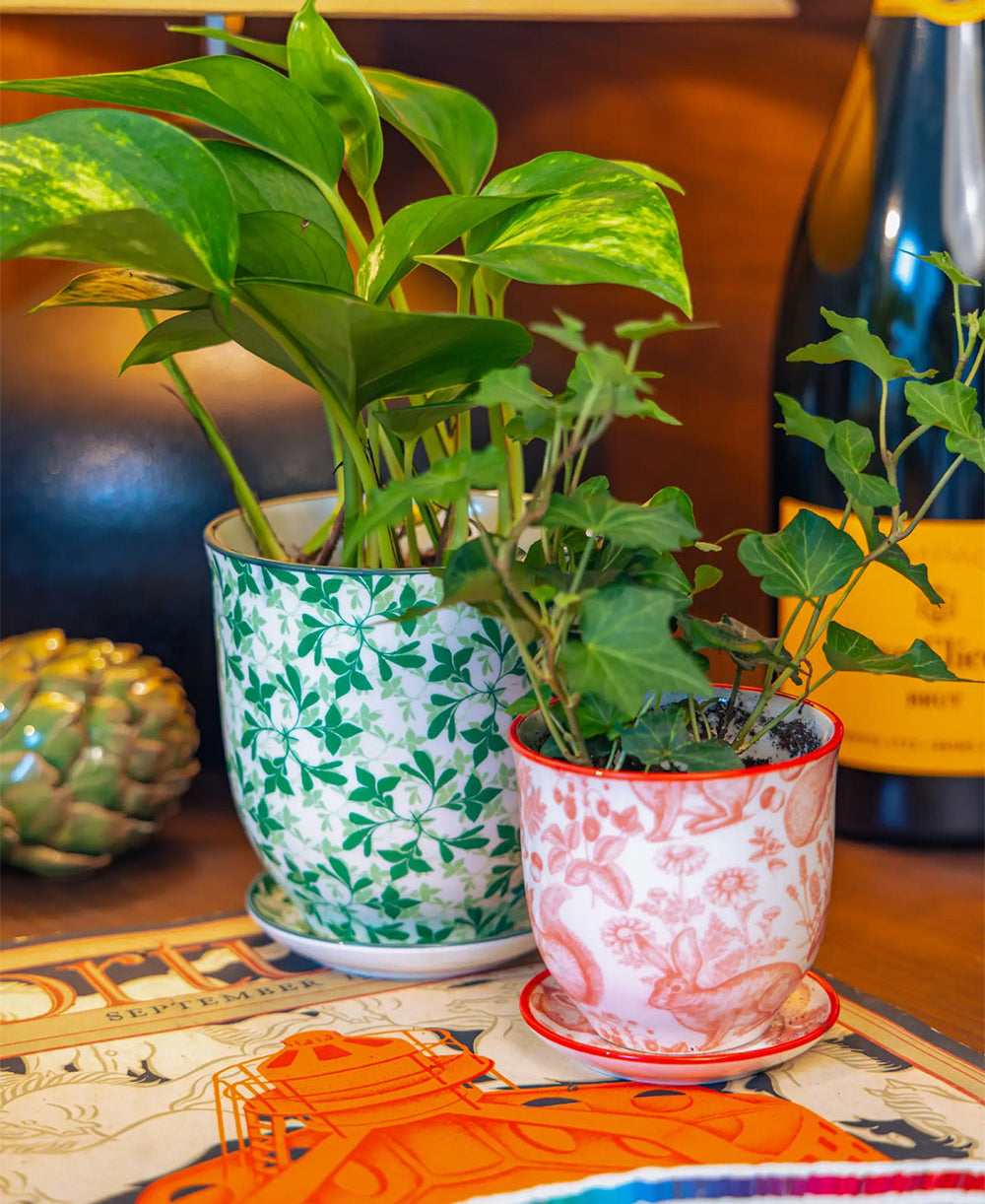
Chive Liberté planters in green leaves and red squirrels prints, styled with a golden pothos and ivy on a wood surface.

Two Timescales, One Windowsill

Put a Liberte Pot and Saucer in 4 inches next to this and the pair covers two timescales at once. A cut stem here is a week, generously. A plant in porcelain with drainage underneath is several years, assuming nobody overwaters it in February. One windowsill, one object for the short version and one for the long.


We Make the Hidden Part

Nothing on this piece is subcontracted, including the part nobody looks at. The weighted section under the opening is the entire mechanism, it is invisible in normal use, and it is the one component standing between a leaning stem and a stem lying on the floor, so it gets made here alongside everything else. Chive opened in 2004 and the rule has not changed since: if a component decides whether the object works, we make it. Farming out the visible parts while keeping the hidden ones would be precisely the wrong way round, and a surprising number of companies do exactly that and describe it as craftsmanship in their marketing.


Inside the Chive Design Studio

Low maintenance, high impact. Let's make home styling look easy.

The Best 10 Styles of Vases

Jessie Duenas
The glorious world of flower vases! Because nothing says "I have my life together" quite like a carefully chosen vessel for your soon-to-be-wilting flora. Gather 'round, fell...
Read the full story

Wedding Centerpiece Vases: The Planning Guide Nobody Gives You

Todd Newgren
Wedding centerpiece vases work best small and plural — three to seven per table, one to three stems each. A fifteen-table reception needs roughly seventy-five vases and 100 to 1...
Read the full story

Frequently asked questions

What is a kenzan vase and how does it hold stems?

Traditionally a kenzan is a separate spiked base you drop into a shallow dish, and the dish then has to conceal it under pebbles. This version builds the function into the vessel: the throat above the reservoir is deliberately thickened and narrowed, so a stem pushed into it is gripped along a short length and stays wherever it was aimed. There is no insert to position. The glass does the gripping.

Which stems suit the Neutrino's weighted glass opening best?

Firm single stems with some rigidity to them. Ranunculus, craspedia, nigella and black-eyed susan all have enough backbone to be held at an angle without folding at the grip point. Hollow or very soft stems crush instead of seating, and anything heavy-headed on a thin neck will pivot slowly through the evening. Test the stem between two fingers before committing it. Woody cuttings work beautifully.

Is the Neutrino vase sized for a windowsill or a mantel?

A sill, without much argument. At 1.75 inches of height this disappears on a mantel, where the eye is looking along a line roughly five feet up and anything under two inches simply drops out of view. On a sill you look down into it, which is the correct angle for a stem set on the diagonal. This measures well under two inches. Mantels want height.

What glass quality can you expect from the Neutrino vase?

Expect visible variation and treat that as the point. The brown and copper spotting is suspended in the glass rather than applied to it, so density and distribution differ piece to piece, and small bubbles turn up in the heavier lower section. A perfectly uniform version of this piece would mean a machine had made it. The base carries obvious mass.

Does the Neutrino vase need special care between flower arrangements?

It does, and the requirement is unusual, because a piece used with very little water collects dry residue rather than wet. Pollen, dust and pulverised leaf settle into the throat and go unnoticed until a stem will not seat properly. Run water through the opening and let it drain rather than wiping. Blocked grip is the failure to watch for, not cloudiness.

How do you group the Neutrino vase with other Chive pieces?

Give it something taller to stand beside. This is a low object holding a single stem, so it functions as punctuation rather than as the sentence, and grouped only with its own kind it reads as a set of small gestures nobody quite finished. Leave space in front of it so the diagonal has somewhere to go. A Nova or a Nebula behind it supplies the mass.

How does the Neutrino vase compare with the Nova vase in person?

Photographs flatten the difference and in person it is considerable. The Nova stands three inches with a five-inch mouth, so it reads as a proper vessel across a room, whereas this measures under two inches tall and asks you to come closer. Colour separates them too, one clear grey and one spotted brown. Handled side by side, the weight distribution surprises people. This one is denser than it looks.

Why is it called the Neutrino vase and what's the story?

The name points at a particle that passes through solid matter without disturbing it, and the connection is behavioural rather than decorative. A stem in this vessel is held firmly with nothing visible doing the holding, which is roughly the same trick described in reverse. No mechanism, no insert, no hidden armature, and yet the stem stays at whatever steep angle you left it. The physics is duller than the name suggests.

Ceramic astronaut vase with flowers styled on shelf — Chive Studio Toronto
Behind the Studio

The story behind the Chive astronaut vases

The story of Laika, Félicette, a solar eclipse in New York, and a space bar that ordered a hundred vases a month until it closed.