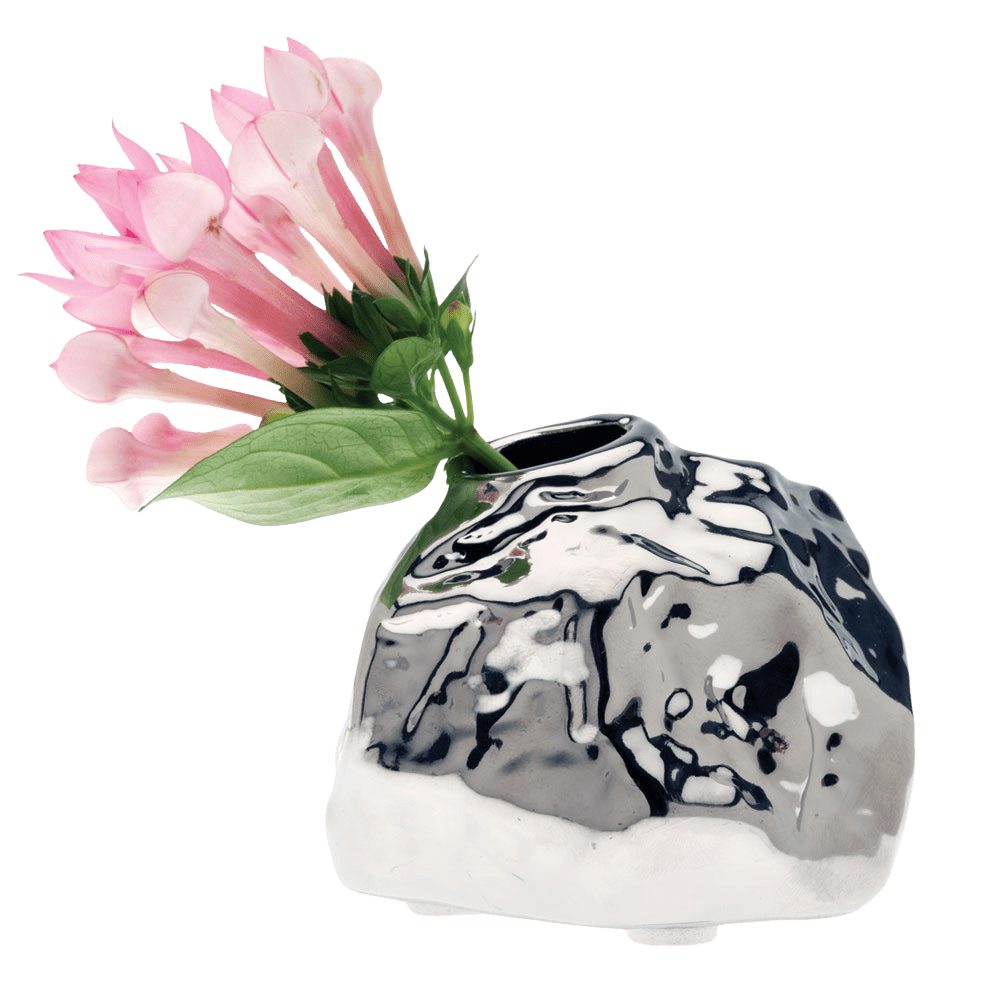
Alu Ceramic Floral Vase

Regular price $17.25
Sizes
Fully Glazed
Dishwasher safe cleaning
30-day return policy

Build Your Effortless Arrangements With These:

Choose a vase as your anchor, then round out the shelf with these for that thrown-together-but-somehow-perfect look.


The Alu vase is ceramic doing a flawless impression of metal — a chrome-glazed piece named for the aluminum it resembles and refuses to be. The name is the joke and the spec sheet at once: it photographs like machined alloy, lifts like clay, and never dents. Since 2018 it has been the studio's answer to rooms that lean industrial but still want one object on the shelf that came from a kiln instead of a factory floor. As a sculpted ceramic vase it takes a low, horizontal stance, closer to a landform than a cylinder, and as an organic form vase it carries short stems at an easy sideways angle rather than at attention. The large runs five inches long and sits low enough for a mantel's front edge. Mirror finishes forgive nothing, so every piece leaves the studio polished and checked by hand — the slowest step here, and the least negotiable.

Product detail
  • Vase Type:
  • Material: Ceramic
  • Glaze finish: Glazed
  • Water Resistance: Watertight
  • Year Designed: 2018
Dimension
  • Large: 5 inches long, 2 inches wide, 2.5 inches tall
  • Small: 2 inches diameter, 2.5 inches tall
Vase Care Instructions

Every ceramic vase in this collection is dishwasher safe on the top rack, making cleanup between arrangements as simple as loading it in with the rest of the dishes. The glazed surface holds up fine to regular washing, so there's no need to hand-wash unless you'd prefer to.

If you're cleaning a piece with painted or sculpted detail, a gentler cycle or a quick hand-wash with warm water and mild soap will help keep the finish looking sharp for longer. Either way, rinse and dry after each use — especially if flower food or cut-stem residue was in the water — so nothing lingers and clouds the glaze.

No special sealants, no periodic maintenance. Wash it, dry it, put flowers back in it.

Flowers that Love this Vase
  • Cosmos
  • Zinnia
  • Daisy
  • Gerbera Daisy
  • Coneflower
  • Black-Eyed Susan
  • Gomphrena
  • Waxflower
  • Pansy
  • Flowering Dill

Quick Guide to Building a Floral Arrangement

  1. Pick your vase first
  2. Start with your anchor flower.
  3. Build in odd numbers.
  4. Add height, then fill.
  5. Greenery does the quiet work.
  6. Cut stems at an angle, underwater if you can.
  7. Step back before you decide it's done.

Shipping & returns

Shipping

  • Free shipping: Orders $200+ within the US
  • Standard: 5–8 business days, Express 2–3 business days (at checkout)
  • International Ships: to 40 countries — rates at checkout
  • Packaging Ships: in outer box to protect gift box

View full shipping policy →

Returns

We accept returns within 30 days of delivery on unused items in original packaging. If your piece arrives damaged, contact us within 7 days with a photo and we will replace it at no charge.

View full return policy →

Wholesale Inquires

Have a cool shop? Know someone that does?
Find Chive on Faire →

Alu Ceramic Floral Vase - Chive Ceramics Studio - Vases - Chive US

Metal, minus the metal — The Alu

Chrome is a finish with rules. It shows every fingerprint, forgives no shortcut in the glazing room, and photographs like a lie detector — any flaw in the surface underneath announces itself at full volume. The studio chose it anyway, because the whole premise of the Alu is conviction: a piece of fired clay committing so completely to its metal impression that visitors pick it up expecting cold and weight, and get neither. The double take is the product. Getting there means the glaze runs go slower than anything else in the building, the rejection rate runs higher, and the final polish is done by hand, piece by piece, by people who have learned to check their own reflection in the work — literally, since the surface functions as a mirror. It comes in two sizes: a large that stretches five inches long and holds a low horizontal line, and a small that sits upright at two inches across. Both were designed for rooms that lean industrial — concrete, steel shelving, black window frames — but want one object with a kiln in its history instead of a production line. Clay pretending to be metal, executed without a wink. The pretense is total. That is exactly why it works.

Chive Studio trimming tulip stems with scissors on a wooden surface, with white, purple, and pink tulips arranged nearby.

A (Mostly) Simple Guide to Cutting Your Flowers

So, you’re making an arrangement? Let’s ensure it lives long enough to impress someone—even if it's just you.

  1. Scrub the Scissors: Wash your shears first. Your flowers do not want a side of Dorito dust.
  2. Cut at 45°: Snip stems at an angle. It gives them a straw instead of making them chug from the bottle.
  3. Trim Underwater (Fancy Mode): Cut them submerged to block air bubbles. It’s extra, but they didn’t ask to suffocate.
  4. Ditch Submerged Leaves: Strip anything below the waterline. Unless you are actively going for a swamp aesthetic.
  5. Snip Again if Stale: If they sat out on the counter, trim them again. They need a fresh start (don’t we all?).
  6. Swap the Water: Change it and trim the stems every few days so they don't die immediately.

Voilà! You are now a domestic deity. Go take your Instagram photo before you forget to water them.

Pro Tip: Keep It Short and Sweet!

When it comes to flower stems, shorter is better. Not only do shorter stems look chic in arrangements, but they also help your blooms last longer. Why? Because the shorter the stem, the less distance water has to travel to keep those petals perky. It’s like giving your flowers a shorter commute—less stress, fewer breakdowns.

Perfect Pairs for Any Shelf

Ceramic astronaut vase with flowers styled on shelf — Chive Studio Toronto

Astronaut Ceramic Vase

The ceramic vases at Chive come out of the same studio habit that produced everything else here: design the object once, correctly, then resist every opportunity to complicate it. Each one holds stems. None of them holds back. The Alu is that habit doing a metal impression. For the habit in a spacesuit, honoring everyone who ever went up, the Astronaut Ceramic Vase reports for duty.

The Ceramic Vases Collection

Every Chive vase is built around one decision about how flowers should stand, then finished by hand until that decision reads as obvious. For the Alu, the decision was commitment: a chrome glaze pursued to the point that clay passes for alloy in photographs and usually in person. It gives industrial rooms the single piece on the shelf that owns a kiln history, and it never breaks character. See every vase in the Ceramic collection.

Shido Seeds packets styled in soil with sunlight — Chive Studio

Bird of Paradise Flower Seeds

Chrome wants drama, and few stems supply it like a bird of paradise. A packet of Bird of Paradise Flower Seeds is the long game — months of growing for a bloom that looks engineered — parked beside a vase that looks machined and never was. Patience on the windowsill, payoff on the mantel. The Alu will wait.


Chive Studio at Chelsea Flower Show displaying ceramic pooley vases of different colors.

One Roof, Every Step — Chive

Everything Chive sells is made under one roof, and has been since 2004 — sketch, model, mold, glaze, firing, polish, inspection, box. The studio keeps the whole chain in-house not out of romance but out of control: when a finish demands a rejection rate nobody sane would accept from a contractor, the only workable supplier is yourself. That arrangement makes some pieces slow and some pieces expensive to perfect, and the studio has made peace with both. What it gets in exchange is the right to be difficult about details no customer will ever consciously notice and every customer will feel. One roof, every step, no exceptions worth naming. The pieces are the audit trail.


Inside the Chive Design Studio

Low maintenance, high impact. Let's make home styling look easy.

Wedding Centerpiece Vases: The Planning Guide Nobody Gives You

Todd Newgren
Wedding centerpiece vases work best small and plural — three to seven per table, one to three stems each. A fifteen-table reception needs roughly seventy-five vases and 100 to 1...
Read the full story

The Best 10 Styles of Vases

Jessie Duenas
The glorious world of flower vases! Because nothing says "I have my life together" quite like a carefully chosen vessel for your soon-to-be-wilting flora. Gather 'round, fell...
Read the full story

Frequently asked questions

How does the Alu earn its name as a alu vase?

The name is short for aluminum, which the vase impersonates and is not. An alu vase, in this studio's usage, is fired clay under a chrome glaze polished until it passes for machined metal, in pictures and mostly in person, right up until someone lifts it and finds kiln weight instead of alloy. The name confesses the trick up front. The surface still fools people.

Do short-stemmed garden flowers work well in the Alu vase?

They are the intended crop. The Alu holds stems at a relaxed sideways angle rather than bolt upright, and short garden cuttings — pansies, cosmos, a stray zinnia — drape naturally along that line. Long formal stems fight the low profile and lose. Trim short, lay the bloom toward the mirror finish, and let the reflection double your flower count. Short and casual wins here.

What footprint does the Alu vase take up on a table?

The large measures five inches long, two inches wide, and two and a half tall — a low horizontal strip rather than a column, sized for the front edge of a mantel or a narrow console. The small is a two-inch rounder that tucks in almost anywhere. Neither blocks a sightline, which is the advantage of designing low. Horizontal room is all they ask.

Is the Alu vase's ceramic body durable for everyday use?

The ceramic body is as tough as anything in the catalog; the mirror glaze deserves ordinary courtesy. Fired clay handles daily life — water, handling, the occasional bump — without complaint, and unlike genuine chrome-plated metal, it cannot dent or peel. Fingerprints wipe away with a soft cloth. Treat the finish like eyeglasses rather than armor. The body will outlast the fashion.

Is the Alu vase dishwasher safe or hand wash only?

Hand wash — the studio is firm on this one. Dishwasher detergents are mildly abrasive by design, and over many cycles they haze exactly the kind of high-polish surface the Alu depends on. Warm water, mild soap, a soft cloth, and a dry buff restores the mirror in under a minute. Machines wash well enough. Mirrors deserve better.

Does the Alu vase work as decor without any flowers in it?

That is most of its life. The Alu functions as a small chrome-look sculpture that happens to accept stems — in industrial and modern rooms it holds shelf space empty for months at a stretch, reflecting whatever the room does around it. Flowers arrive as an event, not a requirement. It was styled that way on purpose. Empty is the default.

What makes the Alu vase different from the Astronaut vase nearby?

The Alu is a material joke; the Astronaut is a character. One is clay committed to a chrome impression, abstract and low, at home in strict modern rooms. The other is a figure — a person in a suit, holding flowers, carrying a whole space-program backstory. Choose the Alu for finish, the Astronaut for narrative. They share a shelf surprisingly well.

How did the Alu vase's design evolve at Chive studio?

It started in 2018 as a glaze experiment: how far could a chrome finish go on fired clay before it stopped reading as ceramic at all. The answer required the studio's slowest glaze runs and its highest rejection rate, plus a hand-polish step nobody has managed to shorten. The form stayed simple so the surface could carry everything. The finish was the whole project.

Ceramic astronaut vase with flowers styled on shelf — Chive Studio Toronto
Behind the Studio

The story behind the Chive astronaut vases

The story of Laika, Félicette, a solar eclipse in New York, and a space bar that ordered a hundred vases a month until it closed.