Bulb Forcer Glass Flower Vase

Regular price $26.95
Sizes
Hand Blown Glass
Dishwasher safe cleaning
30-day return policy

Build the Arrangement That Looks Harder Than It Was

Pick a vase to anchor the shelf, then add the rest until it reads as curated instead of collected.


There is no defensible reason for how much this building loves a bulb forcing vase, unless the explanation is that we are all, in some unexamined way, secretly Dutch. Say the premise out loud and it sounds strange: you suspend a bulb above water, roots down, nothing quite touching, and wait for it to do in the open what it would otherwise do buried and unwitnessed. Some people would rather watch a thing work than be told that it works. This bulb vase is for them. We have run the same bulbs through this one for well over a decade now. As a hyacinth forcing vase it arrives two ways, the taller one about the width of a teacup and standing eight inches, the shorter one wider at the shoulder and dropping to just over five. Since 2004 the glass has always been shaped by hand at Chive Ceramics Studio, in runs small enough to count on the way out.

Product detail

Product Detail:

  • Material: Glass
  • Glaze finish: Translucent
  • Year Designed: 2020
Dimension
  • Tall: 3.5 inches diameter, 8 inches tall
  • Short: 4.5 inches diameter, 5.25 inches tall
Vase Care Instructions

All glass vases in this collection are dishwasher safe for easy cleaning, with one exception: mercury glass vases should be hand-washed only. The silvered mercury finish is a delicate coating rather than a solid color, and dishwasher heat and detergent can dull or strip it over time.

For standard glass vases, just load it in with the rest of the dishes — no special care needed. For mercury glass pieces, wash gently with warm water and mild soap, and dry with a soft cloth rather than letting it air dry with water spots.

Rinse and dry after each use, especially if flower food or cut-stem residue was in the water, so nothing lingers and clouds the glass.

Flowers that Love this Vase
  • Lisianthus
  • Carnation
  • Baby's Breath
  • Marigold
  • Statice
  • Columbine
  • Tuberose
  • Forget-Me-Not
  • Viola
  • Love-Lies-Bleeding

Quick Guide to Building a Floral Arrangement

  1. Pick your vase first
  2. Start with your anchor flower.
  3. Build in odd numbers.
  4. Add height, then fill.
  5. Greenery does the quiet work.
  6. Cut stems at an angle, underwater if you can.
  7. Step back before you decide it's done.

Shipping & returns

Shipping

  • Free shipping: Orders $200+ within the US
  • Standard: 5–8 business days, Express 2–3 business days (at checkout)
  • International Ships: to 40 countries — rates at checkout
  • Packaging Ships: in outer box to protect gift box

View full shipping policy →

Returns

We accept returns within 30 days of delivery on unused items in original packaging. If your piece arrives damaged, contact us within 7 days with a photo and we will replace it at no charge.

View full return policy →

Wholesale Inquires

Have a cool shop? Know someone that does?

Find Chive on Faire →

Bulb Forcer Glass Flower Vase - Chive Ceramics Studio - Vases - Chive US

Eight Weeks Of Watching Something Work

Nobody warns you about the smell. Weeks one through five are pleasant enough: you seat the bulb in the neck, fill until the water sits a hair beneath its base, put the whole arrangement somewhere cold and dark, and forget about it entirely. Roots arrive first, filling the vessel with white thread, and that stage is genuinely absorbing to watch. Then you carry it into the light, growth accelerates, and if the water has gone stale meanwhile the room will let you know. Change it weekly. That is the one instruction people skip and the one instruction which actually matters. The other thing worth knowing is that a forced bulb is doing something faintly unfair. In eight weeks it spends energy banked across an entire summer, which explains why the flower is spectacular and why the bulb afterwards resembles something recovered from a shipwreck. Plant it out and it sulks for two seasons before flowering again. Or discard it, as most people sensibly do. I have never once managed that. A drawer at the studio holds a box of them, each labelled with a year, none of them ever planted out, all of them technically still alive and waiting on somebody with better follow-through than mine.

Chive Studio trimming tulip stems with scissors on a wooden surface, with white, purple, and pink tulips arranged nearby.
How to Cut Flowers Like a Pro:

A (Mostly) Simple Guide to Cutting Your Flowers

So, you’re making an arrangement? Let’s ensure it lives long enough to impress someone—even if it's just you.

  1. Scrub the Scissors: Wash your shears first. Your flowers do not want a side of Dorito dust.
  2. Cut at 45°: Snip stems at an angle. It gives them a straw instead of making them chug from the bottle.
  3. Trim Underwater (Fancy Mode): Cut them submerged to block air bubbles. It’s extra, but they didn’t ask to suffocate.
  4. Ditch Submerged Leaves: Strip anything below the waterline. Unless you are actively going for a swamp aesthetic.
  5. Snip Again if Stale: If they sat out on the counter, trim them again. They need a fresh start (don’t we all?).
  6. Swap the Water: Change it and trim the stems every few days so they don't die immediately.

Voilà! You are now a domestic deity. Go take your Instagram photo before you forget to water them.

Pro Tip: The light does half the work.

Glass catches and bends light in a way ceramic can't. Set the arrangement somewhere it'll get some late afternoon sun, even for an hour, and the water and stems start doing something a solid vase never will.

Perfect Pairs for Any Shelf
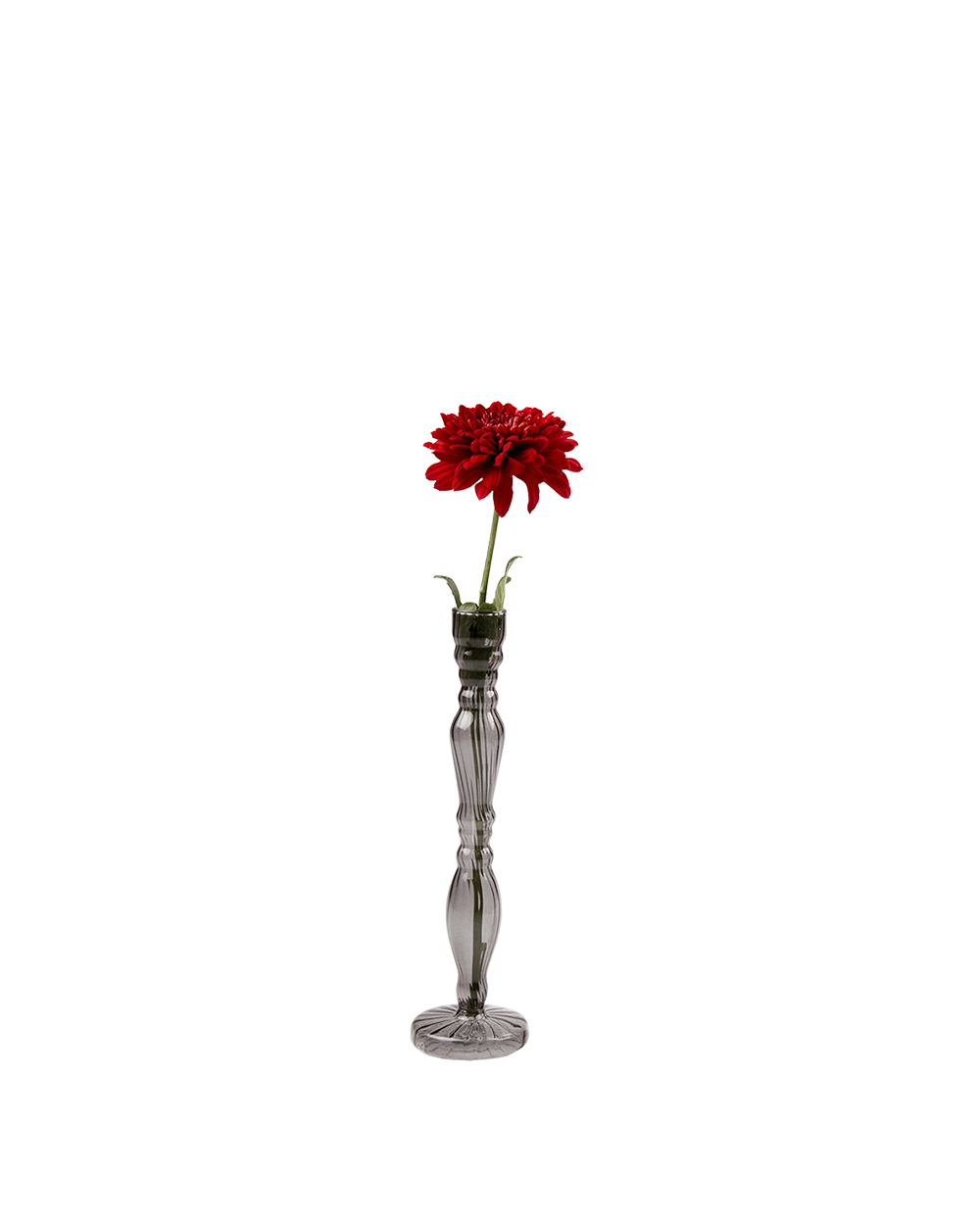
Smoke Glass Modern Flower Vase - Candelabra - handmade by Chive Studio Toronto

For A Single Evening Instead Of The Wait
The glass vases at Chive come out of the same studio habit that produced everything else here: design the object once, correctly, then resist every opportunity to complicate it. Each one holds stems. None of them hides anything. Forcing a bulb is the slowest task you can set a piece of glass, and this one is built around the waiting. For something designed around a single evening instead, look at the Candelabra Glass Vase.

A Job That Answers To Botany First

Every Chive vase is built around one decision about how flowers should stand, then finished by hand until that decision reads as obvious. Purpose-built shapes sit slightly apart from the remainder of the glass vases collection, because they answer to botany before they answer to a room. A forcing vessel carries its waist at one specific height for one specific reason, and that reason is keeping a bulb base dry while roots reach the water beneath. Nothing else here has a job that narrow. Everything else simply holds whatever you put inside it.

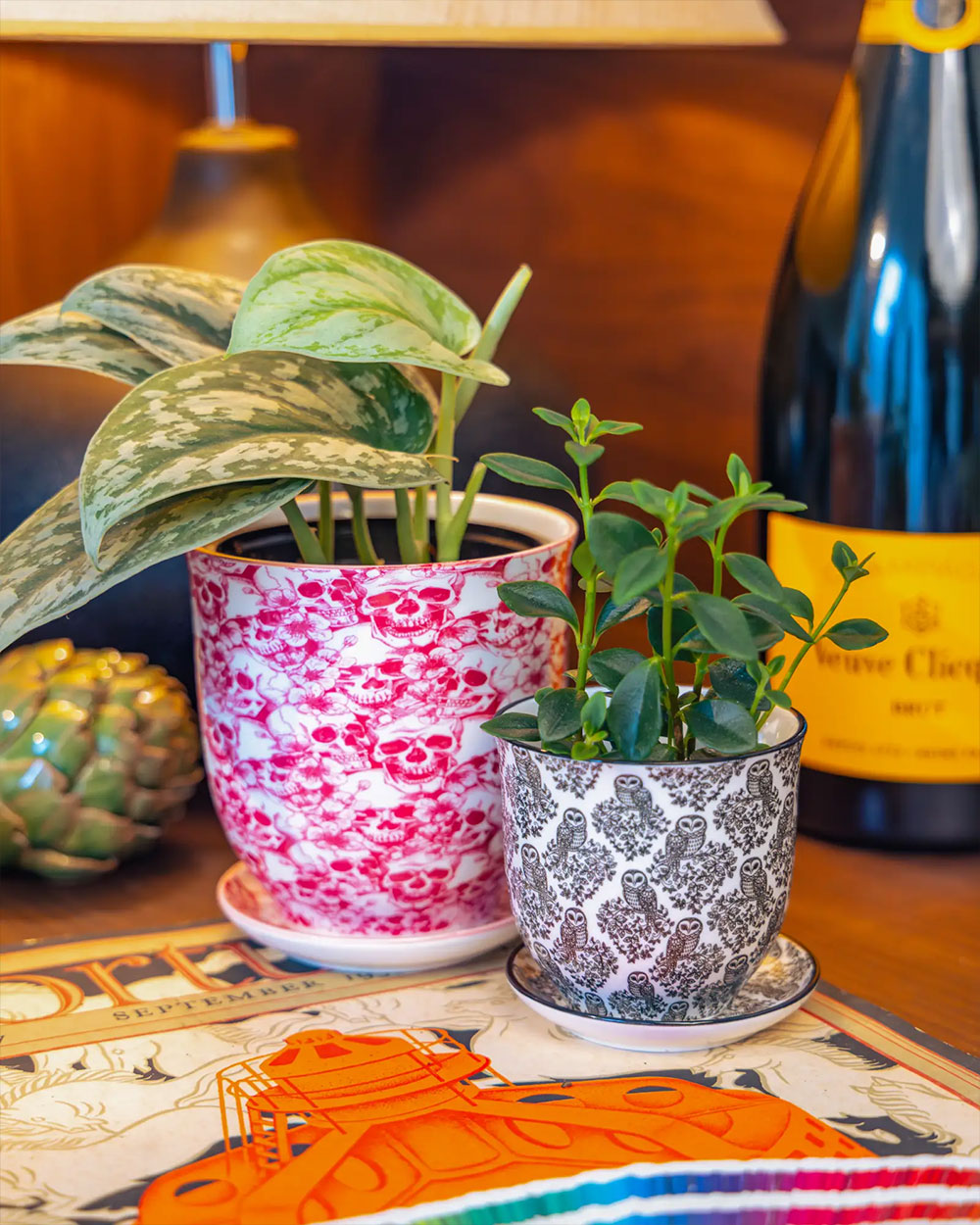
Chive Liberté planters in skull and black owls prints, styled with a silver satin pothos and peperomia on a kitchen table.

Glass For The Performance, Porcelain For Recovery
When the bulb finishes and its leaves begin going over, it wants soil. The Liberté 4-Inch Pot carries on from there, drainage underneath, so the bulb has somewhere to recover for next year. Glass for the performance, porcelain for the convalescence. Most people bin the bulb. You need not.


Objects That Show Their Workings 2004

A single strain runs through everything Chive has made since 2004, and it is a preference for objects that show you their workings. Propagation pieces are the purest expression of it. A rooting vessel, a forcing glass, a rank of cuttings along a windowsill: each turns a process that normally happens underground into something you can inspect with a cup of tea in your hand. We have never been able to leave the category alone. Every year somebody proposes a further variation on it, and every year that proposal is approved with faintly suspicious speed. Nobody has yet argued against one, which for a studio this argumentative is genuinely remarkable.


Inside the Chive Design Studio

Low maintenance, high impact. Let's make home styling look easy.

The Best 10 Styles of Vases

Jessie Duenas
The glorious world of flower vases! Because nothing says "I have my life together" quite like a carefully chosen vessel for your soon-to-be-wilting flora. Gather 'round, fell...
Read the full story

Wedding Centerpiece Vases: The Planning Guide Nobody Gives You

Jessie Duenas
Wedding centerpiece vases work best small and plural — three to seven per table, one to three stems each. A fifteen-table reception needs roughly seventy-five vases and 100 to 1...
Read the full story

Frequently asked questions

What should you look for when buying a bulb forcing vase online?

Check the waist. A proper forcing vessel narrows at a point that suspends the bulb base clear of the surface, and a great deal of what gets sold this way is simply an hourglass with its constriction in the wrong place. Ask the seller for a neck diameter and compare it against whatever you intend to grow. Hyacinth and amaryllis differ considerably. Neck size decides everything.

How many flower stems does the Bulb Forcer vase comfortably display?

One, and that is the entire premise. A forced bulb throws a single flowering spike, so the vessel was never intended to take an armful of anything. Later, once the bulb has gone over and you want to keep using the glass, that narrow neck will grip three or four short stems without much conviction. It would rather have the bulb.

Will the Bulb Forcer vase fit on a narrow shelf or ledge?

The taller version measures three and a half at its widest and rises to eight; the shorter runs broader at four and a half yet stops a little past five. Any standard kitchen shelf accepts either one. A slim picture ledge takes the short version only, and even then the bulb will overhang the front edge. Measure ledge depth first.

Is the Bulb Forcer vase's glass surface prone to marks or scratches?

Glass resists scratching from anything softer than itself, so ordinary handling leaves no trace at all. What it does show is water marks, and a forcing vessel shows them worse than most, because the level holds steady for weeks and mineral deposits build a visible ring precisely where the surface sat. Vinegar removes that ring. It always returns.

How do you clean the Bulb Forcer vase without damaging the finish?

There is no coating to damage, which simplifies matters considerably. Warm water and a soft cloth deal with everything routine. For the ring left behind by a forcing cycle, fill to just above the mark with white vinegar, leave it several hours, then wipe using cloth wrapped round a chopstick to reach the waist. Never use abrasive pads.

How do you style the Bulb Forcer vase on open shelving?

Set it at eye level or fractionally below, because the interesting activity happens underwater and nobody enjoys crouching. Leave clear headroom for the spike, which gains a foot before it flowers. Group it among books rather than further glassware, since a shelf of transparent objects becomes visual noise remarkably fast. One forcing vessel per shelf.

Is the Bulb Forcer vase larger or smaller than the Candelabra?

Broader and lower. The Candelabra is a slender branched design measuring two and a half through its body and climbing toward six, where this one squats wide, built around volume of water rather than reach of stem. They photograph as though they belong to separate lines entirely. In practice both leave the same bench. Bulk against height.

What design tradition does the Bulb Forcer vase draw from?

Dutch, unambiguously. Glass forcing vessels turn up in Netherlands household inventories from the eighteenth century onward, made when growing hyacinths indoors had become an ordinary winter occupation rather than an eccentric one. The form has scarcely altered since, which tells you it was right immediately. We adjusted the proportions slightly. Nothing more.

Ceramic astronaut vase with flowers styled on shelf — Chive Studio Toronto
Behind the Studio

The story behind the Chive astronaut vases

The story of Laika, Félicette, a solar eclipse in New York, and a space bar that ordered a hundred vases a month until it closed.