Flute Glass Modern Clear Flower Vase

Regular price $30.25
Hand Blown Glass
Dishwasher safe cleaning
30-day return policy

Build the Arrangement That Looks Harder Than It Was

Pick a vase to anchor the shelf, then add the rest until it reads as curated instead of collected.


A champagne flute vase borrows a silhouette everybody recognises and puts it to a soberer use. Originally drawn in 2003, the Flute is the oldest design the studio still makes unaltered, and a good deal of what came later was built on the confidence it bought us. It is a fluted glass vase in the plain sense of the word: narrow throat, long taper, a base wide enough to stay upright on a table that is not quite level. As a slim glass vase it suits one tall stem, a bare branch, or the two survivors of an arrangement that has otherwise given up. Nothing has been updated because nothing required updating. Twenty-three years is a long run for any object, and this one has outlasted a studio move, a catalogue rebuild and several people who felt strongly that it was time for something newer. Same glass. Same shape. Same job.

Product detail

Product Detail:

  • Material: Glass
  • Glaze finish: Translucent
  • Year Designed: 2003
Dimension
  • 14 inches long, 1.5 inches wide, 2 inches tall
Vase Care Instructions

All glass vases in this collection are dishwasher safe for easy cleaning, with one exception: mercury glass vases should be hand-washed only. The silvered mercury finish is a delicate coating rather than a solid color, and dishwasher heat and detergent can dull or strip it over time.

For standard glass vases, just load it in with the rest of the dishes — no special care needed. For mercury glass pieces, wash gently with warm water and mild soap, and dry with a soft cloth rather than letting it air dry with water spots.

Rinse and dry after each use, especially if flower food or cut-stem residue was in the water, so nothing lingers and clouds the glass.

Flowers that Love this Vase
  • Daffodil
  • Cherry Blossom
  • Daisy
  • Ranunculus
  • Columbine
  • Penstemon
  • Stock
  • Nasturtium
  • Forsythia
  • Camellia

Quick Guide to Building a Floral Arrangement

  1. Pick your vase first
  2. Start with your anchor flower.
  3. Build in odd numbers.
  4. Add height, then fill.
  5. Greenery does the quiet work.
  6. Cut stems at an angle, underwater if you can.
  7. Step back before you decide it's done.

Shipping & returns

Shipping

  • Free shipping: Orders $200+ within the US
  • Standard: 5–8 business days, Express 2–3 business days (at checkout)
  • International Ships: to 40 countries — rates at checkout
  • Packaging Ships: in outer box to protect gift box

View full shipping policy →

Returns

We accept returns within 30 days of delivery on unused items in original packaging. If your piece arrives damaged, contact us within 7 days with a photo and we will replace it at no charge.

View full return policy →

Wholesale Inquires

Have a cool shop? Know someone that does?

Find Chive on Faire →

Flute Glass Modern Clear Flower Vase - Chive Ceramics Studio - Vases - Chive US

The O List, And What It Did To Us — The Flute

The 24-hole version of this design made the O List, which for a studio our size in the early days was less a marketing win than a logistical emergency. We still have the magazine in the office. Somebody laminated the page at one point, which I found excessive at the time and now understand completely. What nobody tells you about a piece of national coverage is that the coverage is the easy part. The hard part is the following six weeks, when a two-person operation discovers exactly how many units it can physically produce in a day and then discovers that the number is not enough. We packed orders on the floor. We ran out of tissue paper twice and once wrapped a batch in newsprint, which I do not recommend and would do again. The reason this matters is that everything Chive has designed since carries a small amount of that fortnight in it: a habit of drawing objects we could actually make in quantity, rather than objects that photograph well and then ruin your month. Ambition is cheap and any studio has more of it than it needs. Capacity is the thing actually worth having, and we learned that on a floor surrounded by newsprint.

Chive Studio trimming tulip stems with scissors on a wooden surface, with white, purple, and pink tulips arranged nearby.
How to Cut Flowers Like a Pro:

A (Mostly) Simple Guide to Cutting Your Flowers

So, you’re making an arrangement? Let’s ensure it lives long enough to impress someone—even if it's just you.

  1. Scrub the Scissors: Wash your shears first. Your flowers do not want a side of Dorito dust.
  2. Cut at 45°: Snip stems at an angle. It gives them a straw instead of making them chug from the bottle.
  3. Trim Underwater (Fancy Mode): Cut them submerged to block air bubbles. It’s extra, but they didn’t ask to suffocate.
  4. Ditch Submerged Leaves: Strip anything below the waterline. Unless you are actively going for a swamp aesthetic.
  5. Snip Again if Stale: If they sat out on the counter, trim them again. They need a fresh start (don’t we all?).
  6. Swap the Water: Change it and trim the stems every few days so they don't die immediately.

Voilà! You are now a domestic deity. Go take your Instagram photo before you forget to water them.

Pro Tip: The light does half the work.

Glass catches and bends light in a way ceramic can't. Set the arrangement somewhere it'll get some late afternoon sun, even for an hour, and the water and stems start doing something a solid vase never will.

Perfect Pairs for Any Shelf
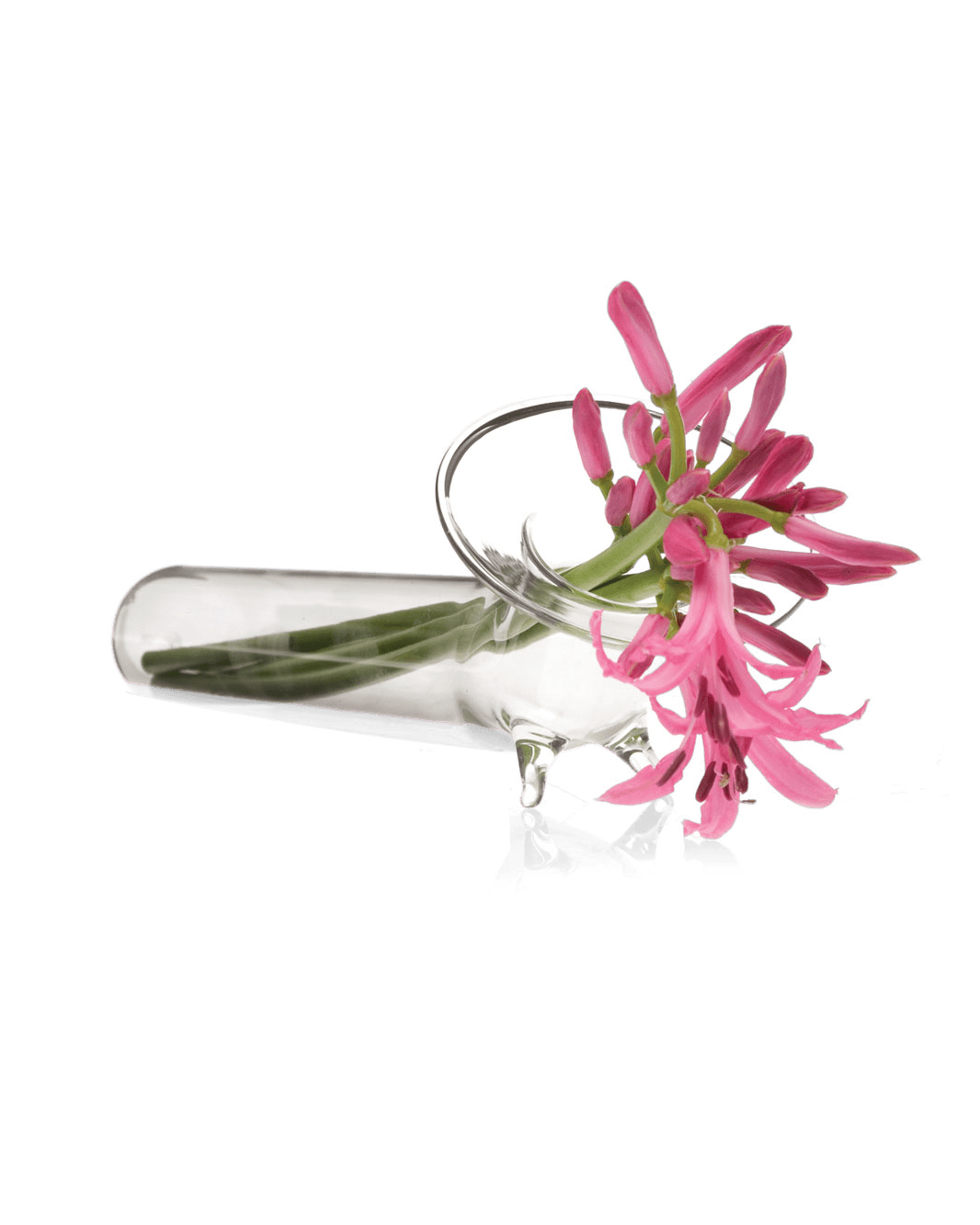
Test Tube Glass Modern Clear Flower Vase - Chive Ceramics Studio - Vases - Chive US

Two Answers To The Same Question

The glass vases at Chive come out of the same studio habit that produced everything else here: design the object once, correctly, then resist every opportunity to complicate it. Each one holds stems. None of them hides anything. A tall narrow throat and a low raised reservoir are two answers to the same question, which is why the Test Tube Glass Modern Clear Vase is shown alongside. One keeps a long stem upright at eye level. The other keeps a short stem alive for three times as long.

A Decision Made In 2003, Never Revisited
Every Chive vase is built around one decision about how flowers should stand, then finished by hand until that decision reads as obvious. For this piece the decision was height, taken in 2003 and never revisited, because a single long stem needs nothing except somewhere stable to stand. Everywhere else in the range that same discipline lands somewhere entirely different: on a wall, on a magnet, under a suspended bulb, across a rack of openings at fixed intervals. What holds the range together is that no piece here was drawn to complement another. Each was drawn to finish something, and the family resemblance arrived afterwards, unplanned.

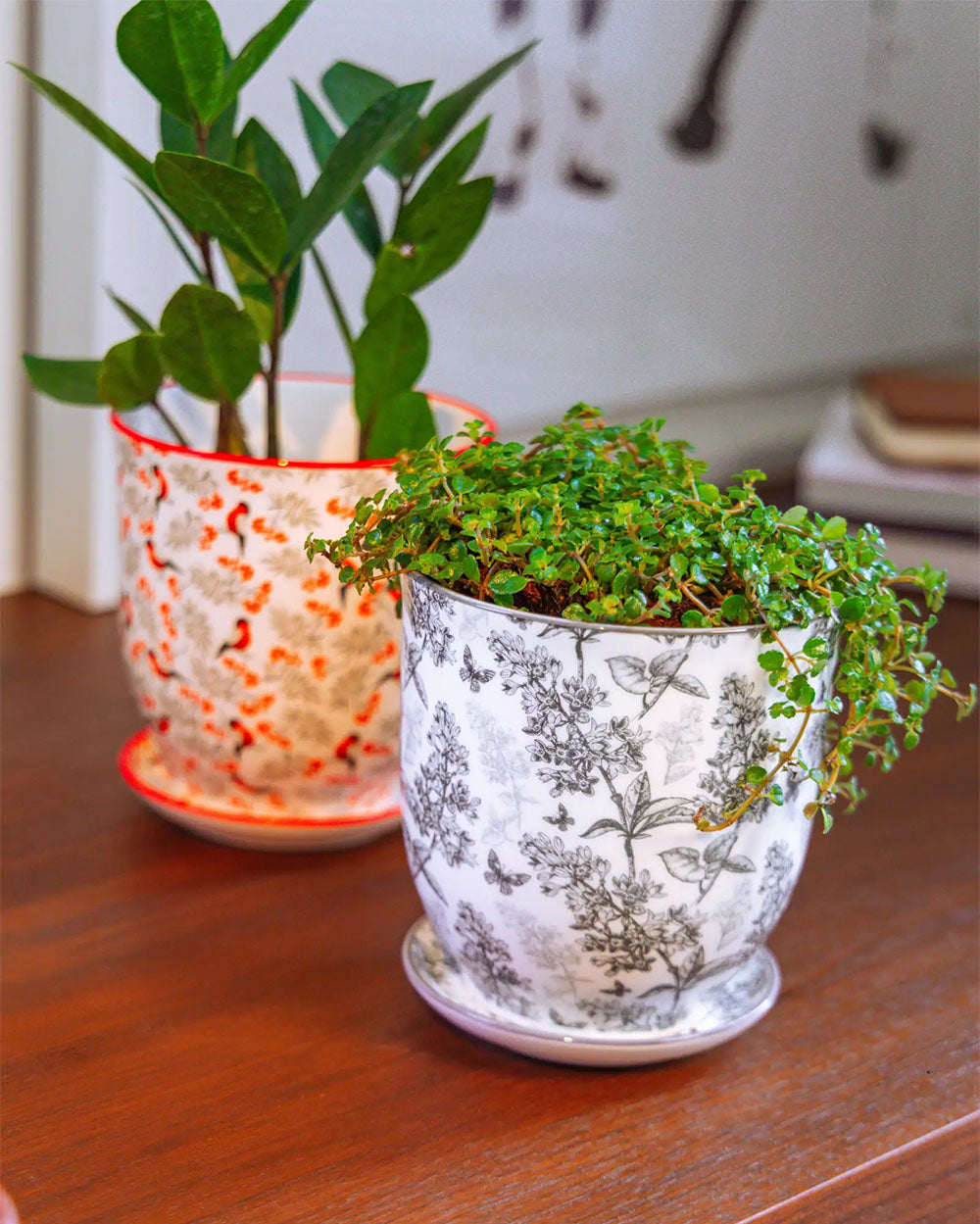
Chive Liberté small planters in grey forest and red birds prints, styled with baby tears and a ZZ plant on a wood surface.

Fourteen Inches Wants A Counterweight
Fourteen inches of glass wants something squat underneath it, and a Liberte 3-Inch Pot is the right counterweight. Porcelain low and left, glass tall and right, and the eye travels between them instead of stopping at either. Height on its own reads as a mistake.


Designs That Outlast Their Decade

Chive began in 2004 and this shape predates the company by a year, which makes it the oldest thing we sell and the only object here older than the business selling it. It has never been redrawn. That is not sentimentality on our part; there has simply been no complaint to answer and no problem to solve, and revising a working object to look current is how studios end up with catalogues full of nearly-good pieces. We design our own work, make it ourselves, and retire nothing that still does its job. A few things here have been in continuous production for over two decades. This is the first of them.


Inside the Chive Design Studio

Low maintenance, high impact. Let's make home styling look easy.

Wedding Centerpiece Vases: The Planning Guide Nobody Gives You

Jessie Duenas
Wedding centerpiece vases work best small and plural — three to seven per table, one to three stems each. A fifteen-table reception needs roughly seventy-five vases and 100 to 1...
Read the full story

The Best 10 Styles of Vases

Jessie Duenas
The glorious world of flower vases! Because nothing says "I have my life together" quite like a carefully chosen vessel for your soon-to-be-wilting flora. Gather 'round, fell...
Read the full story

Frequently asked questions

What is a Champagne Flute Vase and what sets it apart?

The term describes a vessel that borrows the proportions of a drinking flute, narrow bore rising from a stable base, and most examples are decorative rather than useful. This one is genuinely functional at 14 inches with a bore of an inch and a half, which is deep enough to hold a long stem without packing or support. It is also the oldest design we make. Drawn in 2003, unchanged.

Which stems suit the Flute vase's opening and proportions best?

Long single stems and bare branches, since anything short simply vanishes down the bore. Daffodil is the classic answer in spring and cherry blossom the better one, because branching reads well against a narrow column. Camellia works if you strip the lower leaves. Ranunculus needs a wire or it will bend at the neck. Forsythia is close to unbeatable in March.

Is the Flute vase sized for a windowsill or a mantel?

A mantel, and not a windowsill, because 14 inches will foul most sash windows before it is halfway open. Depth is not the constraint here; height is. It wants somewhere with clearance above and a surface deep enough that a knock will not send it over, so a mantel, a console or a bookshelf all work. Check the clearance before you buy.

What glass quality can you expect from the Flute vase?

Clear glass with a wall gauge chosen for the height rather than for the look, which matters more here than on any short piece we make. A column this tall with a thin wall becomes a hazard the first time somebody brushes past it, so the base carries deliberate extra weight to keep the centre of gravity low. Nothing on it is coated or printed at any stage. It is glass throughout.

Does the Flute vase need special care between flower arrangements?

It does, more than the shorter pieces, and the reason is the bore. A narrow column holds a waterline in one place for days, and minerals build a visible ring at exactly that height which gets harder to shift the longer it sits. Run a long brush down it after every arrangement while the deposit is still soft. Waiting a month makes it permanent.

How do you group the Flute vase with other Chive pieces?

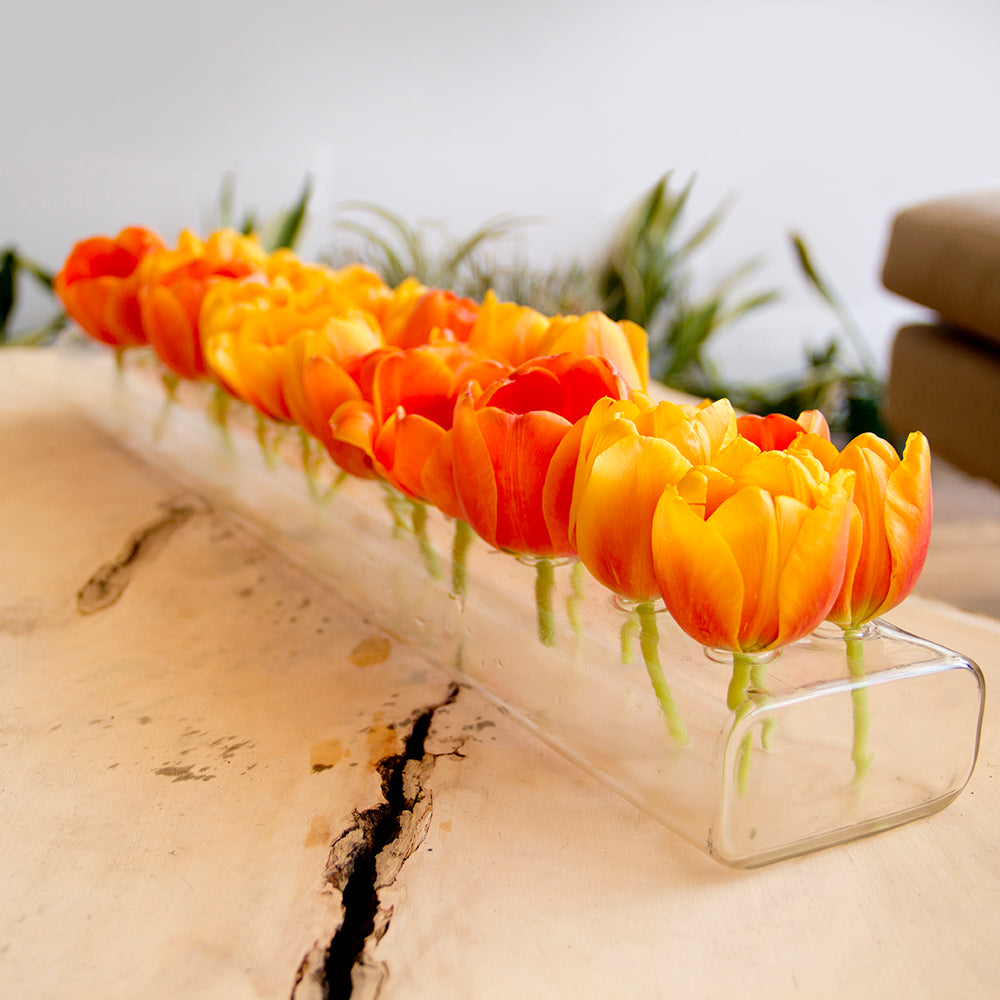
With something low, always. Two tall pieces on one surface fight each other and neither wins, so stand this beside a wide shallow container or one of our porcelain pots and let the difference in height do the composition. The 24-hole rack from the same family is the exception. Same silhouette, multiplied sideways.

Should you choose the Flute vase or the Footed Tube vase first?

Buy this one first if your flowers arrive long and the Footed Tube first if they arrive short, because that single question settles it faster than any comparison of price or looks. Most people cut stems shorter than they think. Ask yourself what you actually bring home on a Friday. Then buy accordingly.

Why is it called the Flute vase and what's the story?

The name is descriptive rather than clever, since the silhouette is a drinking flute scaled up until it could hold a branch. The story attached to it is better than the name: the multi-hole version of this same design was picked up by a national magazine early on, and the resulting six weeks taught a very small studio what capacity means. We still have that issue. Somebody laminated it.

Ceramic astronaut vase with flowers styled on shelf — Chive Studio Toronto
Behind the Studio

The story behind the Chive astronaut vases

The story of Laika, Félicette, a solar eclipse in New York, and a space bar that ordered a hundred vases a month until it closed.