Hanging Airplane Cable & Glass Flower Vase

Regular price $24.75
Sizes
Hand Blown Glass
Dishwasher safe cleaning
30-day return policy

Build the Arrangement That Looks Harder Than It Was

Pick a vase to anchor the shelf, then add the rest until it reads as curated instead of collected.


An airplane vase is a decision about vertical space rather than a decision about an object, which is why the figure that matters here is overall drop. One tube gives you 12 inches from hook to base. Three tubes give you 20. Five tubes give you 30, and 30 inches above a console table is a different room. Each glass tube is three quarters of an inch wide, so the arithmetic is one stem per tube and no negotiating. As a cable hanging vase the hardware is aircraft cable, chosen because it will not fray, will not stretch, and will not gradually lengthen over a year the way cheaper wire does. The glass was the easy part. As a suspended glass vase it asks only that you commit to a hook, which in our experience is the actual obstacle. Measuring twice before drilling once, most people work out that they wanted the five.

Product detail

Product Detail:

  • Material: Glass
  • Glaze finish: Translucent
  • Year Designed: 2008
Dimension
  • 1 Tube Wire: 6 inches long, 0.75 inches wide (for the tube) - 12 inches overall length, 
  • 3 Tube Wire: is 4 inches long x 0.75 inches wide (for the tubes) - 20 inches overall length
  •  5 Tube Wire: is 4 inches long, 0.75 inches wide (for the tubes) - 30 inches overall length.
Vase Care Instructions

All glass vases in this collection are dishwasher safe for easy cleaning, with one exception: mercury glass vases should be hand-washed only. The silvered mercury finish is a delicate coating rather than a solid color, and dishwasher heat and detergent can dull or strip it over time.

For standard glass vases, just load it in with the rest of the dishes — no special care needed. For mercury glass pieces, wash gently with warm water and mild soap, and dry with a soft cloth rather than letting it air dry with water spots.

Rinse and dry after each use, especially if flower food or cut-stem residue was in the water, so nothing lingers and clouds the glass.

Flowers that Love this Vase
  • Zinnia
  • Ranunculus
  • Peony
  • Marigold
  • Strawflower
  • Statice
  • Hellebore
  • Coneflower
  • Bells of Ireland
  • Primrose

Quick Guide to Building a Floral Arrangement

  1. Pick your vase first
  2. Start with your anchor flower.
  3. Build in odd numbers.
  4. Add height, then fill.
  5. Greenery does the quiet work.
  6. Cut stems at an angle, underwater if you can.
  7. Step back before you decide it's done.

Shipping & returns

Shipping

  • Free shipping: Orders $200+ within the US
  • Standard: 5–8 business days, Express 2–3 business days (at checkout)
  • International Ships: to 40 countries — rates at checkout
  • Packaging Ships: in outer box to protect gift box

View full shipping policy →

Returns

We accept returns within 30 days of delivery on unused items in original packaging. If your piece arrives damaged, contact us within 7 days with a photo and we will replace it at no charge.

View full return policy →

Wholesale Inquires

Have a cool shop? Know someone that does?

Find Chive on Faire →

Hanging Airplane Cable & Glass Flower Vase - Chive Ceramics Studio - Vases - Chive US

Six Hours of Twisting Wire, and a Line Came Out of It — The Airplane

Todd once agreed to help build a wall of flowers for somebody's wedding, which sounded like a favour and turned out to be six hours on a stepladder twisting wire around test tubes. Wire, it turns out, has opinions. It kinks where you do not want it to, springs back at the moment you let go, and cuts a thin line across the pad of your thumb roughly every forty minutes. By hour four he had stopped thinking about the flowers entirely and started thinking about the hardware, which is the point at which most of what we sell gets invented. The problem was never the tube. Anybody can hang a tube. The problem was that every cheap way of hanging one either fails visibly or fails slowly, and the slow failure is worse, because a wire that lengthens by a quarter inch over two years leaves a row of tubes at five different heights and nobody can tell you why. Aircraft cable solved it in an afternoon of testing. The wedding wall came down the next morning and nobody kept a photograph of it. The line it produced has been in continuous production since 2008, and the tubes still hang level.

Chive Studio trimming tulip stems with scissors on a wooden surface, with white, purple, and pink tulips arranged nearby.
How to Cut Flowers Like a Pro:

A (Mostly) Simple Guide to Cutting Your Flowers

So, you’re making an arrangement? Let’s ensure it lives long enough to impress someone—even if it's just you.

  1. Scrub the Scissors: Wash your shears first. Your flowers do not want a side of Dorito dust.
  2. Cut at 45°: Snip stems at an angle. It gives them a straw instead of making them chug from the bottle.
  3. Trim Underwater (Fancy Mode): Cut them submerged to block air bubbles. It’s extra, but they didn’t ask to suffocate.
  4. Ditch Submerged Leaves: Strip anything below the waterline. Unless you are actively going for a swamp aesthetic.
  5. Snip Again if Stale: If they sat out on the counter, trim them again. They need a fresh start (don’t we all?).
  6. Swap the Water: Change it and trim the stems every few days so they don't die immediately.

Voilà! You are now a domestic deity. Go take your Instagram photo before you forget to water them.

Pro Tip: The light does half the work.

Glass catches and bends light in a way ceramic can't. Set the arrangement somewhere it'll get some late afternoon sun, even for an hour, and the water and stems start doing something a solid vase never will.

Perfect Pairs for Any Shelf
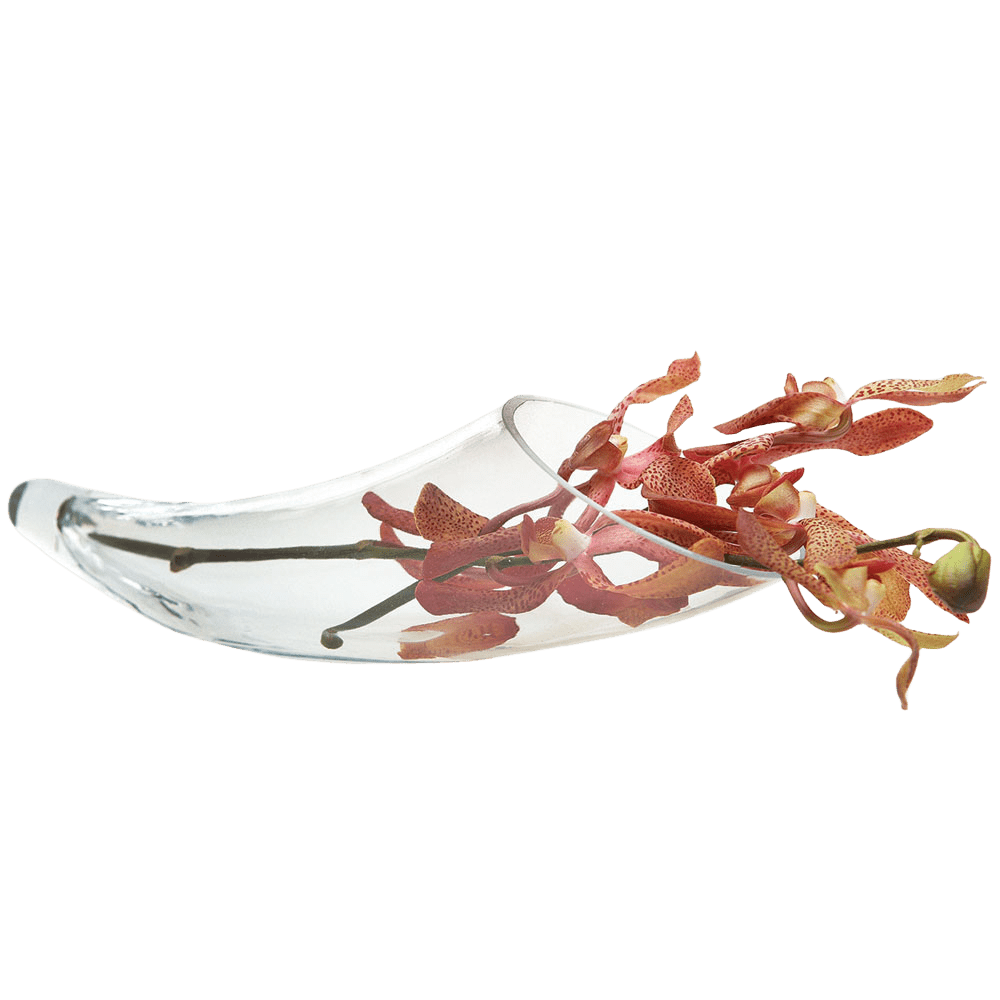
Horn Glass Modern Clear Flower Vase - Chive Ceramics Studio - Vases - Chive US

The Opposite View, Lying On Its Side

The glass vases at Chive come out of the same studio habit that produced everything else here: design the object once, correctly, then resist every opportunity to complicate it. Each one holds stems. None of them hides anything.

This is the only piece in the range that never touches a surface, which makes every decision about it a decision about height. For the same problem solved along a table instead of down a wall, the Horn Glass Modern Clear Vase lies on its side and takes the opposite view entirely.

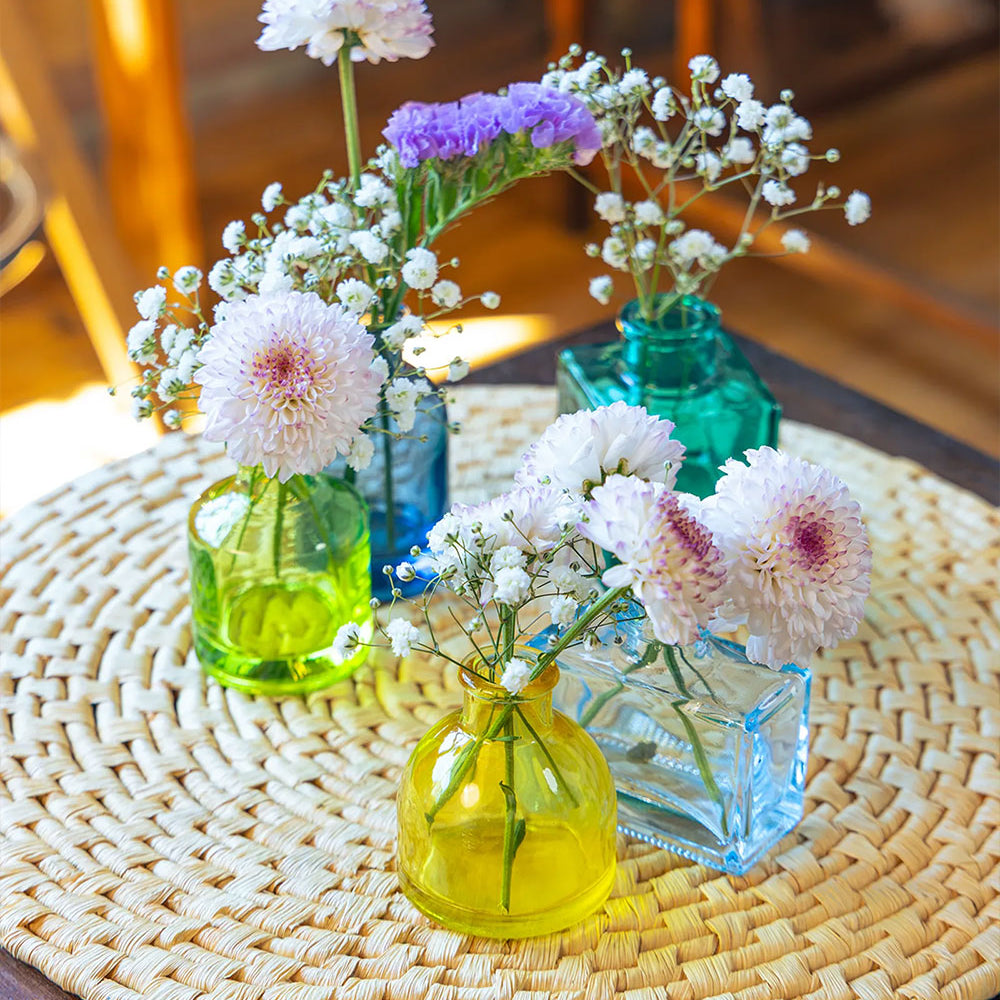
Chive Loft glass bud vase set in assorted shapes and colors on a table mat, each styled with flowers.

The Cable Was Specified Before The Glass
Every Chive vase is built around one decision about how flowers should stand, then finished by hand until that decision reads as obvious.

Here the decision was made twice: once about the tube, which is narrow enough to accept exactly one stem, and once about what holds it up. Steel aircraft cable was specified before the glass was, because the failure everybody eventually has with a hung object is never the vessel. It is the thing the vessel is attached to. Cable does not fray, stretch or sag on a schedule. Elsewhere in the glass range the arguments are quieter.

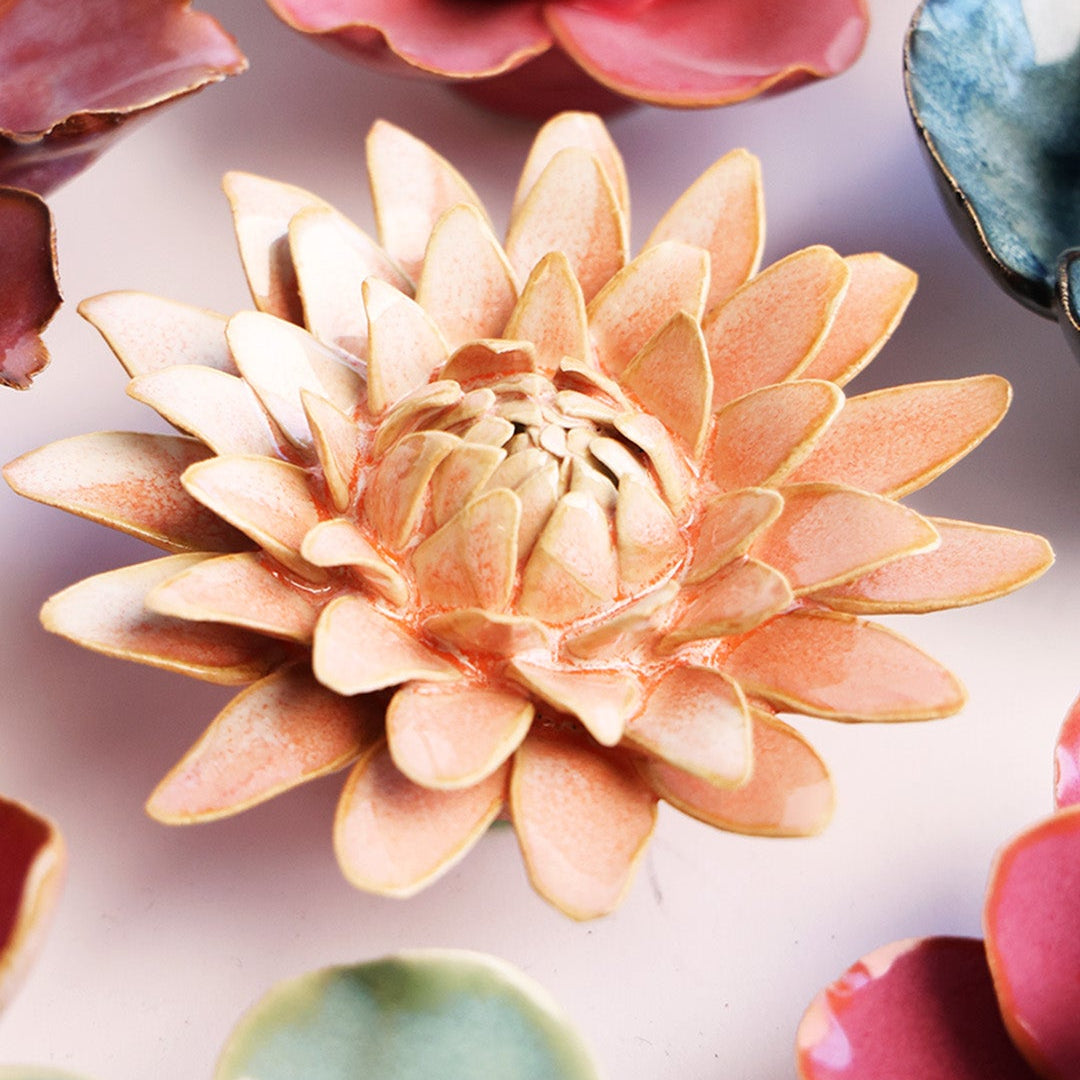
Peach Pink Strawflower ceramic wall flower styled on a white table with other flowers — Chive Studio

A Wall With Two Things Looks Finished
A Peach Pink Strawflower belongs on the same wall for the obvious reason: both are objects that hang, and a wall with one thing on it looks unfinished in a way that a wall with two does not. Strawflower is also on this vase's own flower list, which was not planned. It reads as though it were.


The Parts Nobody Photographs Get Specified Too

Since 2004 the working assumption here has been that the part nobody photographs decides whether an object survives ownership. Glass is the easy half. The hard half is the hook, the cable, the crimp at the top, the question of what happens to any of that after four years in a room with a kettle in it. So those parts get specified with the same argument and the same sampling as the visible ones, and the assembly happens on this floor rather than arriving bought in as a set and trusted. It is an unglamorous discipline and it never appears in a photograph. It is the reason we still sell a design drawn eighteen years ago.


Inside the Chive Design Studio

Low maintenance, high impact. Let's make home styling look easy.

Wedding Centerpiece Vases: The Planning Guide Nobody Gives You

Todd Newgren
Wedding centerpiece vases work best small and plural — three to seven per table, one to three stems each. A fifteen-table reception needs roughly seventy-five vases and 100 to 1...
Read the full story

The Best 10 Styles of Vases

Jessie Duenas
The glorious world of flower vases! Because nothing says "I have my life together" quite like a carefully chosen vessel for your soon-to-be-wilting flora. Gather 'round, fell...
Read the full story

Frequently asked questions

What is an airplane vase and when would you actually use one?

It is a set of glass tubes hung from lengths of aircraft cable, and the cable is where the name comes from. You use one where there is no surface to use: a window with no sill, a stairwell, the wall above a counter where anything freestanding gets knocked into a sink. The case for it comes down to one sentence: there was no shelf, and now there are flowers. Nothing else here does that.

Which stems suit the Airplane vase's opening and proportions best?

The bore measures 0.75 inches, which permits a single stem and nothing with a thick woody base. Zinnia, ranunculus, statice, coneflower, bells of Ireland: all correct. Weight decides more than width does here, since a heavy head on a long stem will swing and then settle crooked. A peony is the exception everyone attempts regardless. Keep the heads small.

Is the Airplane vase sized for a windowsill or a mantel?

Neither, since it does not sit on anything at all. What you are actually choosing is drop: 12 inches overall for the single tube, 20 for the three, 30 for the five. Measure down from the hook and check what the lowest tube clears. Above a kitchen counter the single tube is usually the right answer. In a stairwell the five earns its length.

What glass quality can you expect from the Airplane vase?

Clear tube stock with a rolled lip and a closed rounded base, rather than cut ends that leave an edge you discover later with a finger. Wall thickness stays even down the length, which matters because unevenness shows as a visible ripple once there is water behind it. No pattern, no tint and nothing printed anywhere on it. The tube is plain deliberately.

Does the Airplane vase need special care between flower arrangements?

The glass needs nothing unusual. The cable does. Dry it whenever you empty the tubes, because water running down twisted steel sits in the lay of it and will mark the surface over a few years. Check the hook each spring as well, since it carries considerably more weight full than empty. The tubes take soap and a rinse.

How do you group the Airplane vase with other Chive pieces?

Vertically, and with something solid underneath. A hung piece on its own tends to read as an installation somebody abandoned halfway. Put a low ceramic vessel or a pot on the surface below it so the eye has two stops rather than one. A second Airplane at a different drop on the same wall also works. A third starts looking like shop fitting.

How does the Airplane vase compare with the Horn vase in person?

They are opposites that happen to share a material. The Horn lies flat in its cradle and puts an entire stem under water on a low surface; this one hangs from cable and puts the stem in the air with an inch of water underneath it. One is a table object and one is a wall object. In photographs the two look like close relatives. In a room they are not.

What is a airplane vase and when would you actually use one?

The cable is aircraft cable, and the piece takes its name from the material rather than from anything decided in a meeting. It was specified for reasons that hold up: aircraft cable will not fray at a cut end, does not stretch under a static load, holds a bend without kinking, and cheaper wire fails at every one of those. The glass was never the hard part.

Ceramic astronaut vase with flowers styled on shelf — Chive Studio Toronto
Behind the Studio

The story behind the Chive astronaut vases

The story of Laika, Félicette, a solar eclipse in New York, and a space bar that ordered a hundred vases a month until it closed.