Jordan Glass Modern Flower Vase

Regular price $33.00
Colors: Milk
Hand Blown Glass
Dishwasher safe cleaning
30-day return policy

Build the Arrangement That Looks Harder Than It Was

Pick a vase to anchor the shelf, then add the rest until it reads as curated instead of collected.


An oval vase changes what your hands have to do, because the arranging happens at the rim rather than in your fingers. The Jordan runs 5.5 inches across and 3 inches tall, wider than it is high, which is unusual enough that people pick it up to check. Stems fall outward and rest on the edge, holding whatever angle the rim gives them, so a handful of anemones or tulips settles into a low dome without being coaxed. Mostly this means you can set it on a dining table and still see the person across from you. A jordan vase in translucent white glass keeps the flowers as the coloured part, since the vessel stays pale and lets the stems do the talking. An oval glass vase this shallow wants filling to the brim, because the water is what holds the splay in place. Your side of the table stays visible, which is more than most centrepieces manage.

Product detail

Product Detail:

  • Material: Glass
  • Glaze finish: Translucent
  • Year Designed: 2012
Dimension
  • 5.5 inches diameter, 3 inches tall
Vase Care Instructions

All glass vases in this collection are dishwasher safe for easy cleaning, with one exception: mercury glass vases should be hand-washed only. The silvered mercury finish is a delicate coating rather than a solid color, and dishwasher heat and detergent can dull or strip it over time.

For standard glass vases, just load it in with the rest of the dishes — no special care needed. For mercury glass pieces, wash gently with warm water and mild soap, and dry with a soft cloth rather than letting it air dry with water spots.

Rinse and dry after each use, especially if flower food or cut-stem residue was in the water, so nothing lingers and clouds the glass.

Flowers that Love this Vase
  • Orchid
  • Tulip
  • Lisianthus
  • Anemone
  • Celosia
  • Veronica
  • Coneflower
  • Queen Anne's Lace
  • Viola
  • Flowering Dill

Quick Guide to Building a Floral Arrangement

  1. Pick your vase first
  2. Start with your anchor flower.
  3. Build in odd numbers.
  4. Add height, then fill.
  5. Greenery does the quiet work.
  6. Cut stems at an angle, underwater if you can.
  7. Step back before you decide it's done.

Shipping & returns

Shipping

  • Free shipping: Orders $200+ within the US
  • Standard: 5–8 business days, Express 2–3 business days (at checkout)
  • International Ships: to 40 countries — rates at checkout
  • Packaging Ships: in outer box to protect gift box

View full shipping policy →

Returns

We accept returns within 30 days of delivery on unused items in original packaging. If your piece arrives damaged, contact us within 7 days with a photo and we will replace it at no charge.

View full return policy →

Wholesale Inquires

Have a cool shop? Know someone that does?
Find Chive on Faire →

Jordan Glass Modern Flower Vase - Chive Ceramics Studio - Vases - Chive Ceramics Studio

In Clear Glass It Was Nothing at All — The Jordan

The first Jordan was clear, and clear was a mistake. A shallow oval in clear glass is very close to invisible: you see the water, you see the stems, you see the table through all of it, and the shape you spent four months arguing about registers on nobody. Todd brought a sample home, put it on his own table with tulips in it, and reported back that his family had walked past it for a week without noticing there was a new object in the room. That is a hard result to argue with. The second version went pale, and everything changed, because a wide flat oval in translucent white reads as a deliberate line across a surface rather than as an absence with flowers standing in it. The colour was never the point. The colour was what made the point visible, which is a distinction worth holding onto, since a great many objects get coloured for the opposite reason. The clear prototypes are still in a cupboard here. Someone suggests reviving them roughly once a year. It has not happened yet, and the objection each time is the same one Todd's family made without meaning to. An object nobody notices is not a quiet object. It is an absent one.

Chive Studio trimming tulip stems with scissors on a wooden surface, with white, purple, and pink tulips arranged nearby.
How to Cut Flowers Like a Pro:

A (Mostly) Simple Guide to Cutting Your Flowers

So, you’re making an arrangement? Let’s ensure it lives long enough to impress someone—even if it's just you.

  1. Scrub the Scissors: Wash your shears first. Your flowers do not want a side of Dorito dust.
  2. Cut at 45°: Snip stems at an angle. It gives them a straw instead of making them chug from the bottle.
  3. Trim Underwater (Fancy Mode): Cut them submerged to block air bubbles. It’s extra, but they didn’t ask to suffocate.
  4. Ditch Submerged Leaves: Strip anything below the waterline. Unless you are actively going for a swamp aesthetic.
  5. Snip Again if Stale: If they sat out on the counter, trim them again. They need a fresh start (don’t we all?).
  6. Swap the Water: Change it and trim the stems every few days so they don't die immediately.

Voilà! You are now a domestic deity. Go take your Instagram photo before you forget to water them.

Pro Tip: The light does half the work.

Glass catches and bends light in a way ceramic can't. Set the arrangement somewhere it'll get some late afternoon sun, even for an hour, and the water and stems start doing something a solid vase never will.

Perfect Pairs for Any Shelf

Lantern Glass Unique Flower Vase - Chive Ceramics Studio - Vases - Chive US

Drawn Along The Opposite Axis

The glass vases at Chive come out of the same studio habit that produced everything else here: design the object once, correctly, then resist every opportunity to complicate it. Each one holds stems. None of them hides anything.

Wider than tall is an unusual proportion to commit to, and this piece has held it since 2012 without adjustment. If the requirement runs the other way, toward a closed form in a strong colour, the Lantern Glass Unique Flower Vase is drawn along the opposite axis entirely.

Chive Loft glass bud vase set in assorted shapes and colors on a table mat, each styled with flowers.

Nothing Should Interrupt The Sightline
Every Chive vase is built around one decision about how flowers should stand, then finished by hand until that decision reads as obvious.

The decision on this one was height, or the refusal of it. Nothing on a dining table should interrupt a sightline, so the whole vessel was held to three inches and the width allowed to run instead, which puts the arranging at the rim where stems can rest rather than in a bunch you have to build with your hands. The water holds the angle. Taller decisions in the glass range are shelved alongside it.

Somewhere For The Bottom Third Of The Row
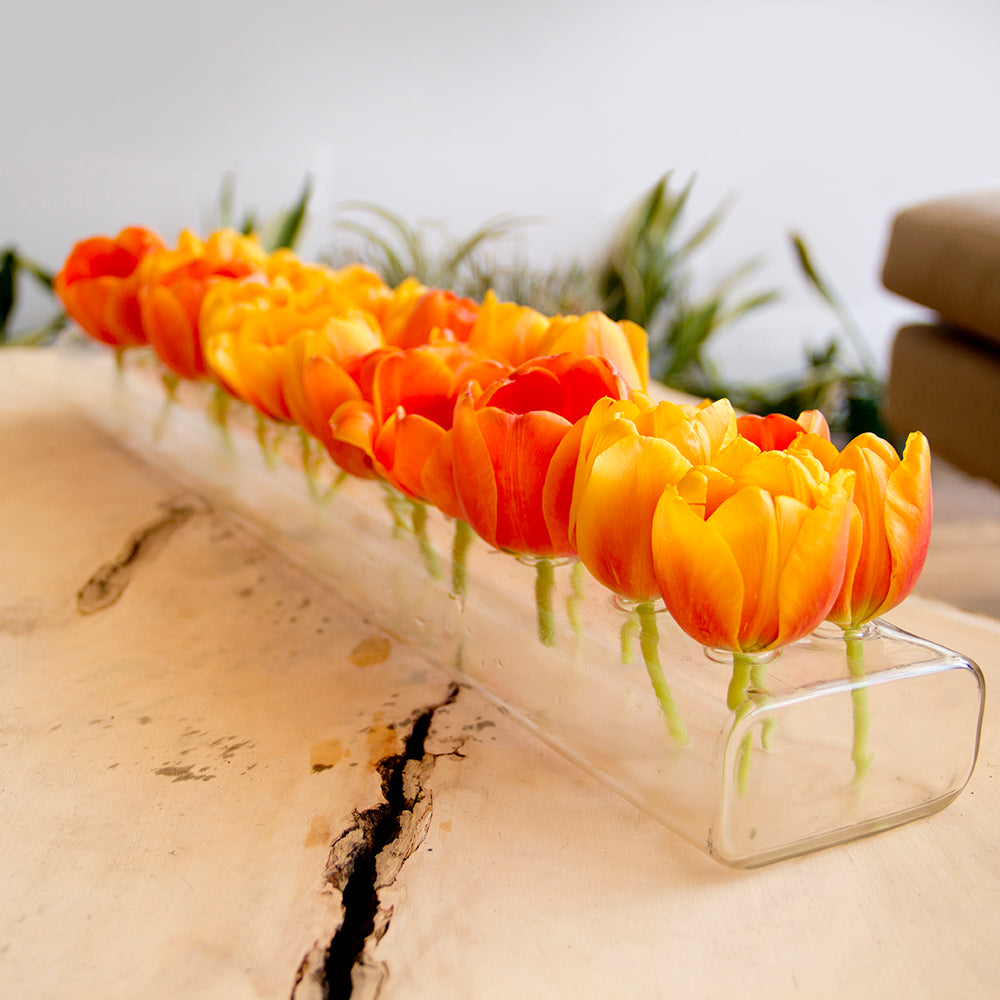
A packet of Snapdragon Flower Seeds is an odd companion for a three-inch vessel until you have grown snapdragons, at which point you will have more spikes than any tall vase can take and a genuine need for somewhere to put the short ones. Cut them low. This is where the bottom third of the row ends up.


We Argue About Colour, Then Make Both

Since 2004 the arguments in this studio have been about color and surface far more often than about shape. Shape tends to settle: somebody draws it, somebody objects, the objection is either right or it is not, and a week later there is a decision. Colour never settles that way, because everybody in the room is confident and nobody can prove anything, so the practice here has become to stop debating and make both. Two samples, same shape, different treatment, sitting side by side on a bench where the answer is usually obvious within a minute. All of it drawn, sampled and finished in-house, bench to bench, which is what makes the experiment affordable. Talking is the expensive part.


Inside the Chive Design Studio

Low maintenance, high impact. Let's make home styling look easy.

The Best 10 Styles of Vases

Jessie Duenas
The glorious world of flower vases! Because nothing says "I have my life together" quite like a carefully chosen vessel for your soon-to-be-wilting flora. Gather 'round, fell...
Read the full story

Wedding Centerpiece Vases: The Planning Guide Nobody Gives You

Jessie Duenas
Wedding centerpiece vases work best small and plural — three to seven per table, one to three stems each. A fifteen-table reception needs roughly seventy-five vases and 100 to 1...
Read the full story

Frequently asked questions

What is an oval vase and what sets the Jordan apart?

An oval vase is one whose opening runs longer in one direction than the other, so stems spread along an axis rather than gathering into a circle. This takes the idea further than most: it is wider than it is tall, three inches high and five and a half across, so the rim ends up doing the arranging. Stems rest on the edge. Nothing stands up straight.

Can the Jordan vase hold dried stems as well as fresh?

It will, though the result looks different and it is worth knowing that before you order. Fresh stems are held partly by the water; remove the water and dried material keeps whatever angle it already had, which in a shallow oval means it splays wider and reads thin. Use noticeably more of it than you would fresh. Twice as much, roughly.

How much water does the Jordan vase hold when filled?

Not much, and the proportions explain why: three inches of depth over a broad footprint gives a wide shallow reservoir instead of a deep one. Fill it to the rim, because the water is part of what holds each stem at its angle. It also evaporates faster than a tall vessel does, the exposed surface being so large. Top it up every morning.

Why was glass chosen for the Jordan vase's construction?

Because the wall has to change thickness within a single piece. A wide shallow bowl with no foot needs weight underneath or it slides on a table, and it needs a fine rim or the edge looks clumsy where stems cross it. Glass delivers both from one gather: heavy below, thin at the lip. A ceramic version would need a foot. That would ruin the line.

Can you remove hard water marks from the Jordan vase easily?

Yes, though you will spot them later than you would on clear stock, and that is worth knowing. On translucent white the mineral film builds as a dull haze rather than a hard ring, so it hides in the colour of the glass until it is fairly advanced. A rinse and a cloth take it off easily enough once noticed. Hold it up to a window monthly.

Where does the Jordan vase look best in a modern room?

On a dining table, which is the one place most vases quietly fail. Three inches of height means nobody is conducting a conversation around it, and a modern table tends to be a long uninterrupted plane that wants breaking up without being blocked. Put it dead centre. On a sideboard it disappears against the depth of the surface. Tables are its room.

Should you choose the Jordan vase or the Lantern vase first?

Start here if you buy flowers and with the Lantern if you buy objects. This is a working shape: low, wide, pale, meant to be filled and refilled and to stay out of the conversation entirely. The Lantern is blue and closed and holds views about what goes into it. One of them is infrastructure and the other is a decision. Buy the infrastructure first.

When did the Chive studio team design the Jordan vase?

In 2012, the brief arrived as a number rather than as a shape: nothing on this table taller than four inches. That was the constraint Todd came back with after a dinner where the flowers had been in the way all evening and nobody could quite articulate why. What came out of it was three inches tall and a good deal wider than that. Constraints make better briefs than ideas.

Ceramic astronaut vase with flowers styled on shelf — Chive Studio Toronto
Behind the Studio

The story behind the Chive astronaut vases

The story of Laika, Félicette, a solar eclipse in New York, and a space bar that ordered a hundred vases a month until it closed.