Swayzak Ceramic Dish For Ikebana Kenzans

Regular price $15.50
Colors: Blush
Thoughtfully Designed
Dishwasher safe cleaning
30-day return policy

Build the Arrangement That Looks Harder Than It Was

Pick a vase to anchor the shelf, then add the rest until it reads as curated instead of collected.


A kenzan needs somewhere to actually sit, and the Swayzak dish is built specifically for that job rather than repurposed from a bowl that happened to be lying around. At 4.25 inches wide, 2 inches long, and 1 inch tall, it holds a kenzan level and steady while stems get arranged, keeping enough water underneath to stay hydrated without wasting depth the pins don't actually reach. Ceramic gives the dish real weight, which matters once an arrangement leans or a stem pulls at an angle the kenzan has to resist. Unlike improvising with mismatched bowls or teacups pulled from a cupboard, a dedicated dish means one consistent, stable base every time an arrangement gets built. It's a quiet piece, doing exactly one job and disappearing beneath the flowers once everything's in place — which is really the entire design goal for something meant to be functional rather than decorative on its own.

Product detail
  • Material: Ceramic
  • Glaze finish: Glazed
  • Year Designed: 2013
Dimension
  • 4.25" width, 2" length, and 1" tall
Flowers that Love this Floral Frogs

Quick Guide to Building a Ikebana Floral Arrangement

  1. Choose a low, open vessel
  2. Set the frog before anything else
  3. Place the main line first
  4. Add the second and third lines
  5. Fill in sparingly
  6. Step back before deciding it's finished
  7. Reset the frog between arrangements

Shipping & returns

Shipping

  • Free shipping: Orders $200+ within the US
  • Standard: 5–8 business days, Express 2–3 business days (at checkout)
  • International Ships: to 40 countries — rates at checkout
  • Packaging Ships: in outer box to protect gift box

View full shipping policy →

Returns

We accept returns within 30 days of delivery on unused items in original packaging. If your piece arrives damaged, contact us within 7 days with a photo and we will replace it at no charge.

View full return policy →

Wholesale Inquires

Have a cool shop? Know someone that does?
Find Chive on Faire →

Kenzan Metal Floral Frogs For Ikebana - Chive Ceramics Studio - Tools & Accessories - Chive Ceramics Studio

The Story Behind the Swayzak Ceramic Dish

My mother arranged flowers in teacups — not one, a rotating population of them, orphans adopted off neighbors over decades, no two matching, until the room looked less like a flower display and more like an episode about people who can't stop accumulating things. I love her. I could not live like that. The Swayzak exists because the flowers are supposed to be the focus, not the seventh teacup you're now hosting on behalf of someone three doors down. One dish, ceramic, sized specifically to hold a kenzan rather than accumulate a collection of mismatched vessels nobody asked to inherit. At 4.25 inches wide and just an inch tall, it holds enough water for a real arrangement without pretending to be anything more ambitious than what it actually is: a stable, shallow home for whatever's currently sitting in the pins. My mother's teacups had charm. This has a job. Both approaches work, technically, but only one of them stops multiplying on its own in a cupboard somewhere. It sits quietly under whatever arrangement it's supporting, doing exactly one job and doing it without asking for any credit or attention beyond that. There's a certain relief in owning exactly one of something instead of an ever-growing, mismatched set nobody quite agreed to start collecting.

Quick Guide to :

Building an Ikebana Arrangement

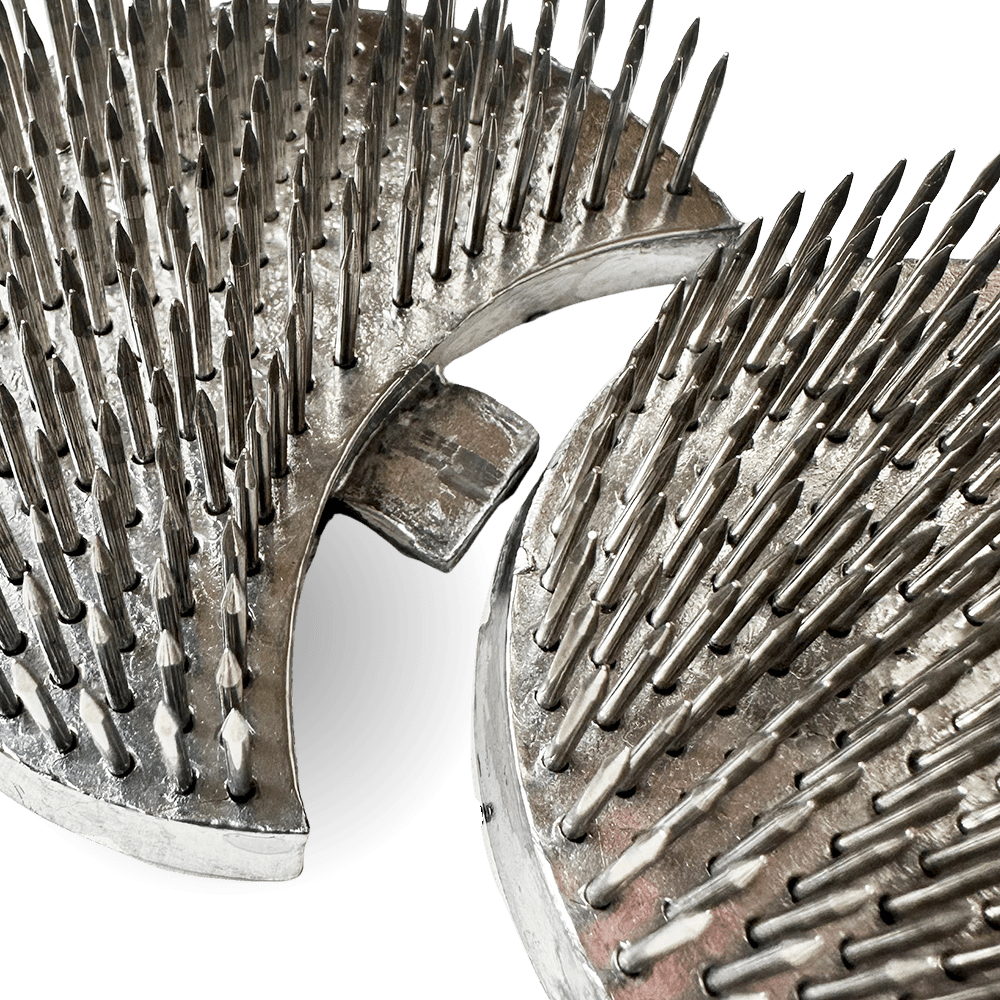
A floral frog, called a kenzan in ikebana, is a small weighted disc studded with metal pins. Stems get pushed onto the pins and hold whatever angle they were given, no tape or spare hand required.

Choose a low, open vessel. Ikebana favors shallow bowls over tall vases, since a kenzan needs a flat base to sit on. A tall bud vase will not do.

Set the frog before anything else. Place the kenzan first, then add water. Water over pins is slippery, and a shifting kenzan takes the arrangement with it.

Place the main line first. Ikebana builds around three stems at different heights: tall (shin), mid (soe), short (hikae). Start with the tallest, cut with intention, since it sets the scale.

Add the second and third lines. Lean the mid stem outward, then the short stem the opposite way, low and close to the rim. Together they form an uneven triangle. Symmetry is what a kenzan avoids.

Fill in sparingly. Empty space is a design element, not a gap to fix. A few stems angled to hide the pins is enough. Past that, it looks like a grocery store bouquet.

Step back before calling it finished. Walk across the room and look again. There is almost always one stem to remove.

Reset the frog between arrangements. Trimmings settle in the pins and give the next stems less to hold onto. Rinse it clear before the next round.

Pro Tip: The light does half the work.

Glass catches and bends light in a way ceramic can't. Set the arrangement somewhere it'll get some late afternoon sun, even for an hour, and the water and stems start doing something a solid vase never will.

Perfect Pairs for Any Shelf

Kenzan Metal Floral Frogs For Ikebana - Chive Ceramics Studio - Tools & Accessories - Chive Ceramics Studio

Two Halves of One Tool

This dish exists specifically to hold a kenzan steady, and the Kenzan Metal Floral Frogs are exactly what it was designed around — the two are really one tool split into two parts.

The Full Ikebana Set

Find this among the rest of Chive's ikebana collection, where dishes, kenzan, and clippers all live together as one coordinated set of tools.

What the Arrangement Still Needs

A shallow dish holds the water; the arrangement itself still needs real stems, and Chive's vase collection covers the taller, more traditional side of the same practice.


A person's hand pressing fresh flowers onto a metal flower frog.

About Chive Studio

Dishes built specifically to hold a kenzan steady have sat in the studio's catalog since 2004, a quieter corner of the catalog compared to the flowers and vases that usually get more attention. A dish like this doesn't need to be interesting on its own; it needs to hold water evenly and let a kenzan sit flat without wobbling, which is a lower bar than most of what the studio makes but not an easier one to actually hit. Simplicity done well takes just as much attention as anything more elaborate. A dish this straightforward rarely gets much thought once it's actually in use, which the studio has come to see as the entire point of designing it well in the first place.


Inside the Chive Design Studio

Low maintenance, high impact. Let's make home styling look easy.

Calathea Care: The Complete Guide

Ryan Hearst
Calathea care doesn't have to be as hard as its reputation — if you know what the plant is actually asking for. These are the most beautiful plants we sell, and yes, the pickies...
Read the full story

How to Repot a Plant: Watch for the Linen

Todd Newgren
How to repot a plant comes down to three signs, one rule, and one soil decision that most people get wrong. Chive Studio has been making drainage pots since 2004. The neighbor i...
Read the full story

Frequently asked questions

What is the Swayzak dish used for?

The Swayzak is a shallow ceramic dish built specifically to hold a kenzan steady while an ikebana arrangement is in progress, keeping everything level and contained in one dedicated vessel rather than repurposing a bowl or dish that wasn't built for the job. Everything stays contained in one place instead of being spread across mismatched containers pulled from a cupboard.

How big is the Swayzak ceramic kenzan dish?

It measures 4.25 inches wide, 2 inches long, and 1 inch tall — shallow and compact, sized to hold a kenzan and a modest amount of water without taking up much shelf space when not in use. That footprint keeps it compact enough to store easily while still holding enough water for a proper small arrangement.

Does the Swayzak dish come with a kenzan included?

No, the dish and the kenzan are sold separately, which lets you pick the kenzan size that actually suits the arrangement you're planning rather than being locked into a single bundled combination. This separation also means one dish can be reused with different kenzan sizes depending on what a given arrangement calls for.

Can the Swayzak dish be used without a kenzan?

Yes, it works perfectly well on its own as a shallow dish for a small arrangement or a floating display, though it was specifically designed with a kenzan's footprint and stability needs in mind. A shallow dish alone still makes a simple, low display, even without any pins holding stems in a fixed position.

Is the ceramic Swayzak dish dishwasher safe?

Handwashing is generally the safer choice for ceramic pieces like this one, since repeated dishwasher cycles can wear down glaze over time faster than gentle handwashing would. A soft sponge and mild soap by hand keeps the glaze looking good for considerably longer than repeated machine washing would. That habit alone adds real years to how the piece holds up over time.

What makes a ceramic kenzan dish different from a regular bowl?

A dish built for this purpose sits low and stable specifically to keep a kenzan from tipping once stems start pulling at odd angles during arranging, which a standard bowl isn't necessarily shaped to prevent as reliably. The wider, flatter shape keeps the whole thing low and stable rather than easily tipped once an arrangement leans to one side.

How much water does the Swayzak dish hold?

Enough to keep a kenzan submerged and stems hydrated for a typical arrangement, though exact capacity depends on how much space the kenzan itself takes up inside the dish. Refilling as needed during a longer display keeps stems properly hydrated without needing to guess at total capacity upfront. A quick visual check is usually all that's needed to judge when a refill makes sense.

When did Chive start making ceramic kenzan dishes?

The studio added ceramic ikebana dishes to its offerings in 2004, filling a quieter, more functional corner of the catalog compared to the more decorative pieces nearby. That functional, unshowy design has stayed consistent even as the rest of the catalog expanded well beyond it. It has stayed a small, steady part of the catalog rather than expanding into multiple sizes or colors.