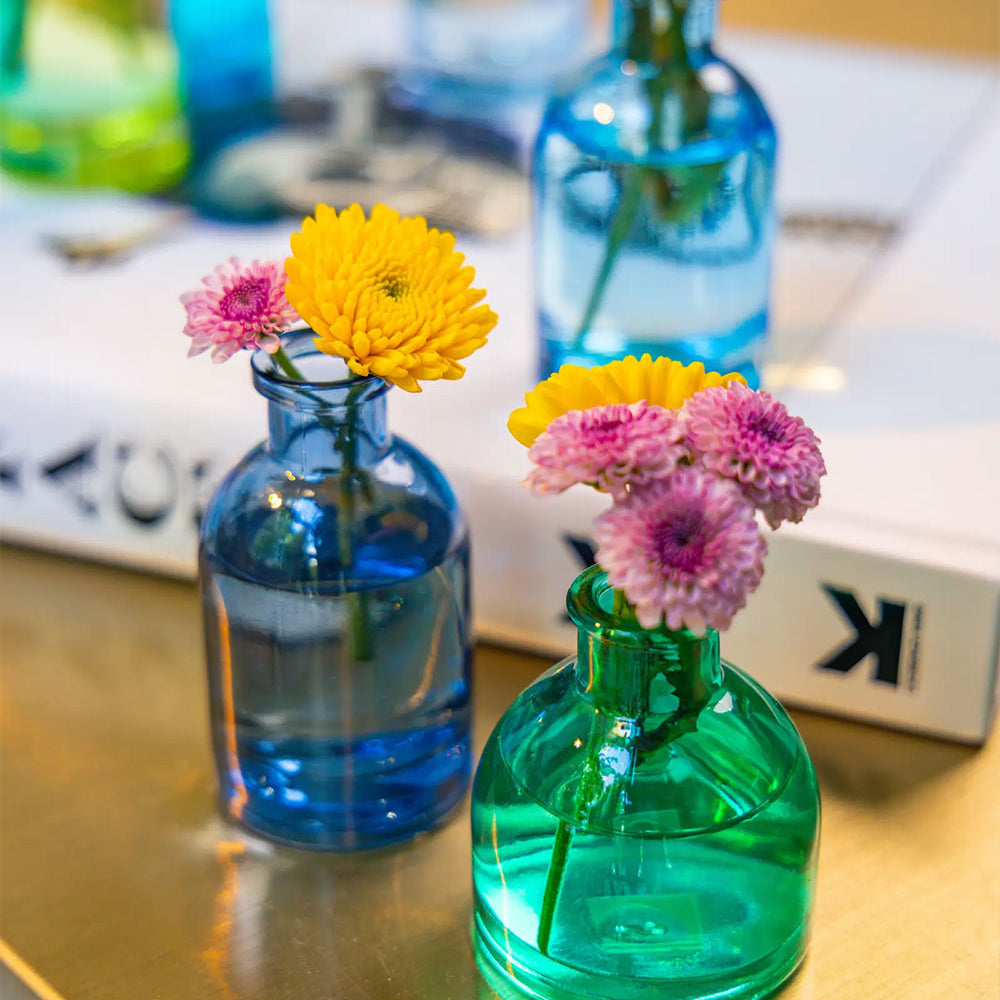
Calla Test Tube Flower Vase

Regular price $13.25
Colors: Blue
Sizes
Hand Blown Glass
Dishwasher safe cleaning
30-day return policy

Build the Arrangement That Looks Harder Than It Was

Pick a vase to anchor the shelf, then add the rest until it reads as curated instead of collected.


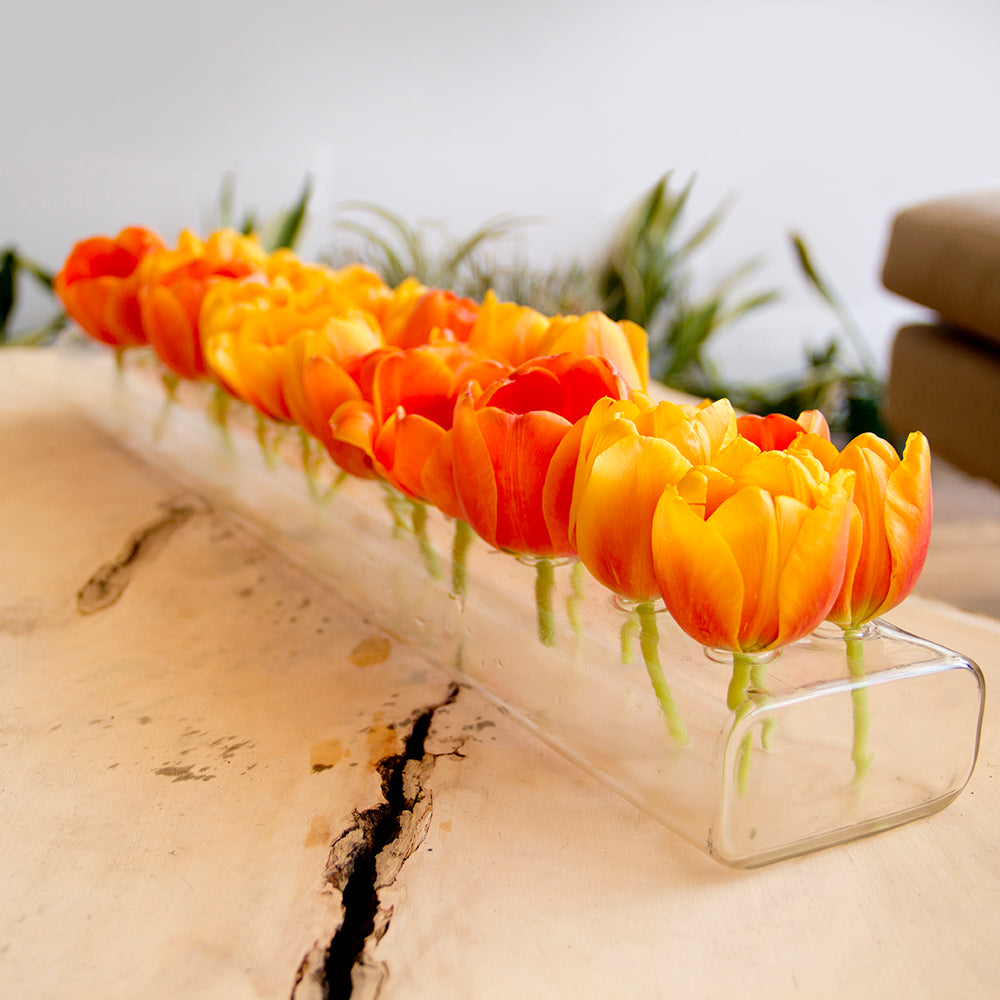
The Calla vase is a set of glass tubes seated in a solid base, and the number of tubes is the product rather than a variation on it. Three, seven or nine. As a three tube vase it is a modest thing for a bedside table; at nine it becomes a table centre with a square footprint. Every version stands 3.5 inches tall no matter how many holes it carries, so height is the constant and layout is the variable: the three runs 4 inches long, the seven stretches to 9, the nine folds into a 4-inch square. Being an mdf base tube vase means the tubes lift out, which matters more than it sounds, because glass tubes rinse properly and a fixed row never quite does. Set the stems apart and the base disappears under them. Whether you fill every tube or half of them, the spacing has already been decided.

Product detail

Product Detail:

  • Material: Glass/MDF
  • Glaze finish: Glazed
  • Year Designed: 2008
Dimension
  • 3-Hole 4 inches long, 2 inches wide, 3.5 inches tall
  • 7-Hole 9 inches long, 2 inches wide, 3.5 inches tall
  • 9-Hole 4 inches diameter, 3.5 inches tall
Vase Care Instructions

All glass vases in this collection are dishwasher safe for easy cleaning, with one exception: mercury glass vases should be hand-washed only. The silvered mercury finish is a delicate coating rather than a solid color, and dishwasher heat and detergent can dull or strip it over time.

For standard glass vases, just load it in with the rest of the dishes — no special care needed. For mercury glass pieces, wash gently with warm water and mild soap, and dry with a soft cloth rather than letting it air dry with water spots.

Rinse and dry after each use, especially if flower food or cut-stem residue was in the water, so nothing lingers and clouds the glass.

Flowers that Love this Vase
  • Cherry Blossom
  • Cosmos
  • Alstroemeria
  • Cornflower
  • Coneflower
  • Hellebore
  • Astrantia
  • Anthurium
  • Goldenrod
  • Blanket Flower

Quick Guide to Building a Floral Arrangement

  1. Pick your vase first
  2. Start with your anchor flower.
  3. Build in odd numbers.
  4. Add height, then fill.
  5. Greenery does the quiet work.
  6. Cut stems at an angle, underwater if you can.
  7. Step back before you decide it's done.

Shipping & returns

Shipping

  • Free shipping: Orders $200+ within the US
  • Standard: 5–8 business days, Express 2–3 business days (at checkout)
  • International Ships: to 40 countries — rates at checkout
  • Packaging Ships: in outer box to protect gift box

View full shipping policy →

Returns

We accept returns within 30 days of delivery on unused items in original packaging. If your piece arrives damaged, contact us within 7 days with a photo and we will replace it at no charge.

View full return policy →

Wholesale Inquires

Have a cool shop? Know someone that does?

Find Chive on Faire →

Calla Test Tube Flower Vase - Chive Ceramics Studio - Vases - Chive US

We meant to make one vase - The Calla

The Calla is the piece that taught this studio the difference between a product and a size run. We drew the seven first, in 2008, because seven felt like the number a table wanted. Then a shop asked for something smaller for a windowsill and we made a three, and then somebody else wanted a square rather than a line and we made a nine, and at no point did anyone stop to notice that we had accidentally built a system.

It became obvious a good deal later, when the reorder sheets started coming in and every single one of them listed a different combination from the last. Nobody was buying the seven. People were buying a three and a nine, or two threes, or a nine and two sevens for a long table, and treating the whole thing as components rather than as objects.

That was not the plan. The plan was one nice vase, and what the plan produced was a kit, which is a more useful thing to have made and slightly humbling to have arrived at by accident.

Delphine still refers to the range as the accident, in front of customers, and has been asked to stop.

Chive Studio trimming tulip stems with scissors on a wooden surface, with white, purple, and pink tulips arranged nearby.
How to Cut Flowers Like a Pro:

A (Mostly) Simple Guide to Cutting Your Flowers

So, you’re making an arrangement? Let’s ensure it lives long enough to impress someone—even if it's just you.

  1. Scrub the Scissors: Wash your shears first. Your flowers do not want a side of Dorito dust.
  2. Cut at 45°: Snip stems at an angle. It gives them a straw instead of making them chug from the bottle.
  3. Trim Underwater (Fancy Mode): Cut them submerged to block air bubbles. It’s extra, but they didn’t ask to suffocate.
  4. Ditch Submerged Leaves: Strip anything below the waterline. Unless you are actively going for a swamp aesthetic.
  5. Snip Again if Stale: If they sat out on the counter, trim them again. They need a fresh start (don’t we all?).
  6. Swap the Water: Change it and trim the stems every few days so they don't die immediately.

Voilà! You are now a domestic deity. Go take your Instagram photo before you forget to water them.

Pro Tip: The light does half the work.

Glass catches and bends light in a way ceramic can't. Set the arrangement somewhere it'll get some late afternoon sun, even for an hour, and the water and stems start doing something a solid vase never will.

Perfect Pairs for Any Shelf

Floral Frogs: The Unsung Heroes of Flower Arranging

The glass vases at Chive come out of the same studio habit that produced everything else here: design the object once, correctly, then resist every opportunity to complicate it. Each one holds stems. None of them hides anything. On the Calla the resistance shows up as a fixed count and a fixed height, with only the layout changing between versions. When the same appetite for repeated openings goes vertical and branching instead of flat, the Candelabra Vase is where it arrives.

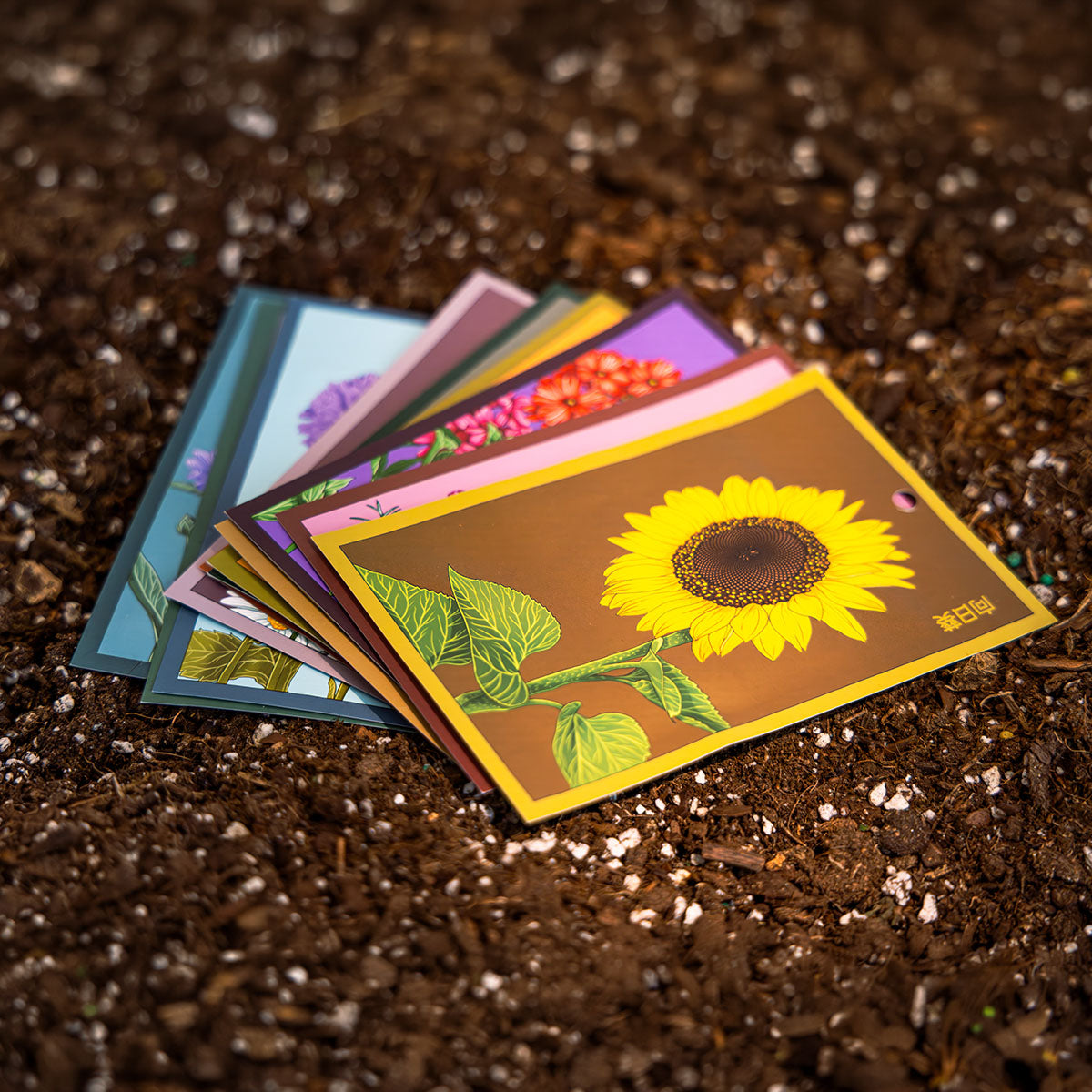
Shido seed packets for vegetable and floral category, by Chive Studio

Shido Seeds Almost Too Pretty to Plant

Every Chive vase is built around one decision about how flowers should stand, then finished by hand until that decision reads as obvious. The Calla settled on removable tubes seated into a solid base, which sounds like a manufacturing note and is actually the whole proposition: you arrange in the hand, then drop the stems back in place. Height never varies across the three versions. Only the count and the layout do. Every piece in the glass vases collection resolves one question this way and leaves it alone afterward.

Cactus Indoor Seeds are the slowest thing we sell and the Calla holds the fastest, which makes them an oddly good pair on one sill. Cut stems last days. A cactus grown from seed will still be there when you move house. Running both means the windowsill always has something on it, regardless of whether anybody remembered to buy flowers this week.


Two Materials, One Bench - Chive Since 2004

Glass and board are two entirely different problems and this piece has both, which is why the tubes and the base are brought together on our own bench rather than arriving as parts to be married later. Board moves with humidity and glass does not, so the seating has to be cut with that in mind, and getting it wrong means a tube that rattles in January and binds in July. Chive has been solving that here since 2004. It is the least glamorous thing in this catalogue to get right, nobody has ever once remarked on it, and a version assembled in two separate places would fail inside a single season.


Inside the Chive Design Studio

Low maintenance, high impact. Let's make home styling look easy.


Frequently asked questions

How does the Calla earn its name as a calla vase?

The name points at the flower's structure rather than its silhouette. A calla sends up one clean upright stem carrying one bloom, with no branching and no side shoots, and this vessel is built around exactly that habit: a separate tube for every stem, each held straight, none of them touching. Put nine callas in a nine-hole and the arrangement builds itself. The form follows the flower's discipline.

Do short-stemmed garden flowers work well in the Calla vase?

Unusually well, and the removable tubes are why. Short garden stems are awkward to place because you cannot see what you are doing down inside a vessel, whereas here you lift a tube out, drop the stem in at eye level, and seat it back. Cornflowers, coneflowers and cosmos all suit the height. Arranging in the hand changes everything.

What footprint does the Calla vase take up on a table?

Three different answers, and height is not one of them. All three versions stand 3.5 inches, so the choice is purely about the shape of the space: the three-hole runs 4 inches by 2, the seven-hole stretches to 9 inches by 2 for a table centre, and the nine-hole sits square at 4 inches each way. A square suits a side table. A line suits a run.

Is the Calla vase's glass body durable for everyday use?

Yes, and the failure mode is unusually forgiving. If something goes wrong it is a cracked tube rather than a ruined vase, and a tube is a component rather than the object, so the piece survives an accident that would finish a one-piece vessel. The base itself is solid and takes knocks well. Replaceability is the durability argument here.

Is the Calla vase dishwasher safe or hand wash only?

Hand wash, and the base must not go anywhere near water. It is mdf, which is board rather than timber, and board swells irreversibly once it wets through. Lift every tube out, wash them under a tap as you would any drinking glass, and wipe the base with a barely damp cloth and dry it at once. Never soak the base.

Does the Calla vase work as decor without any flowers in it?

It does, better than most vases empty, because the base is the object and the tubes are close to invisible. What you see on a bare table is a low block with a rhythm of openings across it, which reads as something deliberate rather than as a vase waiting for flowers. Leaving it bare for a season is entirely legitimate.

What makes the Calla vase different from the Candelabra vase nearby?

Direction, mainly. The Calla lays its openings out flat in a line or a square, so everything sits at a single height and the arrangement stays low across a table. The Candelabra sends its openings upward on branching arms, so stems occupy air rather than surface. One organises a plane and the other organises a volume. Choose by the space you have spare.

How did the Calla vase's design evolve at Chive studio?

It started as the seven-hole in 2008 and became a range by accident rather than design. A shop asked for a smaller version for a windowsill, a square layout was requested elsewhere in place of a line, and the three and the nine followed. Only afterward did the reorder patterns show that customers were combining them rather than choosing between them. The system was discovered, not planned.

Ceramic astronaut vase with flowers styled on shelf — Chive Studio Toronto
Behind the Studio

The story behind the Chive astronaut vases

The story of Laika, Félicette, a solar eclipse in New York, and a space bar that ordered a hundred vases a month until it closed.