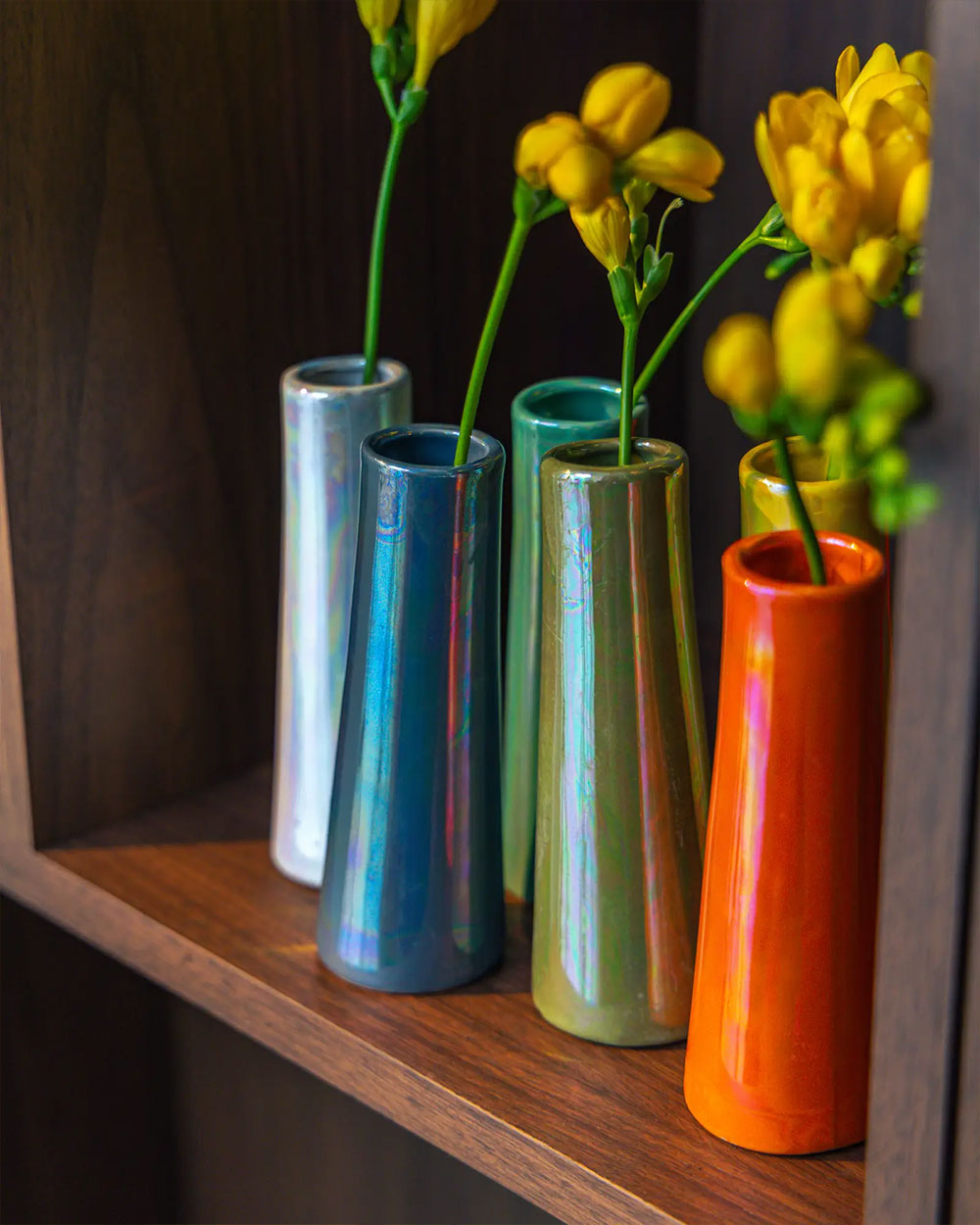
Olmstead Porcelain Bud Vase

Regular price $21.50
Colors: Grey
Sizes
Fully Glazed
Dishwasher safe cleaning
30-day return policy

Build Your Effortless Arrangements With These:

Choose a vase as your anchor, then round out the shelf with these for that thrown-together-but-somehow-perfect look.


The Olmstead vase is a matte porcelain bud vase, designed in 2015 for the stems that never quite justify a full arrangement — a single peony, three sprigs of waxflower, the one buttercup that survived the walk home. It comes in three colorways: white, lilac, and the muted green that makes it the sage porcelain vase people request by color before they remember its name. The matte glaze takes light softly, so the piece reads the same in person as it does in a photograph, which is rarer than it sounds. On a narrow shelf or a crowded desk it keeps a small footprint and a lower profile, holding stems upright without announcing the effort. If you want a porcelain stem vase that behaves like good punctuation — present, structural, unnoticed until removed — this is the shape to start with. Artisans shape these pieces by hand, because an object this plain has nowhere to hide a shortcut.

Product detail
  • Vase Type:
  • Material: Porcelain
  • Glaze finish: Matte
  • Water Resistance: Watertight
  • Year Designed: 2015
Dimension
  • 2.5 inches diameter x 6 inches height
Vase Care Instructions

Every ceramic vase in this collection is dishwasher safe on the top rack, making cleanup between arrangements as simple as loading it in with the rest of the dishes. The glazed surface holds up fine to regular washing, so there's no need to hand-wash unless you'd prefer to.

If you're cleaning a piece with painted or sculpted detail, a gentler cycle or a quick hand-wash with warm water and mild soap will help keep the finish looking sharp for longer. Either way, rinse and dry after each use — especially if flower food or cut-stem residue was in the water — so nothing lingers and clouds the glaze.

No special sealants, no periodic maintenance. Wash it, dry it, put flowers back in it.

Flowers that Love this Vase
  • Lisianthus
  • Calla Lily
  • Peony
  • Buttercup
  • Sweet William
  • Muscari
  • Dianthus
  • Waxflower
  • Bells of Ireland
  • Goldenrod

Quick Guide to Building a Floral Arrangement

  1. Pick your vase first
  2. Start with your anchor flower.
  3. Build in odd numbers.
  4. Add height, then fill.
  5. Greenery does the quiet work.
  6. Cut stems at an angle, underwater if you can.
  7. Step back before you decide it's done.

Shipping & returns

Shipping

  • Free shipping: Orders $200+ within the US
  • Standard: 5–8 business days, Express 2–3 business days (at checkout)
  • International Ships: to 40 countries — rates at checkout
  • Packaging Ships: in outer box to protect gift box

View full shipping policy →

Returns

We accept returns within 30 days of delivery on unused items in original packaging. If your piece arrives damaged, contact us within 7 days with a photo and we will replace it at no charge.

View full return policy →

Wholesale Inquires

Have a cool shop? Know someone that does?

Find Chive on Faire →

Olmstead Porcelain Bud Vase - Chive Ceramics Studio - Vases - Chive US

Named by Five O'Clock — The Olmstead

We name things badly here, and I say that with the affection of a participant. The building runs behind schedule as a matter of identity, and this vase was finished, photographed, and priced before anyone remembered it needed to be called something. Five o'clock was the deadline. At four-forty, someone pulled an architecture book off the shelf, closed their eyes, and put a finger down on a page. Olmstead. It sounded distinguished — like a man who wore a serious hat and held firm opinions about parks — and we learned only later that this was roughly accurate, which is the sort of luck you do not question out loud. The vase deserved actual research. It received a deadline instead, a fact I have carried quietly for years and made my peace with, because the object itself was never rushed: the porcelain got its full schedule, the matte glaze got its tests, the sage, the lilac, and the white got argued over properly, separately, and at considerable length. Only the name was improvised. If anything, the split feels honest — all of the care went where you can see it, and none of it went into the part we invented at four-forty on a Thursday.

Chive Studio trimming tulip stems with scissors on a wooden surface, with white, purple, and pink tulips arranged nearby.

A (Mostly) Simple Guide to Cutting Your Flowers

So, you’re making an arrangement? Let’s ensure it lives long enough to impress someone—even if it's just you.

  1. Scrub the Scissors: Wash your shears first. Your flowers do not want a side of Dorito dust.
  2. Cut at 45°: Snip stems at an angle. It gives them a straw instead of making them chug from the bottle.
  3. Trim Underwater (Fancy Mode): Cut them submerged to block air bubbles. It’s extra, but they didn’t ask to suffocate.
  4. Ditch Submerged Leaves: Strip anything below the waterline. Unless you are actively going for a swamp aesthetic.
  5. Snip Again if Stale: If they sat out on the counter, trim them again. They need a fresh start (don’t we all?).
  6. Swap the Water: Change it and trim the stems every few days so they don't die immediately.

Voilà! You are now a domestic deity. Go take your Instagram photo before you forget to water them.

Pro Tip: Keep It Short and Sweet!

When it comes to flower stems, shorter is better. Not only do shorter stems look chic in arrangements, but they also help your blooms last longer. Why? Because the shorter the stem, the less distance water has to travel to keep those petals perky. It’s like giving your flowers a shorter commute—less stress, fewer breakdowns.

Perfect Pairs for Any Shelf
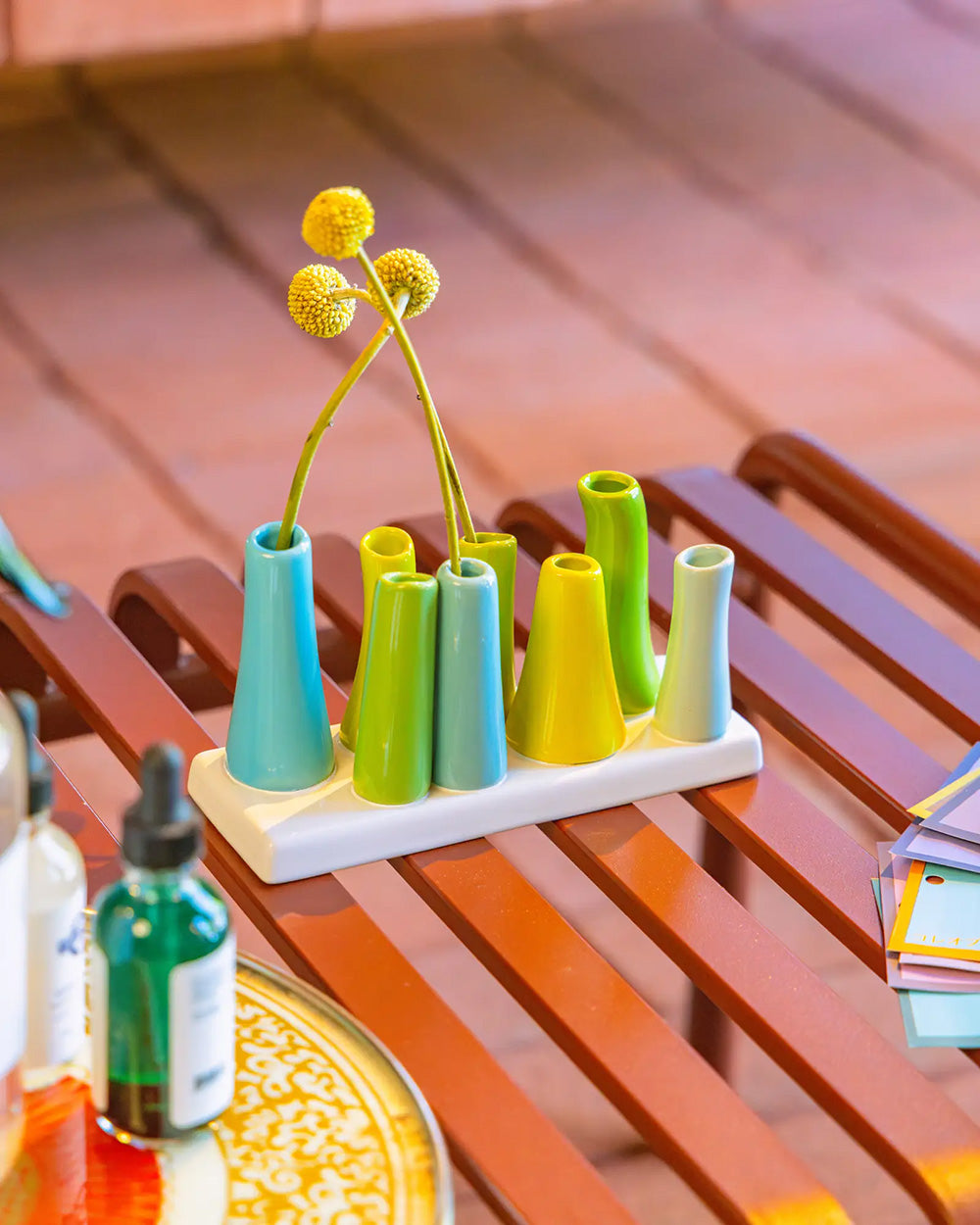
Chive ceramic pooley bud vase in color scout blue, styled with fresh flowers, on a red bench.

Pooley 3 Ceramic Vase

The ceramic vases at Chive come out of the same studio habit that produced everything else here: design the object once, correctly, then resist every opportunity to complicate it. Each one holds stems. None of them holds back. The Olmstead is that restraint at single-stem scale. When one opening starts to feel like a constraint, the Pooley 3 Ceramic Vase answers with three set into one low base — the arranging finished before the water goes in.

The Ceramic Vases Collection

Every Chive vase is built around one decision about how flowers should stand, then finished by hand until that decision reads as obvious. The ceramic side of that decision runs from single-tube bud vases to sculptural pieces that take a whole handful, all glazed in the same building by the same hands. The Olmstead sits at the quiet end of the range. See what sits at the loud end in the Ceramic Vases Collection.

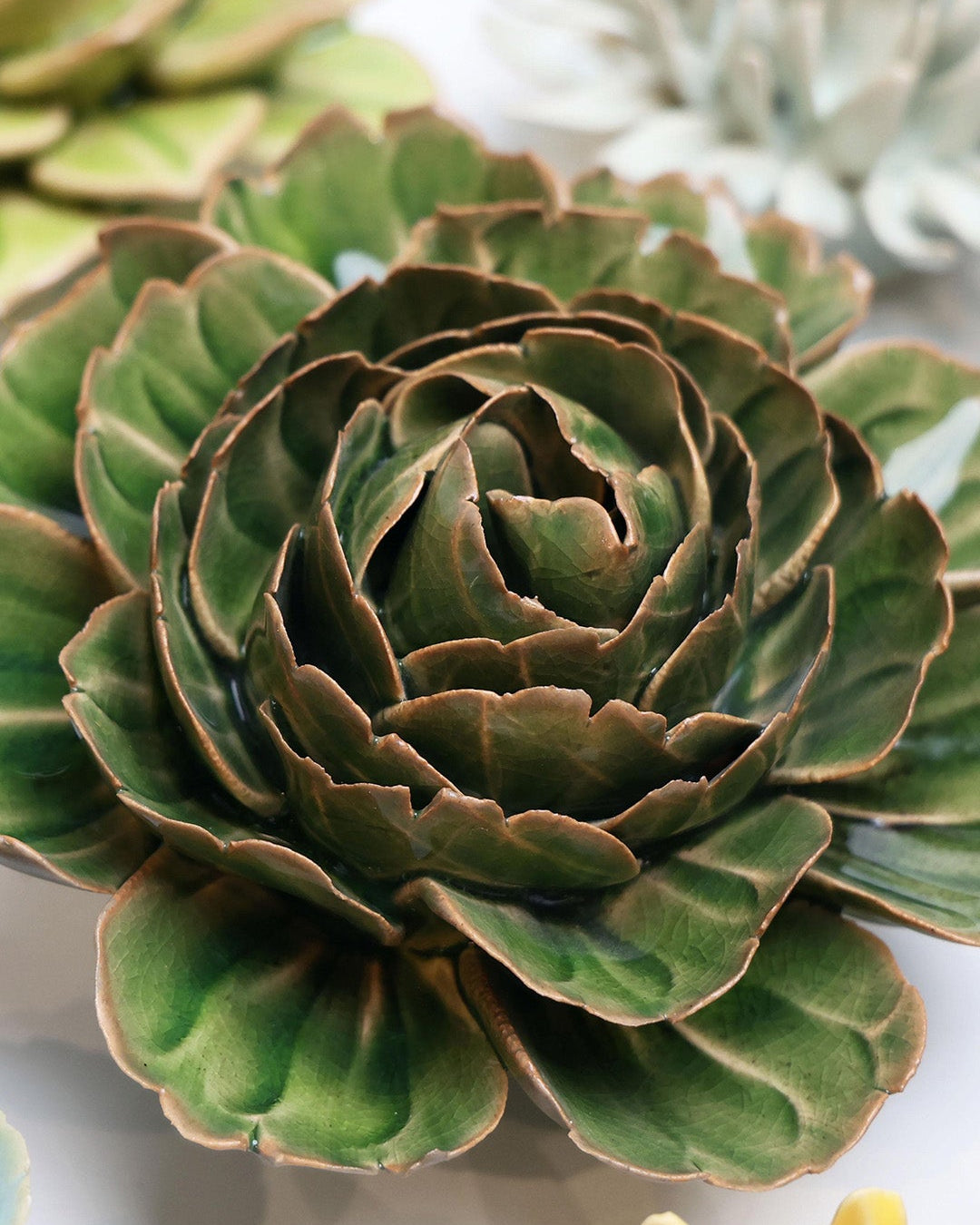
Avocado Green Rozella Peony ceramic wall flower styled on wall — English Garden — Chive Studio Toronto

Peony Ceramic Flower Wall Art

A vase this committed to one stem deserves a stem with equal commitment. The Mint Green Peony from our ceramic flowers line is glazed ceramic that never wilts, never drops a petal, and never needs its water changed — the only bloom in the catalog with a longer attention span than the vase holding it. Meet the Peony Ceramic Flower Wall Art.


Chive Studio at Chelsea Flower Show displaying ceramic pooley vases of different colors.

The Habit of Less — Chive Since 2004

Chive has been a working ceramics studio since 2004, which is long enough to have learned that restraint is a skill rather than a shortage of ideas. The Olmstead comes out of that education: a bud vase reduced to footprint, glaze, and three colors, with nothing left on it to explain. We make pieces in small runs, glaze them in-house, and quietly retire any idea that needs a full paragraph to justify itself. Twenty-two years in, the test hasn't changed — if an object still looks right after the trend that inspired it has died, it stays in the catalog. The Olmstead has already outlived several of them. It isn't going anywhere.


Inside the Chive Design Studio

Low maintenance, high impact. Let's make home styling look easy.

Wedding Centerpiece Vases: The Planning Guide Nobody Gives You

Todd Newgren
Wedding centerpiece vases work best small and plural — three to seven per table, one to three stems each. A fifteen-table reception needs roughly seventy-five vases and 100 to 1...
Read the full story

The Best 10 Styles of Vases

Jessie Duenas
The glorious world of flower vases! Because nothing says "I have my life together" quite like a carefully chosen vessel for your soon-to-be-wilting flora. Gather 'round, fell...
Read the full story

Frequently asked questions

What makes the Olmstead a genuinely useful olmstead vase at home?

The Olmstead earns its keep by fitting where arrangements can't: a windowsill, a desk corner, the sliver of counter beside the coffee maker. One clipping from the yard makes it read as planned, and the matte porcelain stays composed even standing empty, which most vases cannot claim. Mine lives beside the toaster, displaying whatever survived the week. It always looks intentional anyway. That's the trick.

How many flower stems does the Olmstead vase comfortably display?

Comfortably, one to three short stems — this is bud-vase territory, sized for a single bloom with perhaps a sprig of company. A lone dianthus or a small cluster of muscari suits the opening best; anything fuller starts to argue with the silhouette. The piece was drawn around the idea that one flower, chosen well, outperforms a dozen chosen quickly. Trust the arithmetic on this one. One wins.

Will the Olmstead vase fit on a narrow shelf or ledge?

Yes — narrow shelves and ledges are its natural habitat. The footprint stays compact and the weight sits low, so it doesn't wobble where taller vases would sulk and eventually tip. It's a bud vase in the plainest sense, scaled closer to a coffee cup than a pitcher, so window ledges, mantels, and picture rails are all fair game. Skinny shelf, no drama. That's the assignment.

Is the Olmstead vase's porcelain surface prone to marks or scratches?

Not especially. The porcelain is fired hard and fully glazed, so everyday contact — keys, rings, the occasional confident cat — leaves no record. The matte surface also refuses fingerprints in a way gloss never manages. Skip abrasive pads and gritty cleansers, which can dull any glaze over time, and it will keep its finish for years. Ordinary life won't mark it. Cats included.

How do you clean the Olmstead vase without damaging the finish?

Warm water and a drop of mild soap handle everything. The interior is fully glazed, so residue rinses out instead of soaking in, and the care notes clear it for the dishwasher when you'd rather not bother. Avoid scouring powder and steel wool, which are solutions in search of a gentler problem. A soft cloth dries it streak-free. Done in a minute.

How do you style the Olmstead vase on open shelving?

Give it company that stays out of its way: a short stack of books, a small frame, air on at least one side. Odd-numbered groupings work, and the three colorways were built to sit together without matching. On open shelving the matte glaze reads as texture from across the room, stem or no stem. Empty is a legitimate styling choice. It holds the shelf alone.

Is the Olmstead vase larger or smaller than the Pooley 3 vase?

Smaller, and by design. The Pooley 3's published sizes run up to eight inches across and seven inches tall depending on the version, with multiple openings sharing the work. The Olmstead is a single-opening bud vase with a far more modest footprint — a soloist next to a small choir. If the spot is tight, choose the Olmstead. If the bouquet is big, Pooley.

What design tradition does the Olmstead vase draw from?

Less a single tradition than a studio habit: reduce the form until nothing on it needs defending. Drawn in 2015, it borrows the bud vase's long history of doing one job and the matte-glaze preference for surfaces that absorb light rather than perform it. No movement gets credit on the sticker. The reduction itself is the lineage. That habit predates us.

Ceramic astronaut vase with flowers styled on shelf — Chive Studio Toronto
Behind the Studio

The story behind the Chive astronaut vases

The story of Laika, Félicette, a solar eclipse in New York, and a space bar that ordered a hundred vases a month until it closed.