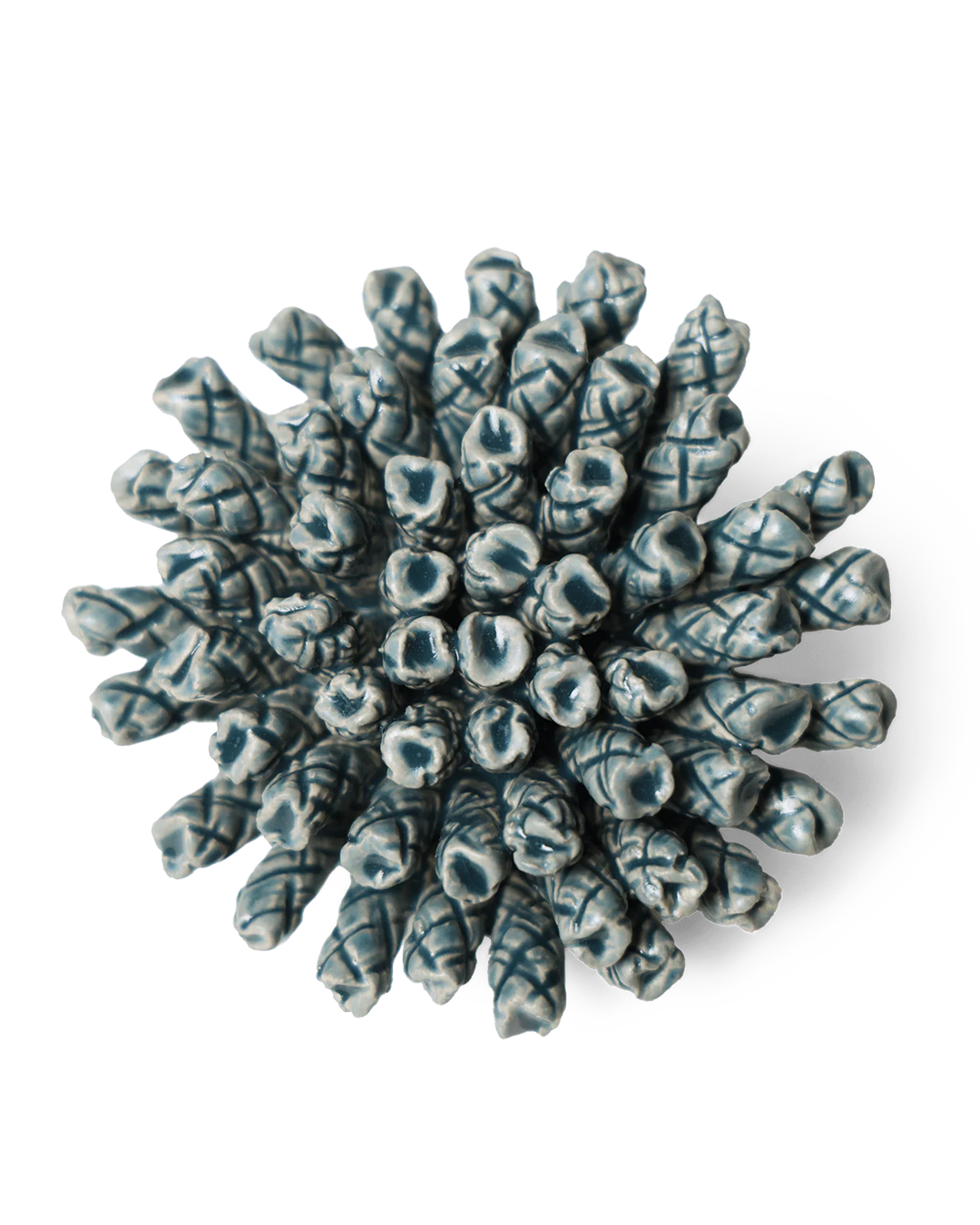
Pooley Modern Round Bud Vase For Flowers

Regular price $41.25
Fully Glazed
Dishwasher safe cleaning
30-day return policy

Build Your Effortless Arrangements With These:

Choose a vase as your anchor, then round out the shelf with these for that thrown-together-but-somehow-perfect look.


The Pooley round vase exists because the original Pooley worked, which turned out to be the problem. Its eight tubes were precisely enough to reveal what was missing, and what was missing was more, so the studio answered with a circular bud vase built on a round base and an unapologetic sequel logic. It comes in white, the least consequential decision involved — that choice was made the day the first Pooley came home and the local gardens started looking negotiable. As a round tube vase it holds each stem upright and separate, so mismatched cuttings read as a plan instead of an apology. The right recipient already owns the original and will understand the message immediately. Artisans shape these pieces by hand, finishing every base one at a time. The Getty carries Chive's Pooley line in its museum store, a fact the studio mentions more often than the Getty does.

Product detail
  • Vase Type:
  • Material: Ceramic
  • Glaze finish: Glazed
  • Water Resistance: Watertight
  • Year Designed: 2010
Dimension
  • 5.5 inches diameter
  • 3.8 inches tall
Vase Care Instructions

Every ceramic vase in this collection is dishwasher safe on the top rack, making cleanup between arrangements as simple as loading it in with the rest of the dishes. The glazed surface holds up fine to regular washing, so there's no need to hand-wash unless you'd prefer to.

If you're cleaning a piece with painted or sculpted detail, a gentler cycle or a quick hand-wash with warm water and mild soap will help keep the finish looking sharp for longer. Either way, rinse and dry after each use — especially if flower food or cut-stem residue was in the water — so nothing lingers and clouds the glaze.

No special sealants, no periodic maintenance. Wash it, dry it, put flowers back in it.

Flowers that Love this Vase
  • Carnation
  • Peony
  • Poppy
  • Lily
  • Black-Eyed Susan
  • Nigella
  • Coneflower
  • Hellebore
  • Iceland Poppy
  • Wallflower

Quick Guide to Building a Floral Arrangement

  1. Pick your vase first
  2. Start with your anchor flower.
  3. Build in odd numbers.
  4. Add height, then fill.
  5. Greenery does the quiet work.
  6. Cut stems at an angle, underwater if you can.
  7. Step back before you decide it's done.

Shipping & returns

Shipping

  • Free shipping: Orders $200+ within the US
  • Standard: 5–8 business days, Express 2–3 business days (at checkout)
  • International Ships: to 40 countries — rates at checkout
  • Packaging Ships: in outer box to protect gift box

View full shipping policy →

Returns

We accept returns within 30 days of delivery on unused items in original packaging. If your piece arrives damaged, contact us within 7 days with a photo and we will replace it at no charge.

View full return policy →

Wholesale Inquires

Have a cool shop? Know someone that does?
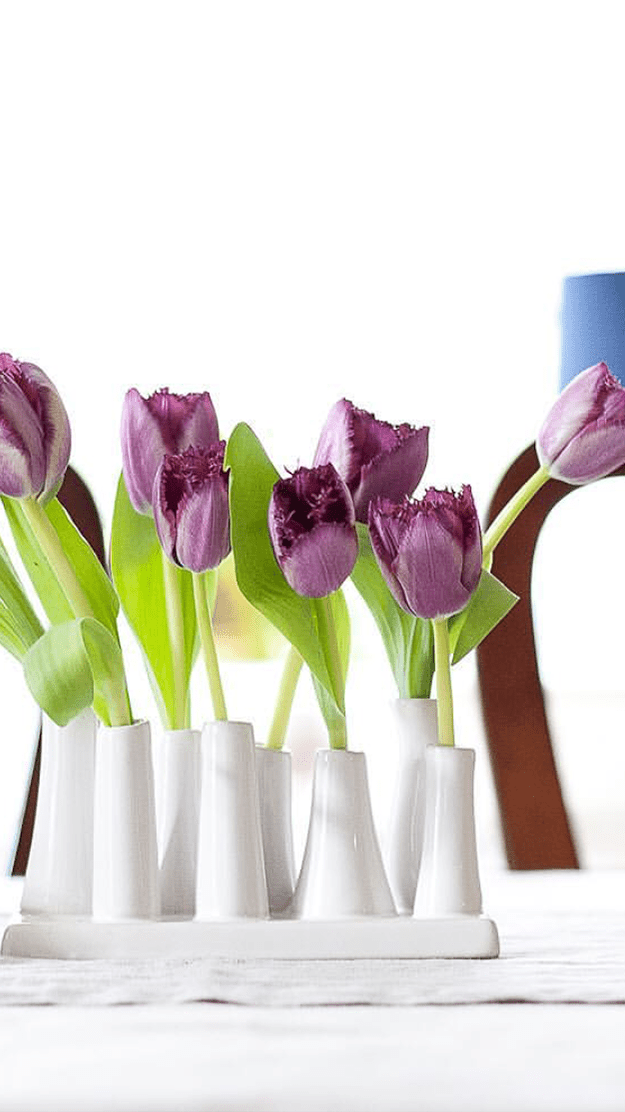
Find Chive on Faire →

Pooley Modern Bud Vase For Flowers - Chive Ceramics Studio - Vases - Chive Ceramics Studio

A circle with no wrong side — The Pooley Round

Round objects get handled differently, and the studio did not fully believe this until the Pooley Round shipped. People pick it up. They rotate it while talking. They set it down facing a new direction and nobody can tell, because a circle has no direction to face, and this turns out to be the entire secret of its usefulness. A vase with a front spends its life being straightened. The Round cannot be crooked. Put it in the middle of a table and every chair gets the good view; put it on a kitchen island and it looks composed from the stove, the sink, and the doorway where someone is asking what's for dinner. The white glaze was the other stubborn decision. Color would have given it a mood, and the studio wanted the flowers to bring the mood — the vase supplies the order, a quiet ring of tubes holding each stem at its own address. What owners report, more than anything, is rotation as fidgeting: turning the piece a few degrees the way other people click pens. The vase absorbs this without complaint. Somewhere in the spinning, the stragglers of a week-old bouquet get promoted to an arrangement again. That promotion is the product.

Chive Studio trimming tulip stems with scissors on a wooden surface, with white, purple, and pink tulips arranged nearby.

A (Mostly) Simple Guide to Cutting Your Flowers

So, you’re making an arrangement? Let’s ensure it lives long enough to impress someone—even if it's just you.

  1. Scrub the Scissors: Wash your shears first. Your flowers do not want a side of Dorito dust.
  2. Cut at 45°: Snip stems at an angle. It gives them a straw instead of making them chug from the bottle.
  3. Trim Underwater (Fancy Mode): Cut them submerged to block air bubbles. It’s extra, but they didn’t ask to suffocate.
  4. Ditch Submerged Leaves: Strip anything below the waterline. Unless you are actively going for a swamp aesthetic.
  5. Snip Again if Stale: If they sat out on the counter, trim them again. They need a fresh start (don’t we all?).
  6. Swap the Water: Change it and trim the stems every few days so they don't die immediately.

Voilà! You are now a domestic deity. Go take your Instagram photo before you forget to water them.

Pro Tip: Keep It Short and Sweet!

When it comes to flower stems, shorter is better. Not only do shorter stems look chic in arrangements, but they also help your blooms last longer. Why? Because the shorter the stem, the less distance water has to travel to keep those petals perky. It’s like giving your flowers a shorter commute—less stress, fewer breakdowns.

Perfect Pairs for Any Shelf
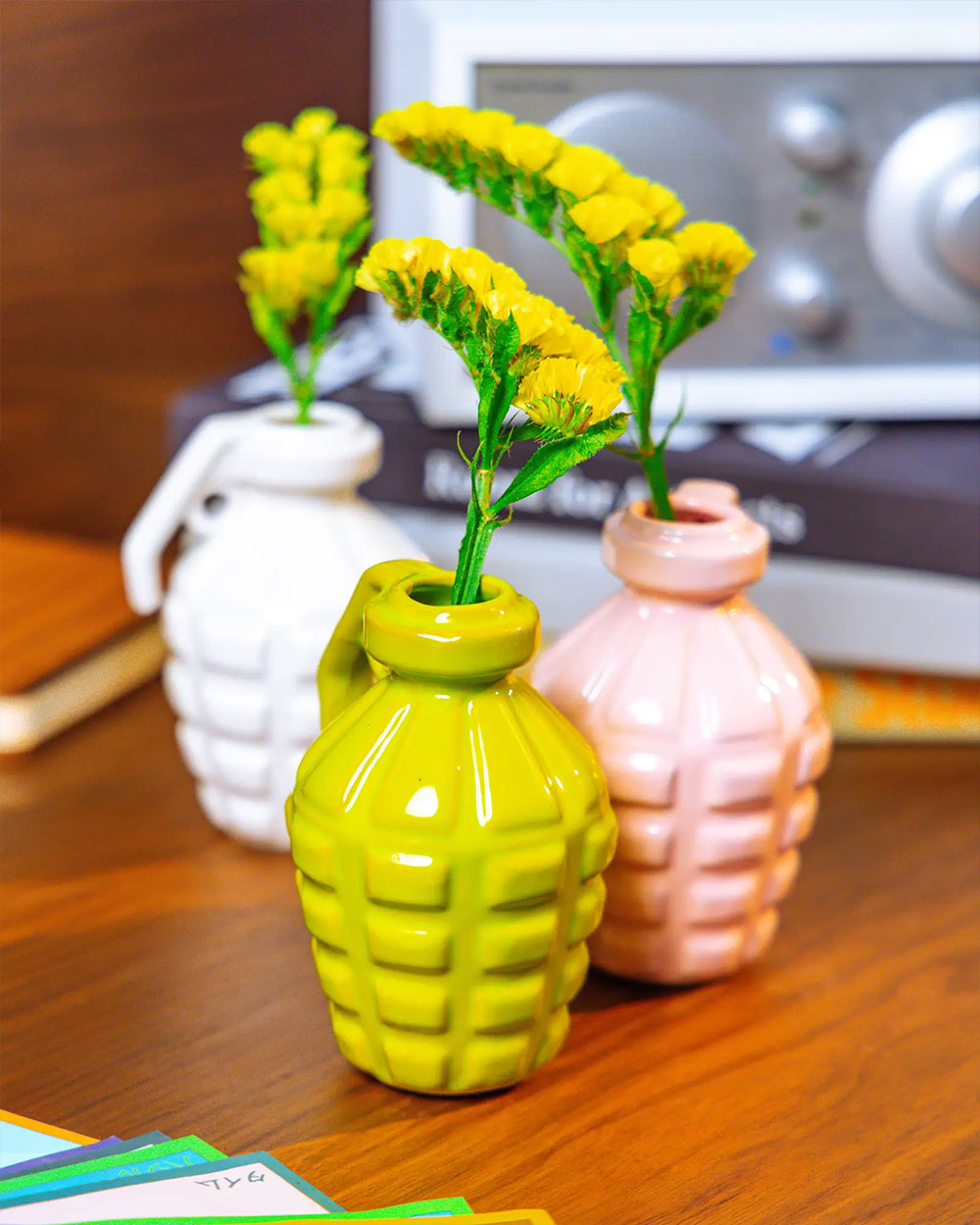
Kapow, or Grenade, depending who's talking
The ceramic vases at Chive come out of the same studio habit that produced everything else here: design the object once, correctly, then resist every opportunity to complicate it. Each one holds stems. None of them holds back. Kapow keeps one shape across six colors, and some of us still call it Grenade out of habit. The name changed. The shape didn't need to.

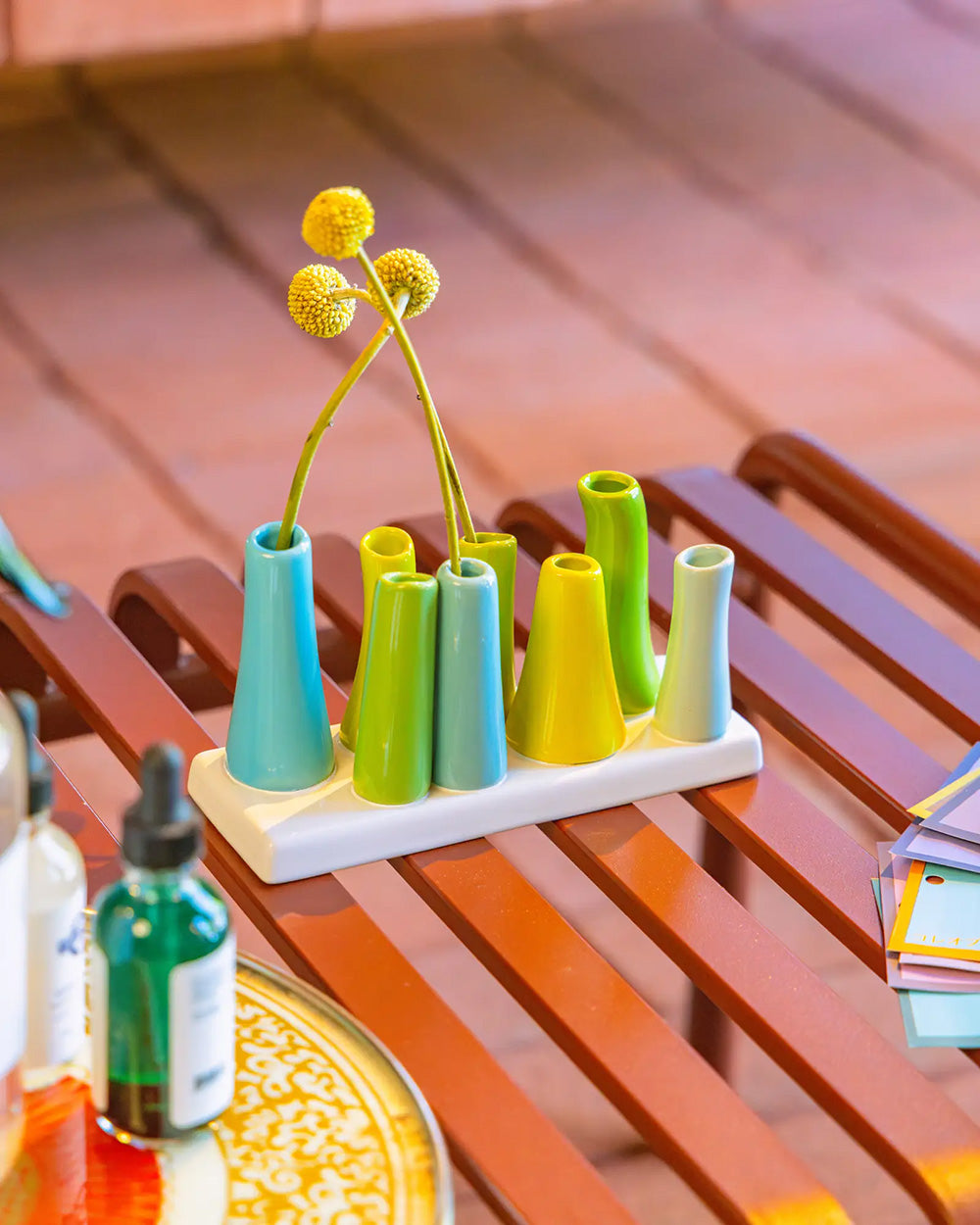
Chive ceramic pooley bud vase in color scout blue, styled with fresh flowers, on a red bench.

The Ceramic Vases Collection

Every Chive vase is built around one decision about how flowers should stand, then finished by hand until that decision reads as obvious. For the Round, the decision was geometry: a ring of tubes with no wrong side, so islands, round tables, and open shelving all get a finished view from every chair in the house. Turn it a few degrees while you talk, because everyone does, and it never needs straightening afterward. See every Ceramic Vase.

Ceramic Flower Wall Art Medium Teal 1 - Chive Ceramics Studio - Ceramic Flowers - Chive US

Medium Teal Ceramic Flower

Mount the Medium Teal Ceramic Flower on the wall behind the Pooley Round, offset from center at eye level, and the tabletop gains a backdrop that never wilts or sheds. Teal behind white reads as water behind porcelain, which sounds precious until you see it, at which point it just reads as correct. Guests assume a decorator. Say nothing.


Chive Studio at Chelsea Flower Show displaying ceramic pooley vases of different colors.

Original Since 2004. Often Copied, Never First.

Chive Ceramics Studio has been making its own designs since 2004, and the operative word there is own. Nothing in the catalog was licensed, borrowed, or reverse-engineered from somebody's trade show booth; everything started as a sketch in this studio and got argued into three dimensions by the people who actually work here. The firing happens in-house. The mistakes happen in-house too, which is where most of the good ideas turn out to come from, though nobody admits this at the time. Two decades of that loop produced a shelf of originals that other companies now imitate with varying degrees of nerve, a development the studio has officially decided to find funny. Original since 2004. Often copied, never first.


Inside the Chive Design Studio

Low maintenance, high impact. Let's make home styling look easy.

Wedding Centerpiece Vases: The Planning Guide Nobody Gives You

Todd Newgren
Wedding centerpiece vases work best small and plural — three to seven per table, one to three stems each. A fifteen-table reception needs roughly seventy-five vases and 100 to 1...
Read the full story

The Best 10 Styles of Vases

Jessie Duenas
The glorious world of flower vases! Because nothing says "I have my life together" quite like a carefully chosen vessel for your soon-to-be-wilting flora. Gather 'round, fell...
Read the full story

Frequently asked questions

What should you look for when buying a pooley round vase online?

A pooley round vase purchased online should state its diameter, its tube size, and its glaze color honestly, and this one publishes all three — including a white that still reads white in actual daylight, photographed without filters or wishful thinking. Screens lie about white constantly and without shame. Ours has witnesses.

What single flowers look striking on their own in the Pooley Round?

Single flowers that hold their heads up look striking on their own in the Pooley Round: a poppy, a scabiosa, one defiant daisy from the yard's far corner. The circle gives every stem identical billing, so no single bloom is the centerpiece and all of them are at once. Democracy, but for flowers. Here it works.

What are the Pooley Round vase's dimensions for shelf or table display?

The Pooley Round vase's dimensions are five and a half inches in diameter and just under four inches tall, a footprint that fits a shelf, a sill, or the middle of a small table without negotiating for territory. It occupies exactly one salad plate of space. The salad never misses it.

How is the Pooley Round vase's ceramic finish made at the studio?

The Pooley Round's ceramic finish is made at the studio the slow way: glaze mixed by hand, applied in passes, fired until the white stops being a color and starts being a surface. There are faster methods. We have met them, and we have opinions. The finish is the opinion.

How often should you change the water in the Pooley Round vase?

Change the Pooley Round's water twice weekly, and the round layout turns the job into a lap instead of a chore — work your way around the circle, tipping each tube and refilling as you go. Thirty seconds if you dawdle, less if the kettle is on. The vase has never once thanked me. I do it anyway.

Which rooms suit the Pooley Round vase's shape and scale best?

Rooms that see traffic from all sides suit the Pooley Round best, since a circle keeps no bad angle in reserve: kitchen islands, round dining tables, the console that greets people coming and going. Every approach gets a finished view of the flowers. No one ends up looking at the wrong side. There isn't one.

Which holds more stems, the Pooley Round vase or the Sisken vase?

Between the Pooley Round and the Sisken vase, the Round holds more stems — a full ring of tubes against the Sisken's single-bloom opening. The Sisken counters by being shaped like a bird, which around this studio counts as a strong counter. So it comes down to capacity or charisma. Math favors the Round.

What was the original idea behind the Pooley Round vase's form?

The Pooley Round's founding idea was surrender: owners of the first Pooley kept asking for more tubes, and the studio finally drew a circle and placed a tube everywhere the pencil paused. The finished shape is a lap of yes, fired in white. Nobody has requested a tenth tube. Yet.

Ceramic astronaut vase with flowers styled on shelf — Chive Studio Toronto
Behind the Studio

The story behind the Chive astronaut vases

The story of Laika, Félicette, a solar eclipse in New York, and a space bar that ordered a hundred vases a month until it closed.