
Smasak Glass Bud Vase

Regular price $11.95
Colors: Gold
Hand Blown Glass
Dishwasher safe cleaning
30-day return policy

Build the Arrangement That Looks Harder Than It Was

Pick a vase to anchor the shelf, then add the rest until it reads as curated instead of collected.


The Smasak vase is two inches in every direction, which makes it the smallest thing in this catalogue and the hardest to photograph honestly. It is essentially a sphere. As a stacked bubble vase the wall bulges in soft tiers rather than running smooth, so a two-inch object still has something happening across its surface at arm's length. Gold is the original and the reason it sells as a gold bud vase, though silver and a milky white run alongside it off the same batch. One stem, cut very short. Two if they are slight. The difficulty at this size is that every tolerance that would pass unnoticed on a six-inch piece becomes the whole object here, and a wall that thickens on one side turns a sphere into a lump. There is no forgiving wall thickness at two inches and no second chance at the annealing stage either. What comes out right comes out right the first time, and what does not goes back into cullet the same afternoon. Small, awkward, worth it.

Product detail

Product Detail:

  • Material: Glass
  • Glaze finish: Translucent
  • Year Designed: 2015
Dimension
  • 2.5 inches diameter, 2.75 inches tall
Vase Care Instructions

All glass vases in this collection are dishwasher safe for easy cleaning, with one exception: mercury glass vases should be hand-washed only. The silvered mercury finish is a delicate coating rather than a solid color, and dishwasher heat and detergent can dull or strip it over time.

For standard glass vases, just load it in with the rest of the dishes — no special care needed. For mercury glass pieces, wash gently with warm water and mild soap, and dry with a soft cloth rather than letting it air dry with water spots.

Rinse and dry after each use, especially if flower food or cut-stem residue was in the water, so nothing lingers and clouds the glass.

Flowers that Love this Vase
  • Freesia
  • Chrysanthemum
  • Peony
  • Dahlia
  • Astilbe
  • Agapanthus
  • Queen Anne's Lace
  • Phlox
  • Blanket Flower
  • Godetia

Quick Guide to Building a Floral Arrangement

  1. Pick your vase first
  2. Start with your anchor flower.
  3. Build in odd numbers.
  4. Add height, then fill.
  5. Greenery does the quiet work.
  6. Cut stems at an angle, underwater if you can.
  7. Step back before you decide it's done.

Shipping & returns

Shipping

  • Free shipping: Orders $200+ within the US
  • Standard: 5–8 business days, Express 2–3 business days (at checkout)
  • International Ships: to 40 countries — rates at checkout
  • Packaging Ships: in outer box to protect gift box

View full shipping policy →

Returns

We accept returns within 30 days of delivery on unused items in original packaging. If your piece arrives damaged, contact us within 7 days with a photo and we will replace it at no charge.

View full return policy →

Wholesale Inquires

Have a cool shop? Know someone that does?

Find Chive on Faire →

Smasak Glass Bud Vase - Chive Ceramics Studio - Vases - Chive US

Smaller than the photograph - The Smasak

Every catalogue photograph of the Smasak is a small lie, and we have run out of ways to fix it.

The problem is that a photograph has no scale unless you put something next to it, and everything we have tried putting next to it looks staged. A hand makes it a hand photograph. A coin makes it an auction listing. We shot one against a matchbox for an entire season and got politely asked by three separate stockists whether the vase was the size of a matchbox, which it very nearly is, so the picture was working and nobody believed it.

What people expect, from the image alone, is something around the size of an orange. What arrives is smaller than a golf ball. The reaction on opening the box divides almost exactly in half between delight and audible disappointment, and there is no third response.

We now print the measurement three separate times on the listing, in two places above the fold. It changes nothing whatsoever. Something about a photograph of a round object simply overrules whatever the text beside it happens to say, and after several years of losing this particular argument I have stopped expecting to win it.

Chive Studio trimming tulip stems with scissors on a wooden surface, with white, purple, and pink tulips arranged nearby.
How to Cut Flowers Like a Pro:

A (Mostly) Simple Guide to Cutting Your Flowers

So, you’re making an arrangement? Let’s ensure it lives long enough to impress someone—even if it's just you.

  1. Scrub the Scissors: Wash your shears first. Your flowers do not want a side of Dorito dust.
  2. Cut at 45°: Snip stems at an angle. It gives them a straw instead of making them chug from the bottle.
  3. Trim Underwater (Fancy Mode): Cut them submerged to block air bubbles. It’s extra, but they didn’t ask to suffocate.
  4. Ditch Submerged Leaves: Strip anything below the waterline. Unless you are actively going for a swamp aesthetic.
  5. Snip Again if Stale: If they sat out on the counter, trim them again. They need a fresh start (don’t we all?).
  6. Swap the Water: Change it and trim the stems every few days so they don't die immediately.

Voilà! You are now a domestic deity. Go take your Instagram photo before you forget to water them.

Pro Tip: The light does half the work.

Glass catches and bends light in a way ceramic can't. Set the arrangement somewhere it'll get some late afternoon sun, even for an hour, and the water and stems start doing something a solid vase never will.

Perfect Pairs for Any Shelf
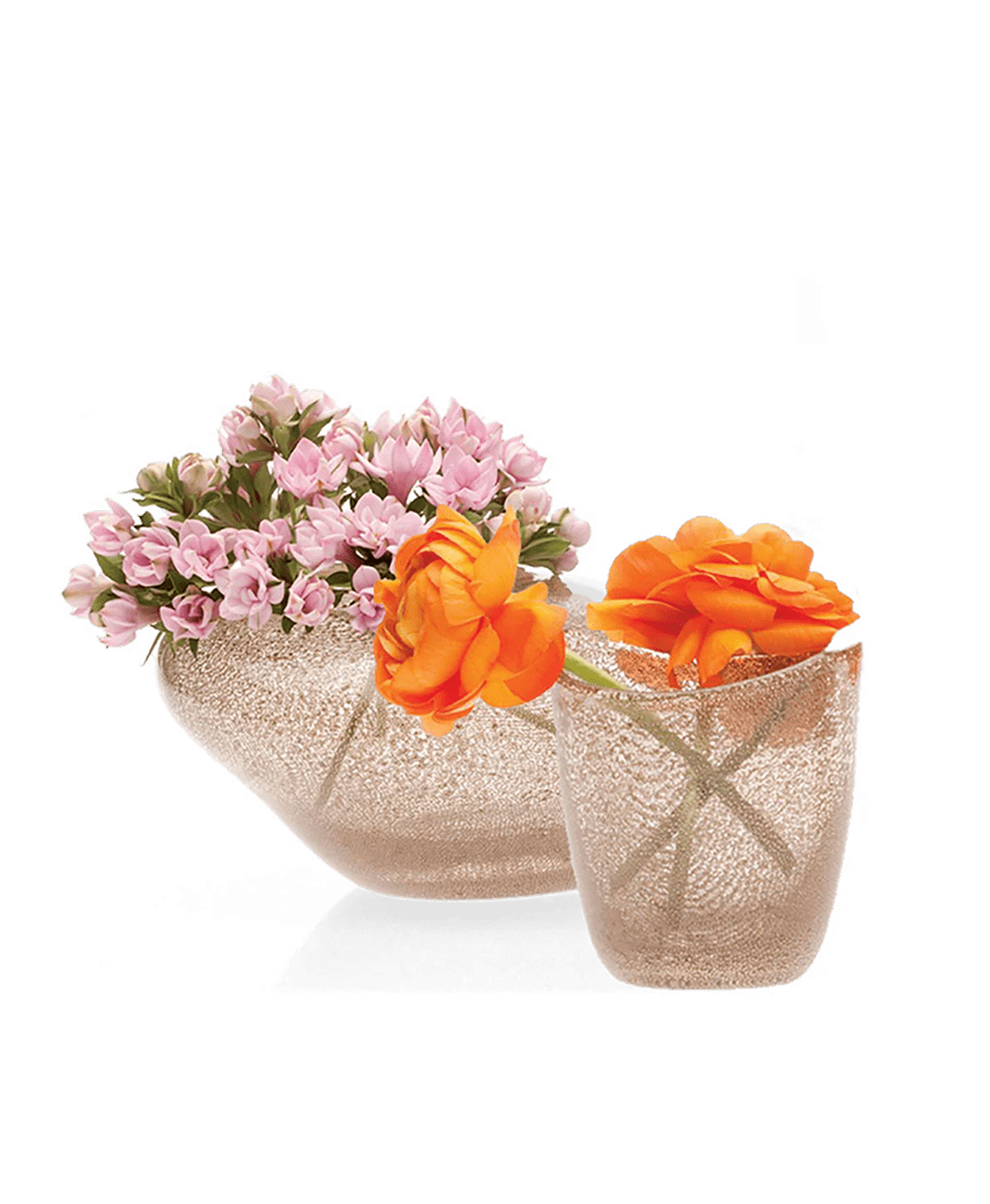
Copper Glass Modern Flower Vase - Chive Ceramics Studio - Vases - Chive Ceramics Studio

A Stand Instead Of A Single Bloom

The glass vases at Chive come out of the same studio habit that produced everything else here: design the object once, correctly, then resist every opportunity to complicate it. Each one holds stems. None of them hides anything. At two inches the Smasak has no room left for anything superfluous, which makes it the most literal case in the range. When a small vessel needs a stand and a visible root system instead of a single bloom, the Copper Tube Holder takes over.

Chive Loft glass bud vase set in assorted shapes and colors on a table mat, each styled with flowers.

All The Interest Pushed Into The Wall
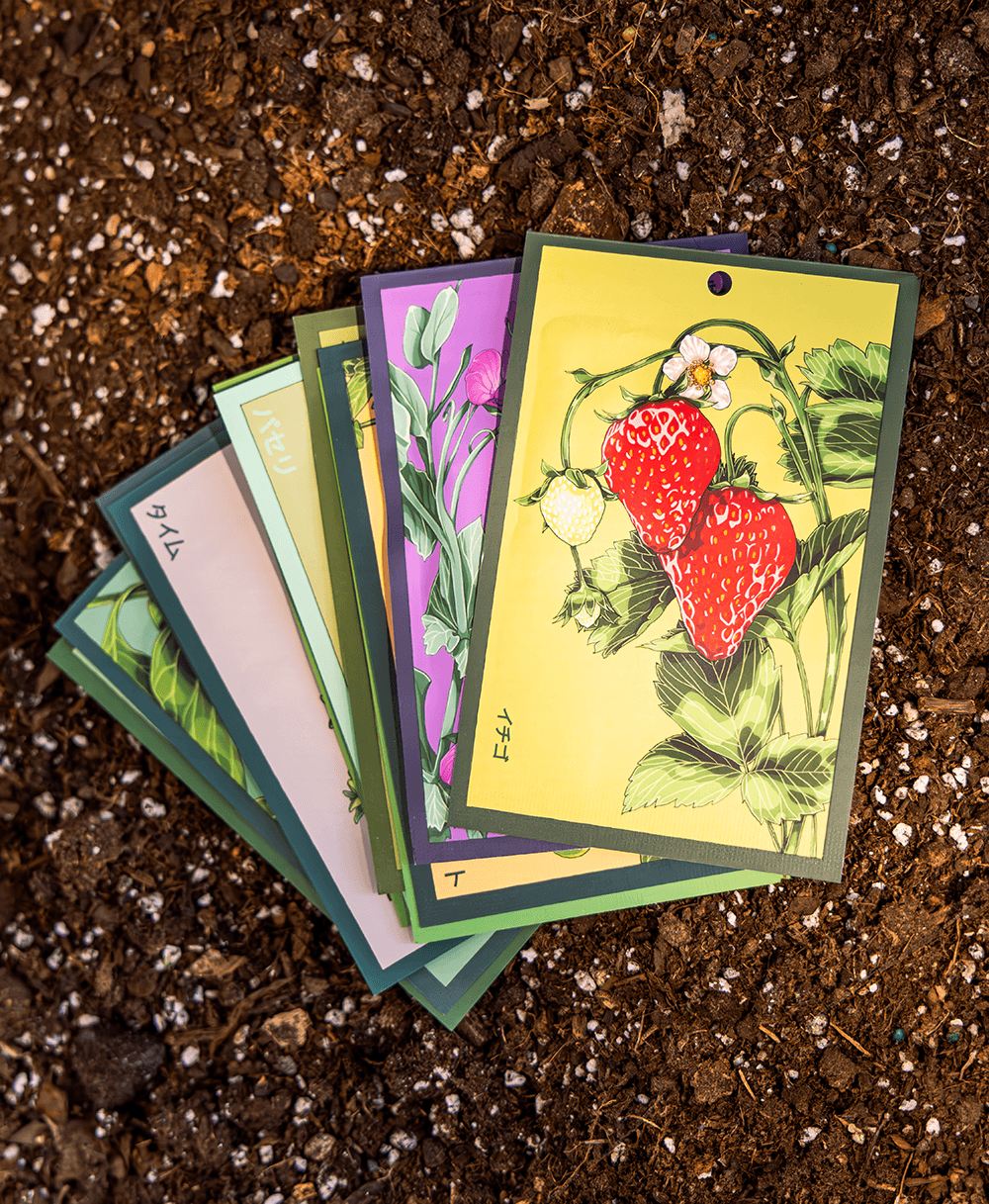
Every Chive vase is built around one decision about how flowers should stand, then finished by hand until that decision reads as obvious. For the Smasak the decision was to go as small as the process allows and then put every remaining bit of interest into the wall, which bulges in soft tiers instead of running smooth. A plain sphere this size would vanish. A tiered one holds attention from a few feet away. Everything in the glass vases collection reaches one decision like that and stops.

Something Small Needs Something To Be Small Against
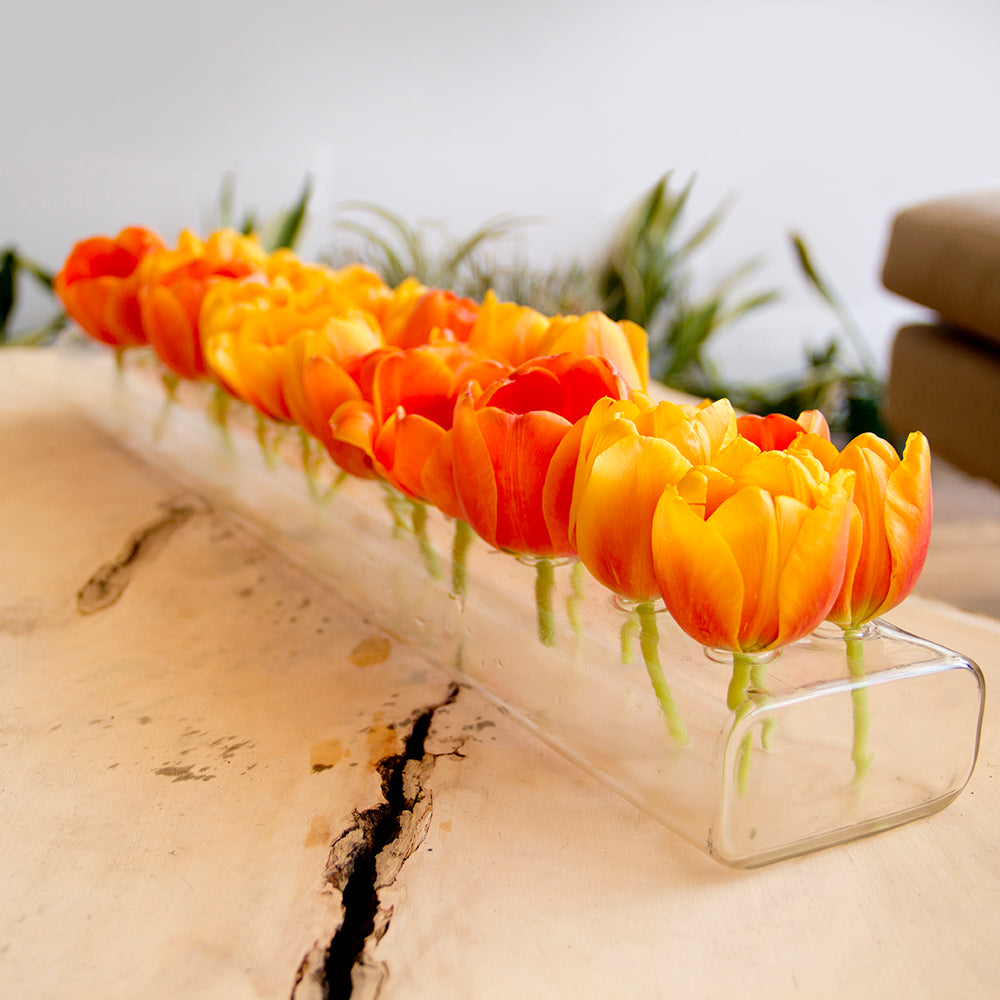
A Lettuce Green Ceramic Flower solves the problem this vase creates, which is that two inches of anything disappears on a wall of shelving. Hang the ceramic piece behind and above it and the small object suddenly has something to be small against. Scale needs a reference or it reads as an accident. One large thing, one tiny thing, nothing in between.


Three Colours, One Batch

Three colourways run on the same day off one batch, which is the only reason the gold, the silver and the white version can sit beside each other on a shelf and look related rather than merely adjacent. Split those runs across separate days and the metallics drift, because a metallic is far more sensitive to how the batch is behaving than a plain colour ever is. Chive has controlled that in one building since 2004. On an object this small the drift would be proportionally enormous, since there is no surface area available to absorb a variation and nowhere at all for a mismatch to hide itself. A larger piece forgives what this one puts on display.


Inside the Chive Design Studio

Low maintenance, high impact. Let's make home styling look easy.

Wedding Centerpiece Vases: The Planning Guide Nobody Gives You

Jessie Duenas
Wedding centerpiece vases work best small and plural — three to seven per table, one to three stems each. A fifteen-table reception needs roughly seventy-five vases and 100 to 1...
Read the full story

The Best 10 Styles of Vases

Jessie Duenas
The glorious world of flower vases! Because nothing says "I have my life together" quite like a carefully chosen vessel for your soon-to-be-wilting flora. Gather 'round, fell...
Read the full story

Frequently asked questions

What makes the Smasak a genuinely useful vase at home?

It goes where nothing else will. Being two inches across and the same tall means a bathroom shelf already holding three other things, the back corner of a desk, a kitchen windowsill behind the tap, a bedside table with a lamp and a book on it. Those places do not accommodate a vase and they accommodate this. Usefulness here is entirely a question of footprint.

How many flower stems does the Smasak vase comfortably display?

One, cut very short, and two only if both are slight. This is a two-inch sphere with a small mouth, so the working length above the rim is around three or four inches before the whole thing goes top-heavy and tips. Ranunculus, freesia, a single chrysanthemum head. Restraint here is not really optional. Anything woody is too much.

Will the Smasak vase fit on a narrow shelf or ledge?

It fits almost anywhere, which is the entire proposition. Two inches across and two tall clears every picture ledge and floating shelf we have encountered, and it will sit comfortably on a ledge too shallow for a book. The base is a flattened curve rather than a foot, so it needs a level surface. On a sloping sill it will roll.

Is the Smasak vase's glass surface prone to marks or scratches?

Less prone than a smooth sphere would be, because the tiered wall breaks up reflections and a scratch has nowhere flat to sit and catch light. The finish is the part to think about rather than the glass. Metallic surfaces mark from grit and from rings rather than from ordinary handling. Keep it off gritty stone.

How do you clean the Smasak vase without damaging the finish?

A cotton bud and warm water, which sounds absurd until you try to get anything else through the opening. The mouth is narrow enough to defeat a brush and your finger will not reach past the rim, so the practical method is to fill, swirl, tip, and then take a bud to the neck where residue collects. Do not soak the metallic finish.

How do you style the Smasak vase on open shelving?

Buy more than one and vary the finish rather than the object. Gold, silver and milky white are the same form in three surfaces, so a row of three reads as a considered set where a single one reads as something that got left behind. Space them along a shelf edge. Put something tall behind them.

Is the Smasak vase larger or smaller than the Copper Tube vase?

Smaller, by a wide margin. The Smasak measures two inches each way while the Copper Tube runs 3.75 across and 6.5 tall in the larger size, which makes it more than three times the height. They also do different jobs entirely: one holds a cut flower and the other holds a cutting growing roots. Scale is not really the comparison.

What design tradition does the Smasak vase draw from?

From the scent bottle rather than from any vase tradition. Small precious glass objects with tiered or faceted walls were a nineteenth-century domestic habit, made small because the contents were expensive and made interesting because the object sat where people would see it daily. The stopper is gone and the tiers remain. Vases arrived at this size much later.

Ceramic astronaut vase with flowers styled on shelf — Chive Studio Toronto
Behind the Studio

The story behind the Chive astronaut vases

The story of Laika, Félicette, a solar eclipse in New York, and a space bar that ordered a hundred vases a month until it closed.