Hanging Thorn Glass Modern Clear Flower Vase

Regular price $19.25
Hand Blown Glass
Dishwasher safe cleaning
30-day return policy

Build the Arrangement That Looks Harder Than It Was

Pick a vase to anchor the shelf, then add the rest until it reads as curated instead of collected.


The Thorn vase is ten inches long and half an inch wide, a ratio of twenty to one, and that proportion decides everything else about it. Hung from a cord it hangs point-down as a hanging teardrop vase, tapering to a tip that gives the form its name and gives the water nowhere to pool. Capacity is almost nothing. A tablespoon, less if the stem is thick, which means this is a spike hanging vase for one slender thing and never for an arrangement. Sweet pea, freesia, a single ranunculus. The reward is that a stem suspended in mid-air at eye level gets looked at properly, where the same stem on a table gets looked past. Overhead it occupies space nothing else in the range can reach, which is the argument for it in a room where every surface is already taken. Hang it clear of a doorway. The cord being the only support, everything depends on where you hang it.

Product detail

Product Detail:

  • Material: Glass
  • Glaze finish: Translucent
  • Year Designed: 2012
Dimension

0.5 inches diameter, 12 inches tall

Vase Care Instructions

All glass vases in this collection are dishwasher safe for easy cleaning, with one exception: mercury glass vases should be hand-washed only. The silvered mercury finish is a delicate coating rather than a solid color, and dishwasher heat and detergent can dull or strip it over time.

For standard glass vases, just load it in with the rest of the dishes — no special care needed. For mercury glass pieces, wash gently with warm water and mild soap, and dry with a soft cloth rather than letting it air dry with water spots.

Rinse and dry after each use, especially if flower food or cut-stem residue was in the water, so nothing lingers and clouds the glass.

Flowers that Love this Vase
  • Cosmos
  • Freesia
  • Sweet Pea
  • Ranunculus
  • Anthurium
  • Lily of the Valley
  • Larkspur
  • Coneflower
  • Pussy Willow
  • Goldenrod

Quick Guide to Building a Floral Arrangement

  1. Pick your vase first
  2. Start with your anchor flower.
  3. Build in odd numbers.
  4. Add height, then fill.
  5. Greenery does the quiet work.
  6. Cut stems at an angle, underwater if you can.
  7. Step back before you decide it's done.

Shipping & returns

Shipping

  • Free shipping: Orders $200+ within the US
  • Standard: 5–8 business days, Express 2–3 business days (at checkout)
  • International Ships: to 40 countries — rates at checkout
  • Packaging Ships: in outer box to protect gift box

View full shipping policy →

Returns

We accept returns within 30 days of delivery on unused items in original packaging. If your piece arrives damaged, contact us within 7 days with a photo and we will replace it at no charge.

View full return policy →

Wholesale Inquires

Have a cool shop? Know someone that does?

Find Chive on Faire →

Hanging Thorn Glass Modern Clear Flower Vase - Chive Ceramics Studio - Vases - Chive US

For people out of surfaces - The Thorn

A hanging vase gets bought by people with no flat space left, and I did not understand that until we started reading where customers said they were putting them.

The assumption in the studio had been windows. Light through glass, a stem suspended in it, very pleasant. What came back instead was a list of places that had nothing to do with light and everything to do with desperation. Above a kitchen sink. Off the arm of a floor lamp. From a curtain rail in a rented flat where nothing may be drilled. One woman had hung four of them in a stairwell, on the grounds that it was the only vertical plane in the building she was allowed to touch.

That reframed the object considerably. It is not a decorative flourish for a room that already works. It is a solution for rooms where every horizontal plane is spoken for, which describes most flats, most shared houses, and a good proportion of the people who write to us.

We have never altered the design as a result of any of this. We did change how we talk about it, which took an embarrassingly long time to get around to, and which mostly involved deleting the word decorative wherever it appeared.

Chive Studio trimming tulip stems with scissors on a wooden surface, with white, purple, and pink tulips arranged nearby.
How to Cut Flowers Like a Pro:

A (Mostly) Simple Guide to Cutting Your Flowers

So, you’re making an arrangement? Let’s ensure it lives long enough to impress someone—even if it's just you.

  1. Scrub the Scissors: Wash your shears first. Your flowers do not want a side of Dorito dust.
  2. Cut at 45°: Snip stems at an angle. It gives them a straw instead of making them chug from the bottle.
  3. Trim Underwater (Fancy Mode): Cut them submerged to block air bubbles. It’s extra, but they didn’t ask to suffocate.
  4. Ditch Submerged Leaves: Strip anything below the waterline. Unless you are actively going for a swamp aesthetic.
  5. Snip Again if Stale: If they sat out on the counter, trim them again. They need a fresh start (don’t we all?).
  6. Swap the Water: Change it and trim the stems every few days so they don't die immediately.

Voilà! You are now a domestic deity. Go take your Instagram photo before you forget to water them.

Pro Tip: The light does half the work.

Glass catches and bends light in a way ceramic can't. Set the arrangement somewhere it'll get some late afternoon sun, even for an hour, and the water and stems start doing something a solid vase never will.

Perfect Pairs for Any Shelf
For Plants With Watering Standards

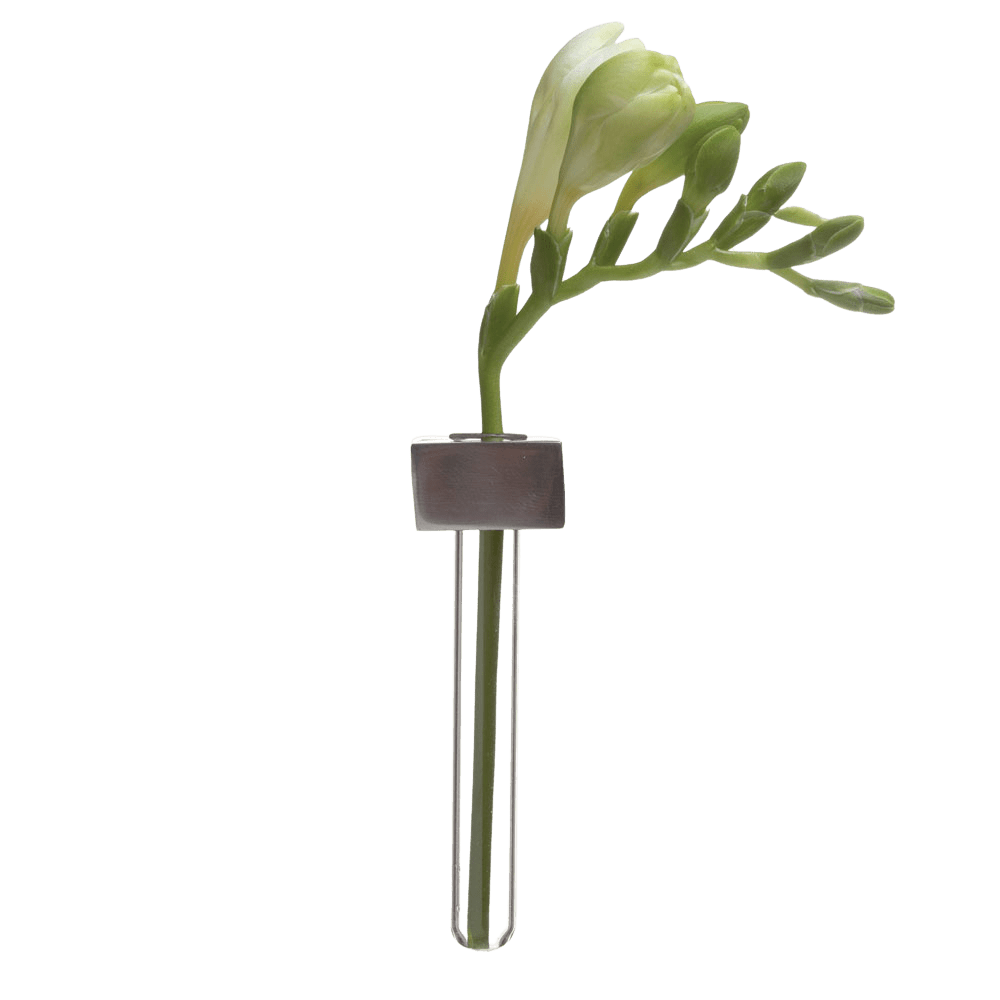
The glass vases at Chive come out of the same studio habit that produced everything else here: design the object once, correctly, then resist every opportunity to complicate it. Each one holds stems. None of them hides anything. The Thorn has almost nothing to hide behind, since there is scarcely any object here beyond a taper and a point. When the same slenderness comes back down onto a surface with three ways to mount it, the Glass Tube Vase is where the chain runs next.

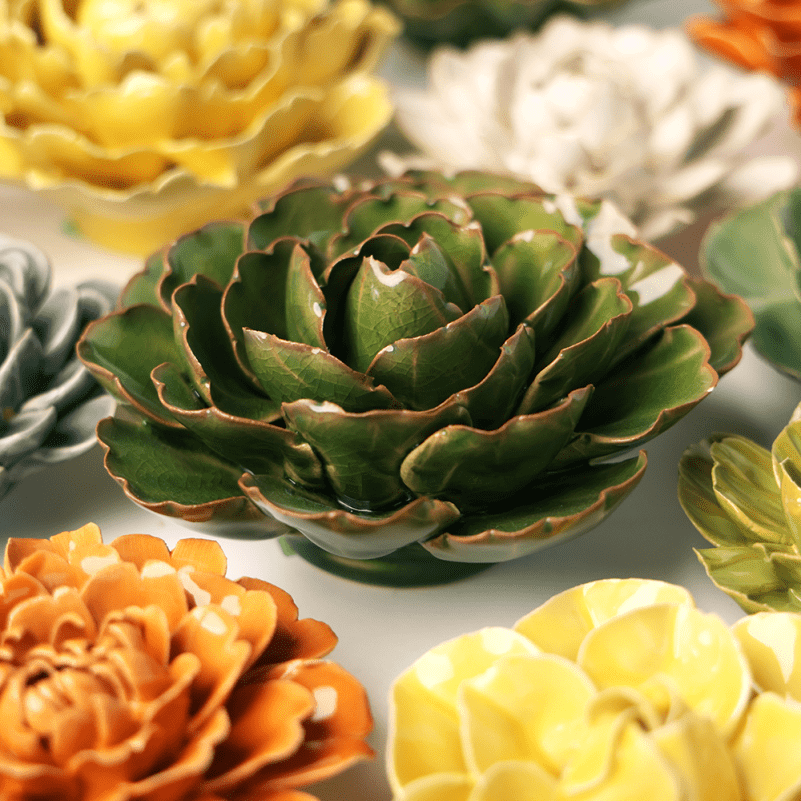
Chive Navy poppy ceramic flower styled with other yellow, green, and pink collection ceramic flowers.

Why let your flowers die when they can live forever?

Every Chive vase is built around one decision about how flowers should stand, then finished by hand until that decision reads as obvious. The Thorn settled on suspension: ten inches of tapering glass hung point-down, with a bore narrow enough that a single stem stands in it without support and wide enough to admit one. Capacity was sacrificed deliberately and completely. What it buys is a flower at eye level in a room with no spare surface. The rest of the glass vases collection is a series of trades made just as plainly.

An Avocado Green Keiko Peony hangs on the wall and never needs water, which makes it the companion for the weeks when this stands empty. A suspended vase with nothing in it reads as neglect, whereas a ceramic bloom on the wall behind carries the corner on its own. Between them the vertical stays occupied all year. One of them is doing the work at any given time.


Drawn by Hand to Length - Chive Since 2004

Drawing a tube out to ten inches while holding the bore at half an inch is done by hand here, one at a time, because the taper has to run the whole length and finish in a point that is actually a point. There is no machine step in it. Pull too fast and the wall goes thin near the tip, pull unevenly and the taper wanders visibly, and both faults are obvious against a window, which is where these end up. The method here has not altered since 2004. It is slow, it produces a proportion of failures nobody advertises, and it is the only method that yields a tip rather than a stub.


Inside the Chive Design Studio

Low maintenance, high impact. Let's make home styling look easy.


Frequently asked questions

What is a thorn vase and what sets the Thorn apart?

A thorn vase is a suspended vessel tapering to a point rather than standing on a base, and this one runs ten inches from cord to tip against a bore of half an inch. That ratio is twenty to one, which is extreme even among hanging vessels and is what distinguishes it. Most hanging vases are bulbs on a string. This is a spike.

Can the Thorn vase hold dried stems as well as fresh?

They suit it better than fresh material does, and the reason is mechanical. Dried stems weigh almost nothing, so a suspended vessel holding them barely swings when somebody walks past, whereas a wet stem plus water gives the whole thing a pendulum it does not need. Dried also removes the refilling problem entirely. Grasses and seed heads hang beautifully.

How much water does the Thorn vase hold when filled?

Roughly a tablespoon, and less than that once a stem displaces some of it. The interesting consequence is that a reservoir this small is emptied by the flower before it has any chance to turn, so the usual failure here is a stem standing dry rather than water going cloudy. Running out happens a good deal faster here than going off. Check it daily.

Why was glass chosen for the Thorn vase's construction?

Because everything hanging from a cord is a weight problem first. Glass drawn to a half-inch bore is thin and light in a way no fired clay could match at the same proportions, since ceramic needs wall thickness to survive a kiln and wall thickness here would double the load. Lightness here is a structural requirement rather than an aesthetic one. A heavy hanging object is a hazard.

Can you remove hard water marks from the Thorn vase easily?

Nothing you own will reach inside it, and that turns out not to matter much. The opening is too narrow to show a deposit at any useful distance, so the marks that form are effectively invisible from the two or three feet at which this hangs. Flush it under a running tap and shake it out. Reach is not available here.

Where does the Thorn vase look best in a modern room?

In the vertical space nothing else uses. Modern rooms are short of surface and full of unoccupied air, so a stairwell wall, the space above a sink, the side of a tall bookcase and a curtain rail are all fair game and all currently empty. Hang it where you would not put a shelf. Height is the whole point.

Should you choose the Thorn vase or the Tube vase first?

Take the Thorn when no surface remains and the Tube when an inch of one does. Capacity is near enough identical and both want the same narrow stems, so this decision is architectural rather than floral. A hanging piece asks for a fixing. A sitting piece asks for a ledge. Rooms usually make this obvious.

When did the Chive studio team design the Thorn vase?

In 2012, alongside the L, during a stretch when the studio was interested in vessels that gave up capacity to gain something else. The trade here was volume against position: accept that it holds next to nothing, and get a bloom lifted to standing height where no shelf could put one. The taper came out of that constraint. Nothing about it has moved since.

Ceramic astronaut vase with flowers styled on shelf — Chive Studio Toronto
Behind the Studio

The story behind the Chive astronaut vases

The story of Laika, Félicette, a solar eclipse in New York, and a space bar that ordered a hundred vases a month until it closed.